In the Park
Margit Selska (Reich)


Basic information
- ID
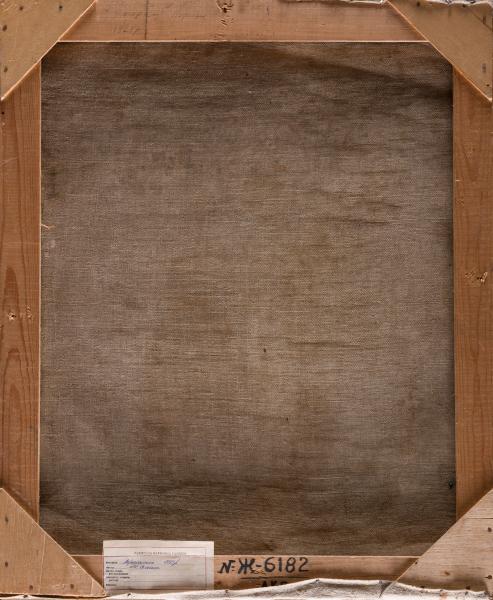
- Ж-6182
- Author
- Margit Selska (Reich)
- Name
- In the Park
- Date of creation
- 1928
- Country
- France
- Culture
- Contemporary times
- Technique
- oil painting
- Material
- canvas oil
- Dimensions (height x width, cm)
- 53.8 x 64.8
Additionally
- Type
- painting
- Genre
- landscape
- Plot
- Landscape
- Provenance
- Gifted by Roman Selskyi, 1983
Information about author
Object description
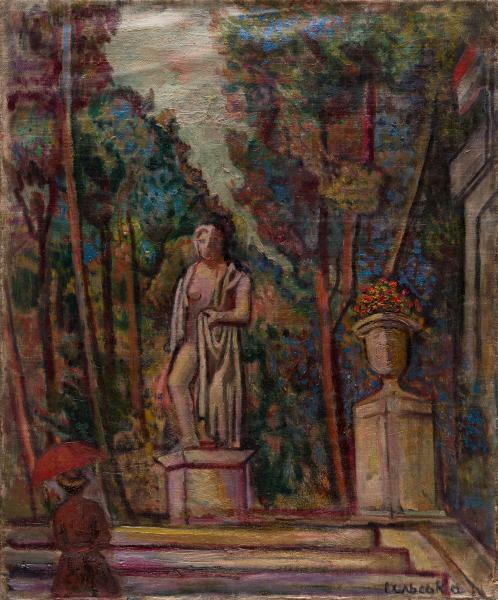
28-year-old Margit Selska created the landscape "In the Park" (1928) in Paris, the artistic centre of Europe, imbued with the spirit of innovation and the desire for creative pursuits. Melancholic and romantic, it absorbed the experience of Polish capitalism and embodied a deep philosophical meaning in subtle colour harmonies. Thus, the white stone classical statue of an ancient deity against the backdrop of a regular French park symbolised the timeless meanings of culture, the inviolability of its axial vertical, and its context-independent aesthetic content. Beautiful and majestic, she appeared as a mirage, a memory, a dream of lost harmony and the Golden Age. A vase on a pedestal added a nostalgic tone to the work: exquisitely ornamental, with scatterings of red flowers, as if borrowed from tapestries or classical engravings. The image is filled with echoes of Versailles and French fête galante. Subtle emotional parallels have been drawn to the paintings by Jean-Antoine Watteau, Jean-Baptiste Pater, and Nicolas Lancret. The inexorable passage of time was reminded by the harsh grey sky, which ran away over the horizon, and the solemn verticals of yellowed autumn trees. Above the flow of everyday events, the park, the vase, and the sculpture have been elevated to signs of artistry, cultivation, creation, and belonging to artes. A staircase and a white stone pedestal outline the boundary between chronotopic registers, the eternal and the fleeting, the everyday and the present. The framed sculpture and the corner of the ancient park seem to evoke – ars longa, vita brevis – and are perceived as a self-sufficient pictorial reality regarding the fragile female figure, as if she had stepped out of Edouard Manet's paintings. At the same time, with purely plastic means – a variety of statics and restrained colours of the background, the organic nature of the female figure, flashes of brown-ochre and red on the umbrella and clothes – the artist convinces that the cultural heritage exists only in new lives and readings, in completions in everyday, constant perception.
Inscriptions
Signature in the lower right corner: "Selska".
Legal regulation
Borys Voznytskyi Lviv National Art Gallery