Crucifixion with Attendant Figures
unknown (South German School)
Basic information
- ID
- С-I-234
- Author
- unknown (South German School)
- Name
- Crucifixion with Attendant Figures
- Previous attributions
- Under the Cross. South Austrian School
- Date of creation
- early 16th c.
- Country
- Germany
- Culture
- Late Renaissance
- Technique
- carving polychromy
- Material
- wood
- Dimensions
- 45 x 19 cm (height x width)
Additionally
- Type
- sculpture sculpture (relief)
- Genre
- religious
- Plot
- The Passion of Christ Crucifixion
- Provenance
- Collection of Leon Pininski
Information about author
Object description
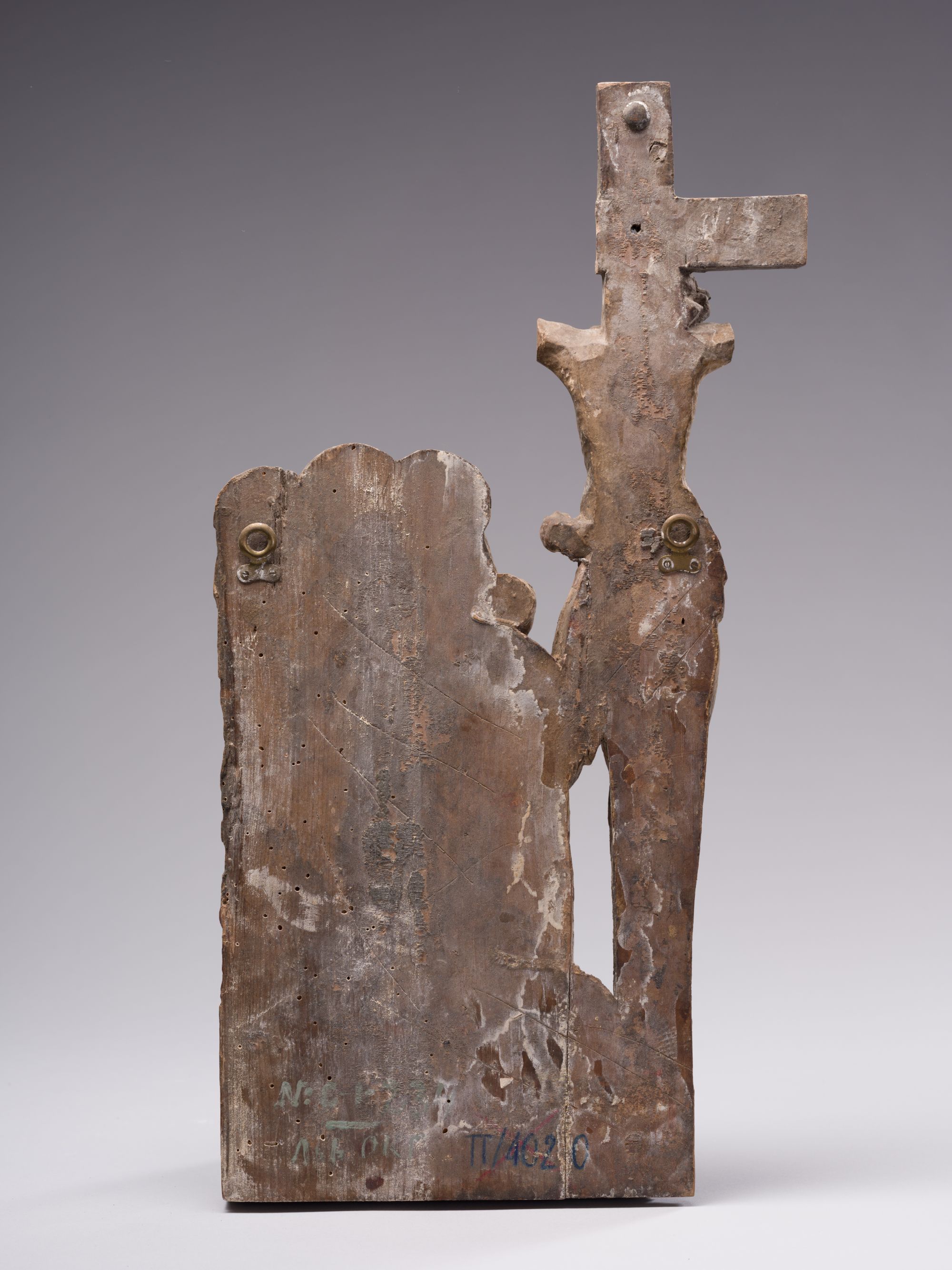
This piece belongs to a Gospel cycle that once adorned the interior of a provincial church in the South German region (Swabia – Bavaria – Tyrol). The series was executed by at least two carvers and a polychromist (Faßmaler). They were all members of the same workshop, which initially focused on church construction before shifting to interior decoration. Among the carvers was a more experienced master, who primarily crafted compositions featuring saints. The second hand was an artisan-carver whose work was less refined; he was tasked with depicting executioners, Pharisees, and other antagonists. This particular relief was executed by the more accomplished master.
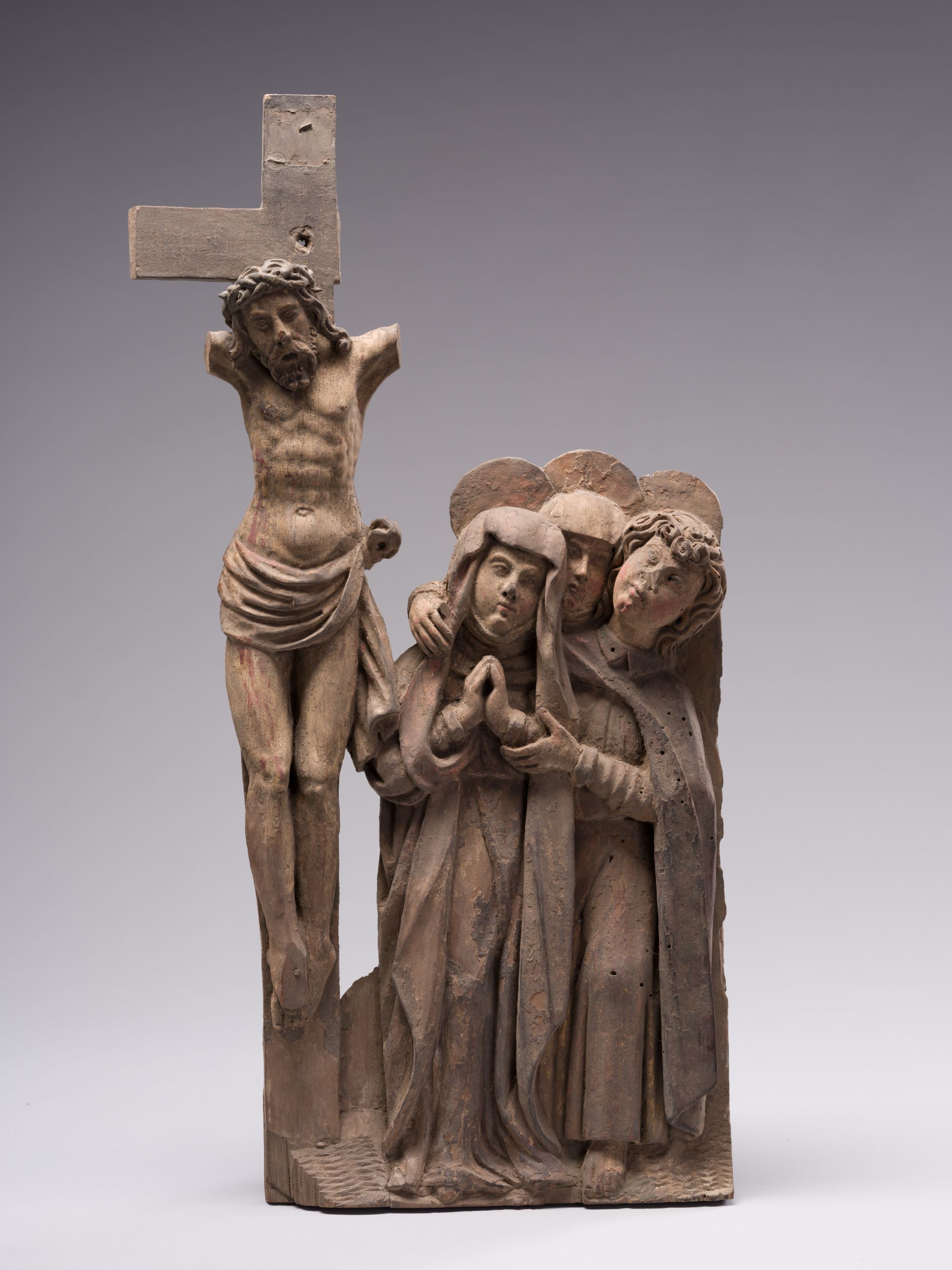
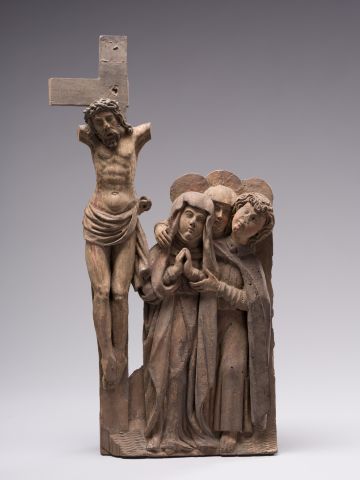
The high-relief carving presented in the collection belongs to a Passion of Christ cycle. Regrettably, the work has been preserved only fragmentarily. On the left, the dominant element is the cross with the crucified Saviour. The cross arm to the spectator's right and Jesus's arms up to the shoulders are entirely lost. The artist masterfully renders the torso. He pays meticulous attention to Christ's head, which inclines to the left, capturing his sorrowful countenance, beard, moustache, and wavy hair. The head is crowned with a wreath of thorns. The loincloth, featuring draped folds, is knotted on the right. The knees are slightly thrust forward. The feet, whose distinct forms have been lost, are pierced by a single nail.
The sculptural modelling closely resonates with the execution of the crucified Christ by the Swabian sculptor Hans Seyfer, which was originally placed outside St Leonard's Church in Stuttgart (1501). This artist's oeuvre served as a benchmark for contemporary masters.
To the right of the Crucifixion stands a group of mourning bystanders. Three figures are modelled within a single relief form: the Mother of God, her sister Mary of Clopas, and John the Evangelist. Haloes are depicted above each head. The Virgin Mary, standing on the left and closer to her crucified Son, is clad in a long maphorion (veiled mantle) that falls in heavy drapery, concealing her feet. Her hands are clasped before her in prayer. She is embraced by the clean-shaven youth, John the Evangelist, who has placed his right hand on her shoulder while supporting her elbow with his left. The Apostle wears a long tunic beneath a draped cloak. Between the heads of John the Evangelist and the Mother of God, the face of a third woman is visible – Mary of Clopas, who stands behind the primary figures.
The figures are executed in high relief. The plastic modelling is further enhanced by chiaroscuro effects arising from the contrast between the volumetric forms and the lower-relief background. Traces of polychromy remain visible on the holy figures' garments. It may be inferred that a figure of Mary Magdalene – now lost – was originally positioned to the left of the Crucifixion. The composition is executed in the Late Gothic style, showing the distinct influence of Early Renaissance sculpture from the Franco-Burgundian and Italian schools.
Legal regulation
Borys Voznytskyi Lviv National Art Gallery