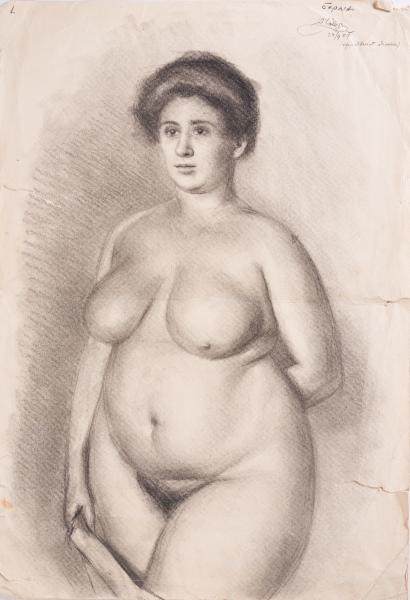
Drawing of a Naked Woman Standing
Yulian Zaiats



Basic information
- ID
- Ф-З-Арх-ЛГМ-5/1
- Author
- Yulian Zaiats
- Name
- Drawing of a Naked Woman Standing
- Date of creation
- 24.09.1909
- Country
- German Empire
- Technique
- drawing
- Material
- paper charcoal
- Dimensions (height x width, cm)
- 35.8 x 24.5
Additionally
- Type
- graphic art
- Genre
- nude art
- Provenance
- Received from Nina Zaiats
Information about author
Object description
The graphic sheet depicts a knee-length female figure in a frontal position with a slight turn of the torso and head. The model's left hand is behind her back, and in her right hand, she holds an unidentified, elongated object with a textured surface (similar to paper or fabric). It is important to note that this pose is quite common in classical academic compositions, as the peculiarities of angles, lighting, and plastic features are important for studying the plastic features of the human body, its anatomical structure, and the reproduction of complex three-dimensional objects on a two-dimensional plane. The interpretation of the face is probably portrait-like, but quite stereotypical, which is also typical for educational productions when the teacher focuses on the analytical study of the model's body. It should be emphasized that, despite the softness of his approach to interpreting the human body, the author does not idealize it, but consistently reproduces the features that make it recognizable – from the massiveness of the torso and hips to the size of the mammary glands and the asymmetry of the hair on the pubic mound. The nature of the work indicates that this is an academic study of a nude female model, executed in a studio, rather than a copy from a photograph. This can be confirmed by the author's approach to reproducing the figure, particularly in the construction of perspective. It should be noted that the source of lighting is clearly visible in the work, allowing the three-dimensionality of the volume to be demonstrated in a classical manner. The shadows are quite soft, and the tonal transitions are correctly applied, revealing the plasticity of the naked human body. The work with strokes is balanced and professional, indicating the author's serious prior practical experience. In the left part of the composition, the author uses strokes to shade the background and highlight the human figure on the sheet of paper. Given the stylistic solution of the composition and the peculiarities of the hatching technique used, the work is a fairly ordinary example of a training studio from the European academic school of the late 19th to the first third of the 20th century. It should be noted that while the artistic value of this work is debatable, its historical significance is undeniable, particularly in the context of analyzing the work of artist Yulian Zaiats and researching his professional development. Thus, in this work, one can clearly see how committed the author was to the learning process and how he sought to solve complex tasks from an analytical perspective, rather than being satisfied with purely visual effects and techniques.
Inscriptions
In the upper right corner is the inscription "Berlin" (written in a different, printed handwriting, and probably made at a different time), with a difficult-to-read signature below. Below is the date "24/9 09", and under the date is another inscription that is not legible. On the reverse side of the work, in the lower left corner, is the number from the entry book and the inventory number.
Legal regulation
Borys Voznytskyi Lviv National Art Gallery