Drawings of Male Heads and Busts
Yulian Zaiats


Basic information
- ID
- Ф-З-Арх-ЛГМ-5/12
- Author
- Yulian Zaiats
- Name
- Drawings of Male Heads and Busts
- Date of creation
- 14.08.1911–18.08.1911
- Country
- German Empire (?)
- Technique
- drawing
- Material
- paper pencil
- Dimensions (height x width, cm)
- 29.4 x 21.4
Additionally
- Type
- graphic art
- Genre
- portraiture
- Plot
- Portrait
- Provenance
- Received from Nina Zaiats
Information about author
Object description
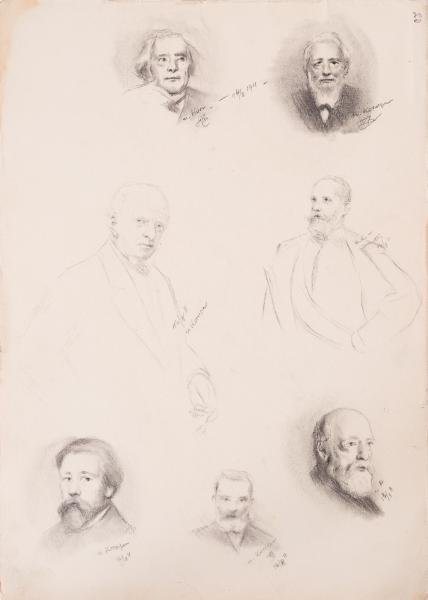
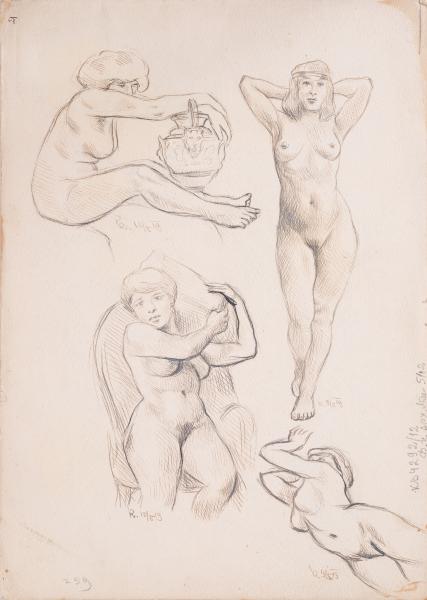
The sheet contains a series of seven portraits of elderly men, executed in an academic manner using soft pencil. The composition is likely an example of an exercise focused on studying age-related facial plasticity and individual types. The portraits are arranged freely, without a rigid compositional axis, which emphasises free sketching. The artist explores the face with age-related changes, including wrinkles, changes in the outline and carnations of the face, nose and cheekbones, which gives the images authenticity and helps to reveal psychological depth. Five of the seven men have beards that vary in shape and carnations: from short, neatly trimmed to sprawling, wavy, or sparse, barely defined. All these details are designed without excessive elaboration, but with attention, because they give the type a certain social and historical context. Some of the portraits have recognisable features inherent in the practices of European painting of the nineteenth and early twentieth centuries (this is confirmed by the author's signatures indicating the authors of the prototypes, which, however, are illegible), in particular in the interpretation of the pose, the manner of shading, and light and shadow modelling. The faces are presented in different angles: full-face and three-quarter view, which indicates the exploration of a variety of perspectives and the study of the expressiveness of plastic anatomy. On the reverse side of the sheet are four drawings of nude female figures from different angles. Two of them are generic: one is depicted in a static frontal pose, the other in a slight turn with an emphasis on anatomical accuracy. Two more figures are presented in full-length, which expands the scope of the studies. One of them stands in a balanced pose with body weight distributed, while the other sits with his hand on a decorative vase. This latter image is distinctly theatrical, almost allegorical in its expression through the combination of gesture and object. All the figures on the reverse are characterised by the desire to reflect a constructive structure and a careful study of the proportions of the naked female body. Like the front part of the sheet, these motifs are evidence of systematic studio work focused on mastering the plasticity of the human figure in the tradition of classical drawing.
Inscriptions
On the front, from top to bottom, left to right: inscription (illegible); signature of Yulian Zaiats; "-14/8 1911-"; inscription (illegible); signature of Yulian Zaiats; "16/8 11"; inscription (illegible); inscription (illegible); "17/8 11"; inscription (illegible); signature of Yulian Zaiats; "16/8 1911"; inscription (illegible); "16/8 1911".
Legal regulation
Borys Voznytskyi Lviv National Art Gallery