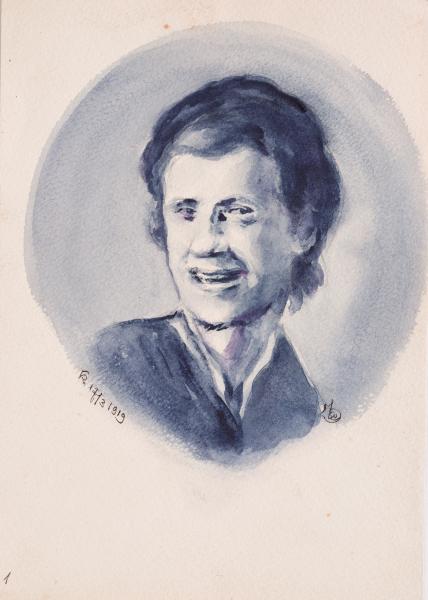
Drawing of a Man's Head
Yulian Zaiats


Basic information
- ID
- Ф-З-Арх-ЛГМ-5/17
- Author
- Yulian Zaiats
- Name
- Drawing of a Man's Head
- Date of creation
- 17.03.1919
- Country
- the Second Polish Republic
- Technique
- watercolour drawing
- Material
- paper watercolour
- Dimensions (height x width, cm)
- 20.8 x 14.7
Additionally
- Type
- painting graphic art
- Genre
- portraiture
- Plot
- Portrait
- Provenance
- Received from Nina Zaiats
Information about author
Object description
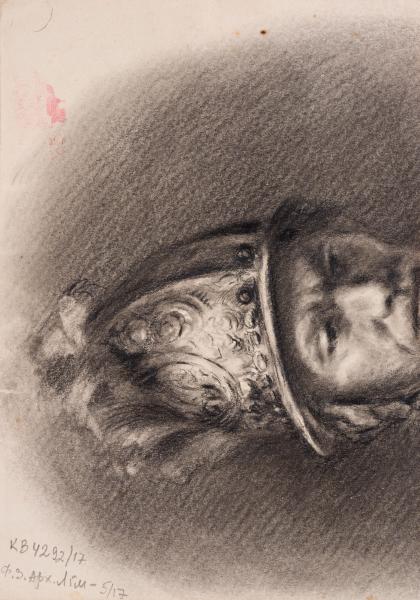
The obverse side of the sheet features a watercolour portrait of a laughing young man, a study for Rembrandt van Rijn's self-portrait of the same name, dated 1629–1630. The image is distinguished by an accurate rendering of the model's spontaneity and emotional emancipation: a wide smiling face, slightly squinted eyes, and the play of light on his cheeks and forehead. The watercolour technique allowed the author of the copy to achieve a subtle modulation of the tone, conveying the colourful softness and vibration of light characteristic of Rembrandt. The image is full of emotion, which is not often seen in portraits of the period. Perhaps it is this sincere emotion that makes the painting unique and attractive for copying. Despite the generalisation of individual pictorial details, the artist accurately conveyed the overall plastic structure of the face, its lively dynamics, and the depth of light and shadow. This indicates a careful study of the work not only as an example of technical skill, but also as a carrier of emotional state. On the reverse side of the sheet is a drawing (partially lost) of the famous painting "Man in a Golden Helmet" (ca. 1650), which was long considered to be a work by Rembrandt, although it is now attributed to one of his students. Nevertheless, the work has not lost its artistic significance and remains popular for academic study due to the monumentality of the image and the dramatic effect of the lighting. In the drawing version, the emphasis is on the volume of the helmet, the shine of metal surfaces, and the plastic relief of the face, where concentration and inner strength are read from the heavy gaze and tense turn of the head. A soft pencil allows us to convey the difference in textures – from shiny metal to matte skin, as well as the depth of shadows inherent in the Rembrandt school. The parallel presentation of these two images of an emotionally open and silent warrior, absorbed in himself, creates a visual dialogue that reveals the breadth of the original author's portrait range. The copies demonstrate not only the artist's technical skill, but also an understanding of the internal logic of chiaroscuro and compositional balance inherent in the Baroque portrait tradition.
Inscriptions
Signature of Yulian Zaiats; "17/3 1919".
Portrayed person
- The name of the person portrayed
- Rembrandt Harmenszoon van Rijn
- Lifetime of the person portrayed
- 15.07.1606–04.10.1669
Legal regulation
Borys Voznytskyi Lviv National Art Gallery