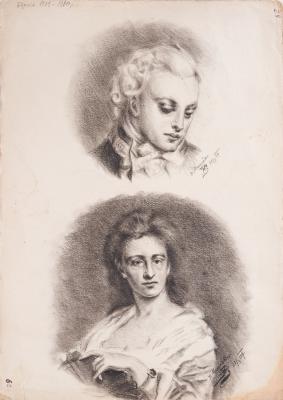
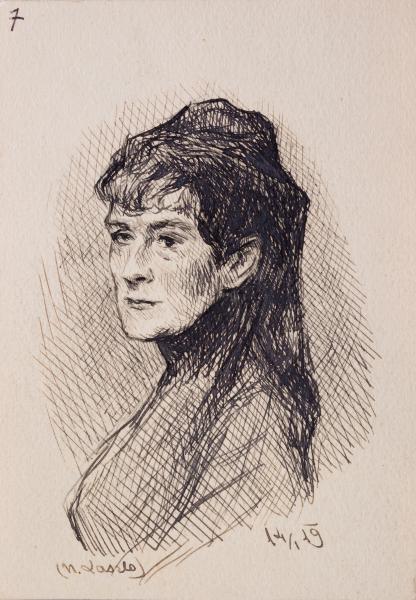
Drawing of a Woman's Bust
Yulian Zaiats


Basic information
- ID
- Ф-З-Арх-ЛГМ-5/23
- Author
- Yulian Zaiats
- Name
- Drawing of a Woman's Bust
- Date of creation
- 14.01.1919
- Country
- the Second Polish Republic
- Technique
- drawing
- Material
- paper Indian ink
- Dimensions (height x width, cm)
- 12 x 8.8
Additionally
- Type
- graphic art
- Genre
- portraiture
- Plot
- Portrait
- Provenance
- Received from Nina Zaiats
Information about author
Object description
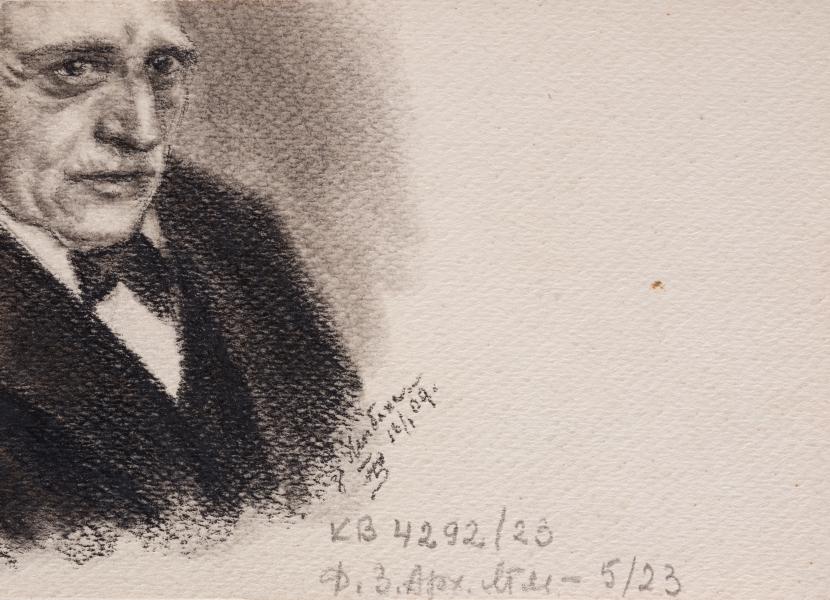
This delicate drawing, executed in ink and pen, represents an academic study typical of the early twentieth century, likely created during the process of studying from models or from life. The image of a woman in profile, concentrating, calm, and slightly detached, has a chamber-like character and an expressive personality. The carefully crafted linear structure of the drawing indicates a mastery of pen techniques and the skill of hatching in multiple directions, which creates both tonal gradations and textural effects. The background is marked with a system of diagonal hatching, which delicately separates the figure from the space, without overloading the composition. The form is presented in a coherent and restrained manner: the face is drawn with light but precise lines, conveying expression and chiaroscuro through variable stroke density. Particularly noteworthy is the study of the hair, which falls in a dense mass on the shoulders, contrasting with the light areas of the face and neck. Stylistically, the work tends to academic realism with a slight influence of Secessionist decorativeness in the manner of hatching. This type of drawing was typical of educated, academic artists of the early twentieth century, who mastered their skills not only by copying famous works but also by studying real life, particularly female portraiture, which was considered one of the most demanding genres. The signature is illegible, indicating a possible artist, although there is no unambiguous identification of the person. The date of January 14, 1919, records the moment when the drawing was created, possibly as part of an academic course or studio work. From the perspective of early twentieth-century artistic pedagogy, such studies aimed not only to train the hand but also to develop visual sensitivity, an understanding of plasticity, and the depth of individual expression. On the reverse side is a fragment of a male portrait, the authorship of the prototype of which is difficult to establish due to the illegibility of the signature.
Inscriptions
On the obverse: illegible signature; "14/1 19". On the back: illegible signature; "16/1 09".
Legal regulation
Borys Voznytskyi Lviv National Art Gallery