Drawings of Two Male Heads
Yulian Zaiats


Basic information
- ID
- Ф-З-Арх-ЛГМ-8/3
- Author
- Yulian Zaiats
- Name
- Drawings of Two Male Heads
- Date of creation
- 21.11.1962–24.11.1962
- Country
- the Ukrainian SSR
- Technique
- drawing
- Material
- paper pencil
- Dimensions (height x width, cm)
- 20.3 x 28.6
Additionally
- Type
- graphic art
- Genre
- portraiture
- Plot
- Portrait
- Provenance
- Received from Nina Zaiats
Information about author
Object description
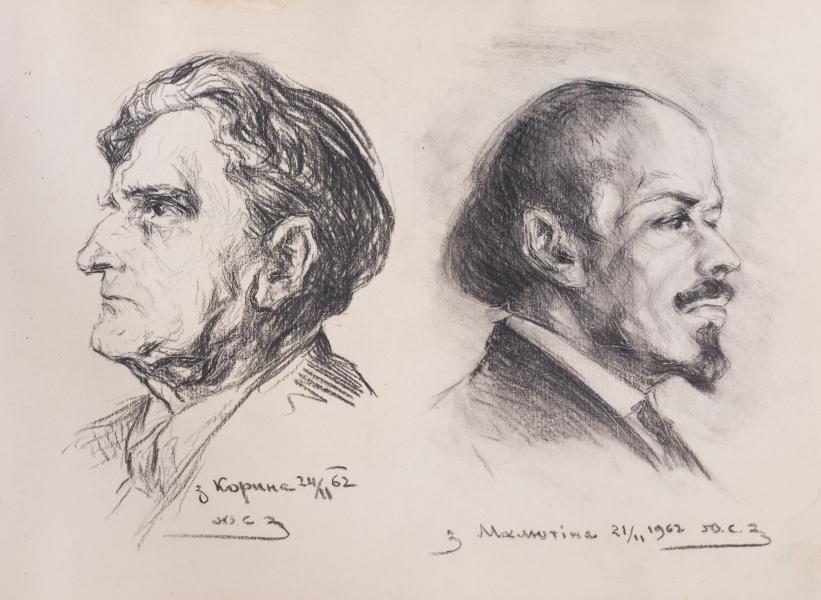
Drawing copies of Martiros Saryan's bust portraits (based on the original by Pavlo Korin) and a self-portrait of Serhii Maliutin, made by Yulian Zaiats in 1962, form a unique graphic diptych composition in which the two images seem to engage in a silent dialogue – either an argument or mutual complementation. Both portraits are profile portraits of mature artists, but they are positioned in opposite directions, as if the subjects' gazes are directed towards different temporal, spiritual, or conceptual horizons. The figure of Martiros Saryan, shown in profile on the left, is executed with exceptional respect for the original painting by Pavlo Korin. Zaiats preserves the clarity and expressiveness of this image: a distinct profile, a concentrated gaze focused on a point invisible to the viewer. Martiros Saryan's profile conveys the strength of will, dignity, and inner concentration of a man who lived through the trials of the turbulent 20th century. Zaiats worked with restraint here, accurately reproducing the plasticity of the face and the character of the lines, focusing all attention on the inner life of the image. In contrast to this is the self-portrait of Serhii Maliutin, located on the right side of the composition, also in profile, but facing the opposite direction. Maliutin's profile is softer, with a moustache and a small beard, medium-length hair, and a calm, attentive gaze that absorbs not only the outside world but also, it seems, the echoes of artistic experience. Y. Zaiats interprets this portrait with particular sensitivity; the lines here are softer than in the image of M. Saryan, yet at the same time expressive, conveying the integrity, independence, and calm dignity of an artist who sees beauty and harmony above all else in the world. Together, these two portraits, facing each other with their backs, create a complex composition in which the directions of their gazes are like vectors of opposite movements of time or ideas. One is directed into the depths of the past, the other into the future; one is a stern, meditative presence, the other a contemplative, almost lyrical mood. It is doubtful that such a composition could have been formed by accident: most likely, Yulian Zaiats, who was already a mature author at that time, used this opposition as a means of visual and sensual exploration of the theme of creative identity, the artist's inner position in history. Both drawings do not simply represent copied originals; they are part of Zaiats' deeper reflection on the phenomenon of the artist as a personality in the cultural space, which unfolds not only in one direction, but in a multiplicity of axes and constant movement between the poles of experience, tradition, and future ideas.
Inscriptions
In the centre, beneath the images: "From Korin"; "24/11 62"; Yulian Zaiats' signature; "From Maliutin"; "21/11 1962"; Yulian Zaiats' signature.
Portrayed person
- The name of the person portrayed
- Martiros Saryan (16(28).02.1880–05.05.1972), Serhii Maliutin (22(04).09(10).1859–06.12.1937)
Legal regulation
Borys Voznytskyi Lviv National Art Gallery