Drawings of Two Male Heads
Yulian Zaiats


Basic information
- ID
- Ф-З-Арх-ЛГМ-8/4
- Author
- Yulian Zaiats
- Name
- Drawings of Two Male Heads
- Date of creation
- 24.11.1962–25.11.1962
- Country
- the Ukrainian SSR
- Technique
- drawing
- Material
- paper pencil
- Dimensions (height x width, cm)
- 20.3 x 28.6
Additionally
- Type
- graphic art
- Genre
- portraiture
- Plot
- Portrait
- Provenance
- Received from Nina Zaiats
Information about author
Object description
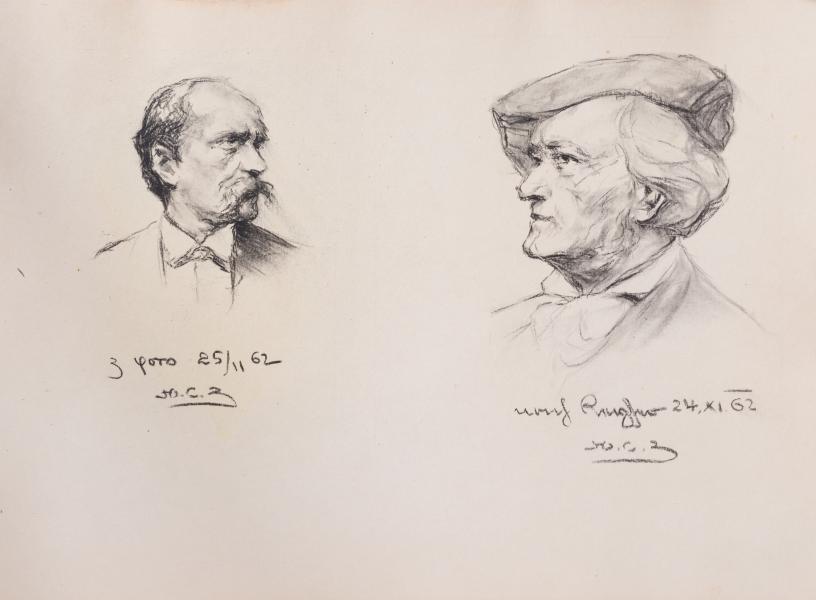
The drawn copies of two full-length male portraits, executed at almost profile angles, demonstrate exquisite compositional symmetry while simultaneously lacking direct eye contact between the depicted characters. Both men are of mature age, each with a distinctly defined facial expression, hairstyle, and clothing, visually representing different socio-cultural types: perhaps a balanced intellectual from an academic environment and a bohemian artist with an exquisite artistic image. The figure on the left is a man in a classic suit with a clearly defined receding hairline. His moustache is particularly striking: long, slightly raised horizontally, as if deliberately stylised in the spirit of restrained eccentricity. His gaze, directed slightly to the side, beyond the boundaries of the sheet, creates the effect of deep thought or contemplation of something timeless. The oval of his face is elongated, his cheeks are slightly sunken, and his chin line is clear. His shoulders are straight, his posture restrained and confident. The man on the right is a stark contrast to the one on the left. His face is illuminated by inner artistry, and his overall image speaks of sophisticated extravagance. He wears a beret, slightly tilted to one side. His hair is longer than that of the first portrait, falling neatly onto his neck in a slight wave. His sideburns softly frame his face, adding refinement and aestheticism. The image refers to the bohemian environment, characterised by its tendency towards style and form creation, even in its appearance. Despite the symmetrical arrangement of both portraits and the fact that they face each other, there is no visual contact between them, as both characters are depicted in perspective, each immersed in their own world. This creates a certain tension in the composition: external closeness turns into internal distance, emphasising the autonomy of each image. The author of the copies, Yulian Zaiats, conveys the characteristic features of the faces and the micropsychology of the portraits with a subtle understanding of graphic language. Executed in pencil, the portraits demonstrate a careful study of form, chiaroscuro transitions, and the plasticity of hairstyles and fabrics. In the choice of these particular images, as well as in their juxtaposition, one senses the author's interest in contrasts, not only external but also mental, as a possible search for expressive types for his own further creative experiments. These drawing studies were probably part of Zaiats' deeper exploration of the theme of portraiture, human expressiveness, and various ways of representing personality through image.
Inscriptions
In the centre, beneath the images: "From a photo"; "25/11 62"; Yulian Zaiats' signature; (illegible); "24/11 1962"; Yulian Zaiats' signature.
Legal regulation
Borys Voznytskyi Lviv National Art Gallery