Crucifixion
unknown


Basic information
- ID
- С-I-1242
- Author
- unknown
- Name
- Crucifixion
- Date of creation
- 18th c.
- Country
- Ukraine
- Technique
- carving polychromy
- Material
- wood
- Dimensions (height x width x depth, cm)
- 68 x 38 x 15
Additionally
- Type
- sculpture
- Genre
- religious
- Plot
- Crucifixion
- Provenance
- Skole district, Lviv region
Information about author
Object description
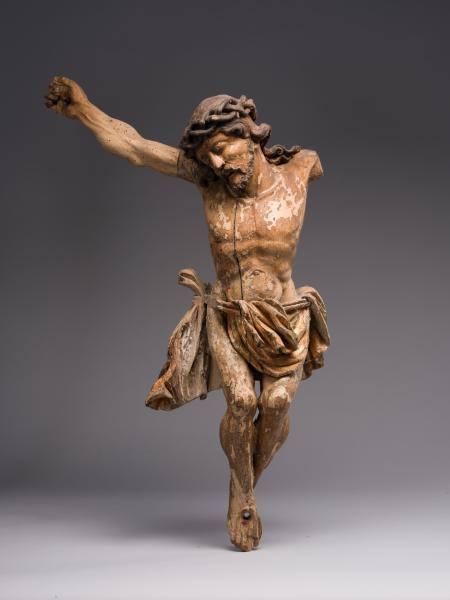
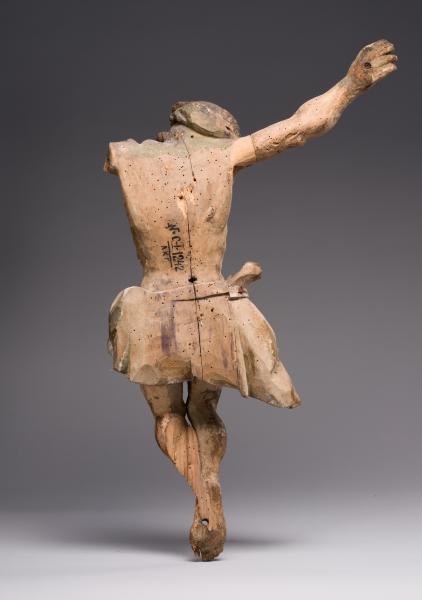
The crucifixion is distinguished by Christ's expressive, dramatic pose, which reflects the tension of the last minutes of his earthly life and, at the same time, his sacrificial grandeur. The slender figure of the Saviour is bent in a pose characteristic of the Baroque era, creating an impression of dynamism, expression, and tension, as if the body still retains movement and suffering. The wave-like curve of his body symbolises physical pain and, at the same time, spiritual victory over it. The anatomy of the human body is eloquently and realistically reproduced: the tense muscles of the arms and legs, the protruding chest, and the thinness. The arms are spread wide, but not in a strictly horizontal line; instead, they are at an angle, which enhances the dramatic effect. The head is tilted to the side and down, with an expression of humility and sorrow. Closed eyes and an open mouth convey the moment of death. The hair and beard are carved with vigorous strands, adding movement and rhythm to the composition. The legs are brought together, bent at the knees, and crossed at the bottom, which gives the figure tension and at the same time creates an impression of tragic fragility. The loincloth on the hips is treated as drapery with pronounced deep folds. The expression of the Crucifixion aims to evoke sympathy and inspire awe. The image combines a realistic depiction of suffering with a sublime spiritual idea to evoke emotional excitement.
Legal regulation
Borys Voznytskyi Lviv National Art Gallery