Paraskeva Friday
unknown



Basic information
Additionally
- Type
- icon
- Genre
- religious
- Provenance
- Demydivka village, Dubno district, Rivne region
Information about author
Object description
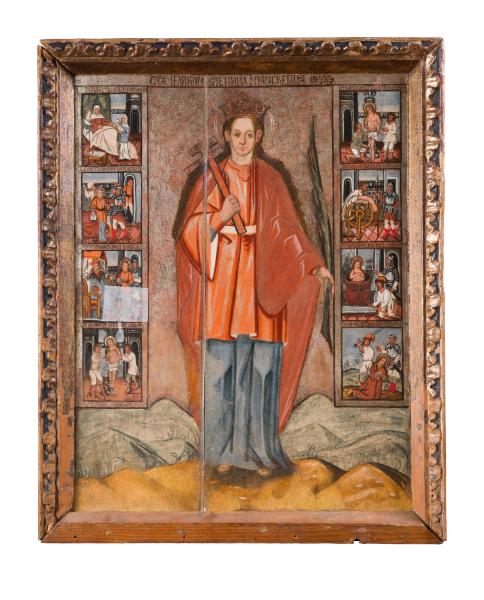
Since early Christianity, the cult of the Great Martyr Paraskeva has been very popular in Western and Eastern Europe, embodying the image of the pagan goddess of spring and fertility. In Christianity, she is the personification of Good Friday and is honoured as a martyr who defended her faith through suffering. In the Ukrainian sacred tradition, female martyrs were rarely depicted; however, the image of Paraskeva was one of the most popular in painting. The icon from the church in the village of Demydivka depicts a slender, frontal full-length figure of a young maiden in the centre, framed on both sides by scenes from her life. The slightly elongated figure is dressed in a blue chiton, over which she wears an orange dalmatic, belted at the waist. Her shoulders are covered with a red shawl. This colour symbolises divine energy and, in images of martyrs, represents suffering, God's love, and salvation. In her right hand, raised to her chest, Paraskeva holds a massive five-pointed cross, and in her left hand, a palm branch. The painter, with ease, used a simplified colour scheme based on the contrast of three local colours of the saint's clothing – a blue tunic, an ochre dalmatic, and a red cloak – to recreate the canonical image of the saint, endowing it with individual characteristics. The colour scheme of the icon is restrained yet rich. Paraskeva's face, with its small, expressive features, is carefully worked out: a high forehead, clear arched eyebrows, eyes framed by thick eyelids, a long, straight nose, and full, tightly closed lips. Her light brown hair falls in wavy strands onto her shoulders. Paraskeva's head is adorned with a crown. Using a limited number of themes, Ukrainian painters developed a systematic approach for selecting scenes that highlighted the main milestones in the saint's life. Scenes from the woman's life are depicted against a backdrop of architectural staffage, except for the last scene, “The Beheading of St. Paraskeva”. Stamps: 1. The Nativity of St. Paraskeva. 2. Torture with candles. 3. The arrest of Saint Paraskeva. 4. Torture with a wheel. 5. The trial of Paraskeva. 6. The Saint in a boiling cauldron. 7. Torture with hooks. 8. The execution of Saint Paraskeva – beheading.
Legal regulation
Borys Voznytskyi Lviv National Art Gallery