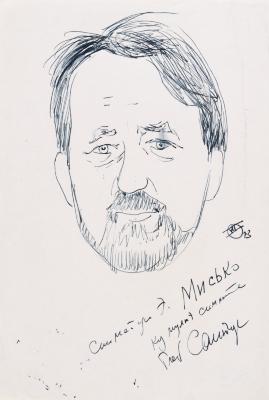
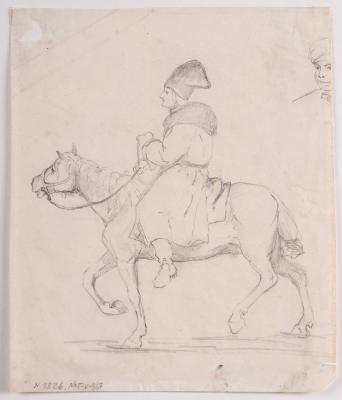
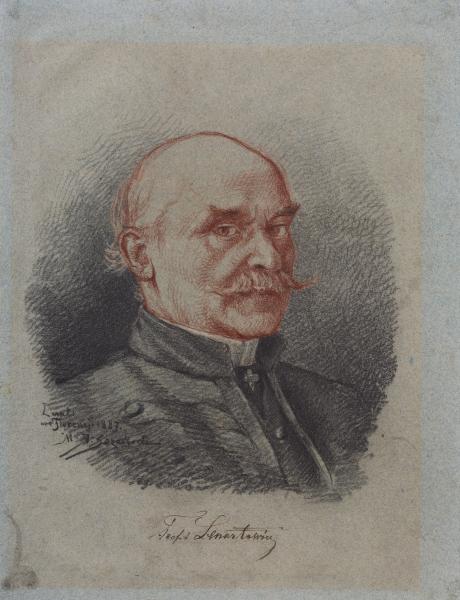
Portrait of Teofil Lenartowicz
Michal Sozanski


Basic information
- ID
- Г-V-338
- Author
- Michal Sozanski
- Name
- Portrait of Teofil Lenartowicz
- Country
- Italy (?)
- Culture
- Modern times
- Technique
- drawing
- Material
- paper on cardboard pencil
- Dimensions (height x width, cm)
- 26 x 19.5
Additionally
- Type
- graphic art
- Genre
- portraiture
- Plot
- Portrait
- Provenance
- the Dzieduszycki collection
Information about author
Object description
Teofil Aleksander Lenartowicz (27 February 1822 – 3 February 1893) was a Polish poet of romanticism, sculptor and ethnographer. Honorary member of the Polish National Museum Society in Rapperswil since 1890. He spent his childhood in the countryside near Rawa Mazowiecka. Around 1833, he settled in Warsaw. In 1837, he began working in law firms. In 1841, he made his debut as a poet. In 1843, fearing arrest, he left for Poznań for several months. In 1847, he was a member of a secret society led by Henryk Krajewski. That same year, he published the poem "The First Performance of Hamlet" in "Dziennik Mody Paryskich" (Paris Fashion Journal). He participated in the underground resistance and the 1848 uprising. In 1849, he moved to Dresden; in 1852, to Paris; and in 1856, to Italy. In 1860, he settled in Florence and married Zofia Szymanowska, Adam Mickiewicz's stepsister. In 1855, a collection of poems was published in Poznań, which brought the artist popularity. In exile, he lectured on Slavic literature, particularly in Bologna. From 1888 to 1893, he was an honorary member of the Poznań Society of Friends of Science, befriended Elżbieta Bosnańska, and corresponded with the artist Juliusz Kossak. In the early 1960s, frustrated by the failure of his poetic works, he decided to take up sculpture and find in it "another way to the hearts". He made his first attempts at clay modelling in 1860 in Rome in the workshop of Henryk Stattler, and later studied with Enrico Pacci in Florence. He studied the works of the "old masters", copied engravings and drew from live models. In 1864, he began sculpting from life and created a series of medallion portraits. T. Lenartowicz is the author of small-format sculptures: chamber pieces with soft modelling of forms. The artist's oeuvre includes images of A. Mickiewicz, in particular, two bronze figures kept in the Polish Library in Paris, memorial sculptures, portraits of Polish kings, military leaders, and other prominent historical figures. Despite his longing for his homeland, the master had a romantic attachment to Florence, reflected in his design for the Savonarola monument and sculptural images of Dante. It is not surprising that T. Lenartowicz's work gained much greater popularity in Italy than in Poland. At the same time, the sculptor was attracted to scenes from the Old and New Testaments, as well as to images of the Virgin Mary, angels, and saints. In 1873, T. Lenartowicz prepared the composition "Eternal Sun. Adoration of Angels" for casting, and in 1874, he created "The Holy Family". The master considered the bronze group "Ave Maria" (1876), purchased by the Krakow Society for Trade in Natural Resources, to be one of his best works. Among the artist's works are compositions of allegorical and symbolic content, in particular "Unita" and "Ideal in Poetry", featuring images of the Muse, genius, a snake, and a shepherd. The composition "Socrates" (1877) demonstrates a return to ancient themes. Works on ethnographic themes occupy a prominent place in T. Lenartowicz's sculptural legacy, in particular "Dancing Maciek" (1881) and "Peasant under the Cross" (1889). In total, about 120 works by T. Lenartowicz are mentioned in scientific sources.
Inscriptions
"Teofil Lenartowicz".
Portrayed person
- The name of the person portrayed
- Teofil Aleksander Lenartowicz
- Lifetime of the person portrayed
- 27.02.1822–03.02.1893
Legal regulation
Borys Voznytskyi Lviv National Art Gallery