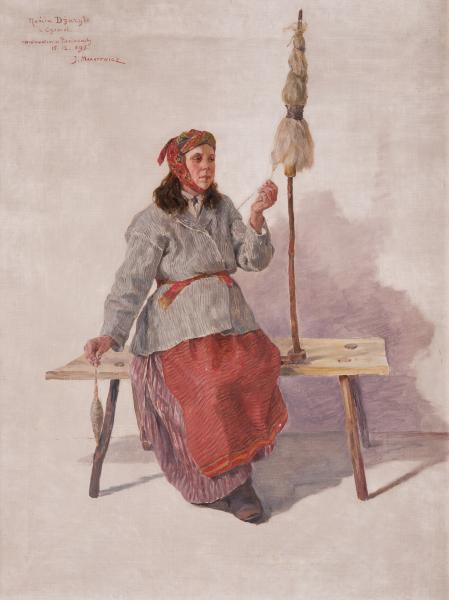
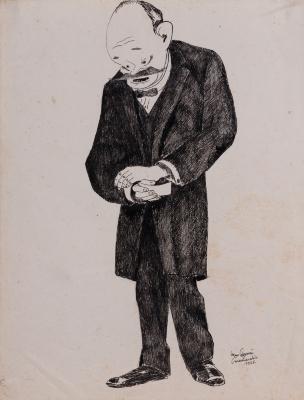
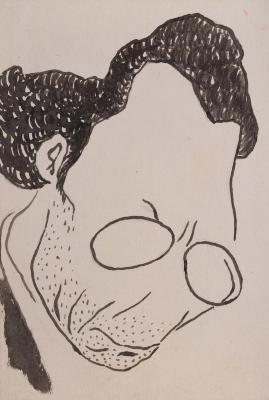
Nastia Dzhurylo – a peasant woman from the village of Chepeliv near Peniaky

Julian Makarewicz

  • Nastia Dzhurylo – a peasant woman from the village of Chepeliv near Peniaky 2
  • Nastia Dzhurylo – a peasant woman from the village of Chepeliv near Peniaky 3
Basic information
ID
Ж-1347
Author
Julian Makarewicz
Name
Nastia Dzhurylo – a peasant woman from the village of Chepeliv near Peniaky
Date of creation
1895
Country
Austro-Hungarian Monarchy
Culture
Modern times
Technique
oil painting
Material
canvas oil
Dimensions (height x width, cm)
80 x 59.5
Additionally
Information about author
Author
Julian Makarewicz
Artist's lifetime
1854–1936
Country
Austrian Empire, Austro-Hungarian Monarchy, Kingdom of Poland, the Second Polish Republic
Biography
Julian Makarewicz (1854–1936) was an artist and restorer. He was born in the village of Verkhnie Synovydne (now in Lviv Oblast). In 1874–1876, he studied at the Imperial and Royal Technical Academy in Lviv (now Lviv Polytechnic National University) in the architecture department. From 1878, he attended the Academy of Arts in Vienna (C. Griepenkerl's workshop) and later studied in Munich, Rome, and Florence. He studied the technique of mural painting and the possibilities of its restoration. He visited Greece (studying Byzantine painting in the monasteries on Mount Athos), Egypt, and Turkey. From 1887, he lived in Lviv and often visited Hutsulshchyna and Pokuttia, where he painted landscapes, genre paintings from peasant life, and portraits. From 1881, he participated in exhibitions in Krakow, Warsaw, Lviv, Berlin, and London. A posthumous exhibition of the master's work was held in 1936 in Krakow. He collaborated with the Zhelenko stained glass factory in Krakow, designing stained glass windows for churches in Lviv and Krakow. He created a series of illustrations. In 1893, he co-founded the Society of Painters and Sculptors in Lviv. In 1897, he became a teacher at a private painting school for women. Since 1899, he has been a member of the Union of Polish Artists in Lviv. He worked mainly in the styles of academic painting, realism, and impressionism. From 1897 onward, the influence of Secessionism was evident in the artist's monumental and applied works. He participated in the restoration of the Jesuit Church in Lviv (1879), the iconostasis of the Church of the Descent of the Holy Spirit in Rohatyn (1880s), the frescoes of the Jagiellonian Chapel at Wawel in Krakow, the frescoes of the Holy Trinity Castle Chapel in Lublin, the frescoes in the Cathedral in Sandomierz, and the iconostasis of the Church of the Exaltation of the Holy Cross in the Manyava Skete Monastery (Bohorodchany Iconostasis, 1883–1885). As a monumentalist, he is known for his murals in the scientific library of the Ivan Franko National University of Lviv (now at 5 Dragomanova Street) (1904). He participated in the decoration of the Discalced Carmelite monastery complex in Lviv (now the Church of St. Clement the Pope). J. Makarewicz is the artist who created the images of St. Teresa of Avila and St. John the Baptist on the side wings of the main altar of the church. In the 1890s, he created the stained glass window designs "Saints Constantine and Helena" and "Christ and the Holy Spirit" for the Latin Cathedral in Lviv. In 1899–1905, he painted murals in the Greek Catholic Cathedral in Stanyslaviv. In 1891, based on the artist's designs, a temporary triumphal arch was erected in Lviv on the occasion of the anniversary of the 1791 constitution, and a silver lamp with sculptures and enamels was made for the trip of priest Stojałowski. In the same year, the artist designed decorations for masquerades and balls in Lviv. In 1892, based on a sketch by J. Makarewicz, a Khorugv (guild banner) of sculptors, bricklayers, stonemasons, and carpenters in Lviv was created with the image of the Archangel Michael. In 1895–1896, a stained-glass window depicting St. Helena and Constantine was made based on the master's sketch and installed above the entrance to St. Joseph's Chapel. In 1899, Julian Makarewicz served on the jury for the competition to design a monument to Adam Mickiewicz in Lviv. In 1904–1905, he carried out restoration work in the Chapel of the Holy Cross at Wawel in Krakow. In 1907–1908, he decorated the facade and interiors of a hotel in Yaremche in the "Hutsul" Secession style. In 1909, he was a member of the jury for the design competition for the Sobieski Chapel in Kahlenberg, Vienna. He was a member of the Society for the Protection of Polish Art and Cultural Monuments, and from 8 March 1912, he served on its board. In 1921, he created images of St. Martin and St. Roch in the parish church of St. Roch in the town of Słocin. In the same year, he joined the Lviv Union of Artists of Malopolska. In 1925–1927, he painted the St. Stanislaus Church in the town of Brzesko Kujawskie. In 1934, he supervised the restoration of Wit Stwosz's altar in St. Mary's Basilica in Krakow. He made drawings and prepared measurement drawings of the Buchach, Bohorodchany, and Rohatyn iconostases during the pre-restoration research initiated by Wojciech Dzieduszycki (1848–1909). He created book illustrations. He died in Kraków in 1936 and was buried in the Rakowicki Cemetery.
Legal regulation
Borys Voznytskyi Lviv National Art Gallery