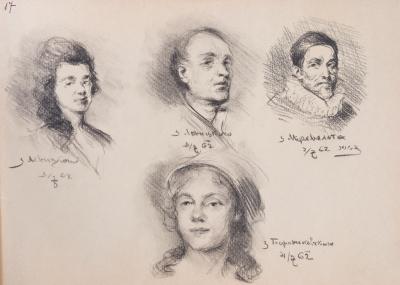
Collection of Ethnographic Drawings
Kajetan Kielisinski

Basic information
- ID
- Г-V-424_136
- Author
- Kajetan Kielisinski
- Name
- Collection of Ethnographic Drawings
- Country
- Kingdom of Poland
- Culture
- Modern times
- Technique
- drawing
- Material
- pencil
Additionally
- Type
- graphic art
- Genre
- genre art
- Provenance
- the Dzieduszycki collection
Information about author
Object description
Kajetan Wincenty Kielisiński created numerous etchings and drawings devoted to folklore, life in Polish villages and towns, historical monuments, and landscapes. He was one of the first to develop bookplates in Poland. During his travels to various locations, he collected graphic materials for the publications "Polish Antiquities" and "Folk Costumes". In 1855, Poznań publisher Jan Konstanty Żupanski published "Kielisiński's Album", which collected the artist's scattered works. Kielisiński's graphic works, drawings, sketchbooks, and correspondence were kept in the Kórnik Library of the Polish Academy of Sciences, as well as in national museums (Kraków, Poznań, Warsaw) and renowned libraries (Jagiellonian University, Ossolineum, Warsaw University). The drawing depicts a man in traditional clothing, standing in profile, facing right. He is probably a traveller or soldier – possibly a Turk or Cossack in winter attire. The character's appearance and style of clothing suggest an Eastern European or Ottoman context from the 18th–19th centuries. The man is wearing a long cloak or caftan, high boots, and a fur hat. Such clothing was typical of the peoples of the Ottoman Empire, the South Slavs, or the Cossacks. A stick with a bundle or vessel hanging from it, possibly a jug or a kettle, is slung over his shoulder, and the man is holding a bottle in his right hand. The figure stands upright, looking straight ahead along the road he is walking on. His image is calm, focused, perhaps tired from a long journey, as evidenced by his posture. The image is simple, executed in a linear graphic style, without unnecessary details. The character's backdrop is a rural landscape – a wooden fence and trees in the background. Perhaps this is an image of a Turk, a Cossack, or a traveller. The image has a calm, harmonious character. The lines are clear, the detail is moderate, and we can see the clothing's folds and the facial features. The drawing's background is minimalist. The graphic drawing has undeniable historical and cultural value, as it is a precise and careful reproduction of folk clothing. Since the drawing accurately reflects and conveys the details and features of the folk clothing of a particular region, it has a pronounced ethnographic, historical, and cultural value. Its artistic significance lies in the accurate and detailed reproduction of folk costumes, making it a valuable source for research and study of traditional culture. From an aesthetic point of view, we are dealing with a realistic drawing, with a special emphasis on its documentary nature.
Legal regulation
Borys Voznytskyi Lviv National Art Gallery