Collection of Ethnographic Drawings
Kajetan Kielisinski

Basic information
- ID
- Г-V-424_146
- Author
- Kajetan Kielisinski
- Name
- Collection of Ethnographic Drawings
- Country
- Kingdom of Poland
- Culture
- Modern times
- Technique
- drawing
- Material
- pencil
Additionally
- Type
- graphic art
- Genre
- genre art
- Provenance
- the Dzieduszycki collection
Information about author
Object description
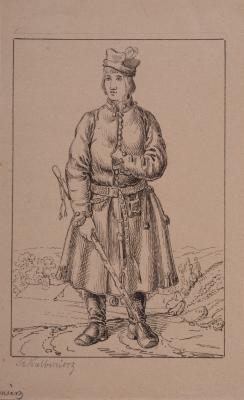
Kajetan Wincenty Kielisiński created numerous etchings and drawings devoted to folklore, life in Polish villages and towns, historical monuments, and landscapes. He was one of the first to develop bookplates in Poland. During his travels to various locations, he collected graphic materials for the publications "Polish Antiquities" and "Folk Costumes". In 1855, Poznań publisher Jan Konstanty Żupanski published "Kielisiński's Album", which collected the artist's scattered works. Kielisiński's graphic works, drawings, sketchbooks, and correspondence were kept in the Kórnik Library of the Polish Academy of Sciences, as well as in national museums (Kraków, Poznań, Warsaw) and renowned libraries (Jagiellonian University, Ossolineum, Warsaw University). The image is rendered as a drawing with fine linear detailing. The drawing depicts a woman standing at full height. The figure is shown in traditional or festive attire from past centuries. On her head is a tall, cylindrical headdress – a fur hat, possibly velvet or cloth with trim, that completely covers her hair, which was typical for married women of higher social status in past centuries. The woman is wearing long, lush outer clothing, probably a fur coat or a dopelen (long traditional coat). The garment is thick, trimmed with fur around the edges, with a characteristic fur trim visible along the sleeves and bottom. The garment almost completely covers the arms, shoulders, and torso and falls to the floor. A large, wide frilled collar, also made of fur, falls on the shoulders. An embroidered apron or the front of a skirt with geometric or floral motifs is visible. Underneath the outer garment, a skirt with thin vertical folds is visible, adding splendour. The shoes in the image are almost invisible, as the dress completely covers the legs. The clothing conveys a sense of wealth and status, indicating affluence or membership of the upper echelons of society. The figure is static, with her hands folded in front of her stomach and a serious, calm expression on her face. The figure is depicted against an interior background, with part of a door or wall and a tiled floor visible. The artist focused on the details of the costume, carefully conveying the fabric's texture, folds, and ornamental elements. Thus, this drawing presents another historical costume portrait that captures the appearance and attire of a person from a particular era. The artistic value of the drawing lies in its documentary and ethnographic accuracy in depicting the historical costume: the author sought to capture the details of the clothing and social image, rather than the individual features of the person.
Legal regulation
Borys Voznytskyi Lviv National Art Gallery