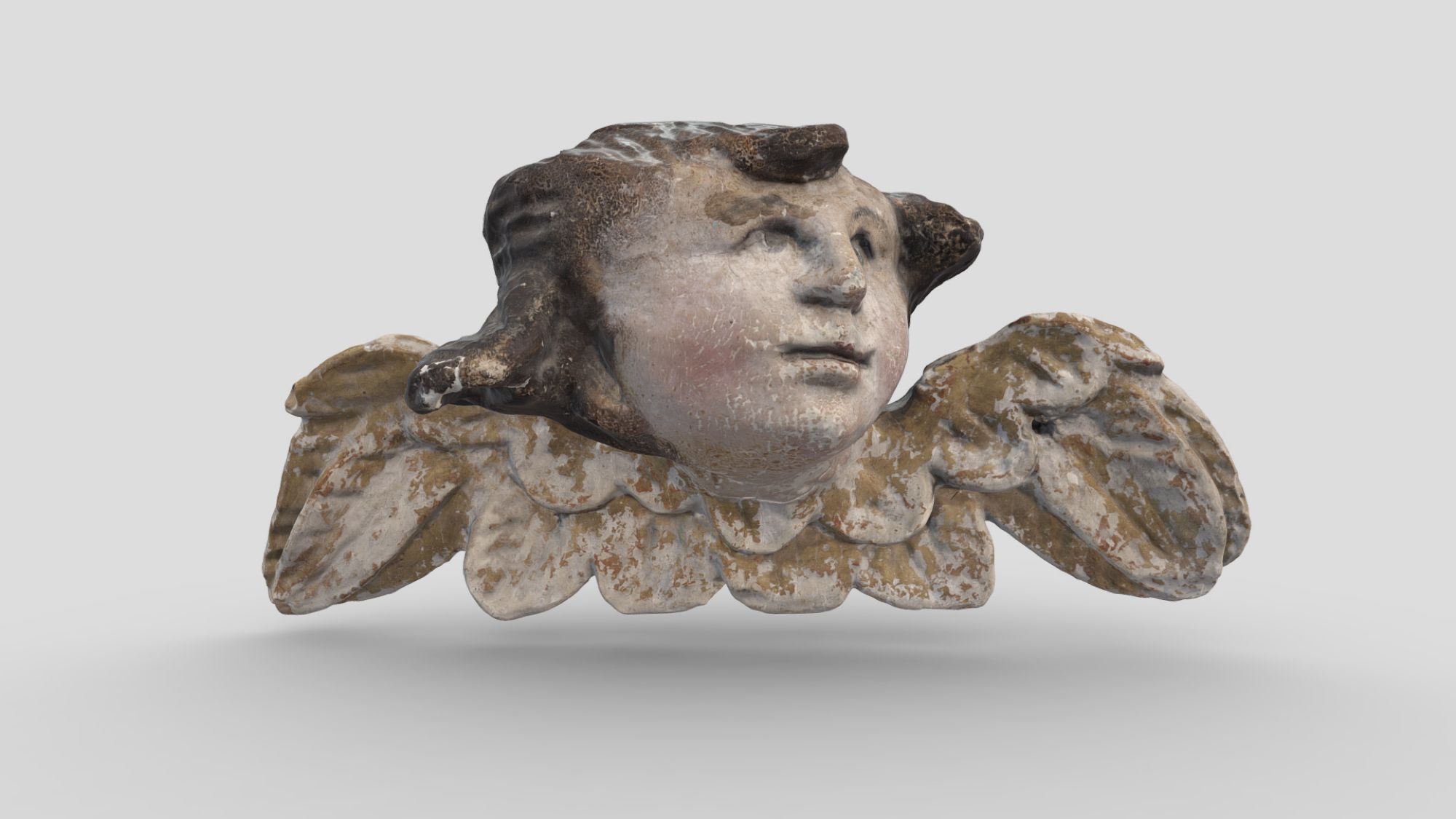
Winged Angel Head
unknown

Basic information
Additionally
- Type
- sculpture 3D
- Genre
- religious
- Plot
- Cherub
- Provenance
- Busk town, Lviv region
Information about author
Object description
This sculptural depiction of a winged cherub belongs to the imagery of the heavenly messenger widely spread in Ukrainian Baroque art. Similar images served as decorative and symbolic adornments for altar compositions, iconostases, shrines, and church interiors.
Carved from a solid block of wood, the angel's head was part of an architectural and sculptural altar composition in a church, where it served as an accentuating feature. The image of the cherub, which in the Christian tradition personifies unceasing doxology and proximity to the throne of God, is rendered laconically, with the head framed by a pair of wings. This artistic approach, characteristic of Baroque art, focuses the viewer's attention on the face, which conveys an image of child-like purity, innocence, and luminous contemplation. The cherub's wings symmetrically frame the head, creating a distinct silhouette and rhythmically organising the volume. Due to the original manner of portraying the image, the plastic form acquires a soft, modelled expressiveness, while the interplay of light and shadow on the recesses and projections enhances the illusion of movement and spirituality.
The image is characterised by softness of contour lines and plasticity in the rendering of the face, featuring plump cheeks and a small, well-defined chin. Upon the fair carnation of the angel's face, small, closely set eyes clearly emerge beneath prominent dark arches of eyebrows, accompanied by a turned-up nose and lips closed in a faint smile. The expressiveness of the angel's countenance is enhanced by dishevelled chestnut hair, while a bright pink blush on the cheeks fills it with a lively resonance.
The carving in this artwork is combined with polychromy and gilding, fulfilling not only a decorative but also a sacred function. In the flickering light, it produces the impression of a celestial radiance, complementing the symbolism of the image. The polychromy infuses the cherub's image with vitality, fully aligning with the aesthetics of the Ukrainian Baroque, which is characterised by a striving for decorativeness, richness of texture, and emotional elevation.
The style of execution of this sculptural depiction points to a connection with a local school of craftsmanship, which fused Western European Baroque influences with folk woodcarving techniques. The artwork demonstrates how canonical iconography was perceived and reinterpreted by Ukrainian provincial masters, preserving its sacred meaning while acquiring a warm, sincere expressiveness.
Legal regulation
Borys Voznytskyi Lviv National Art Gallery