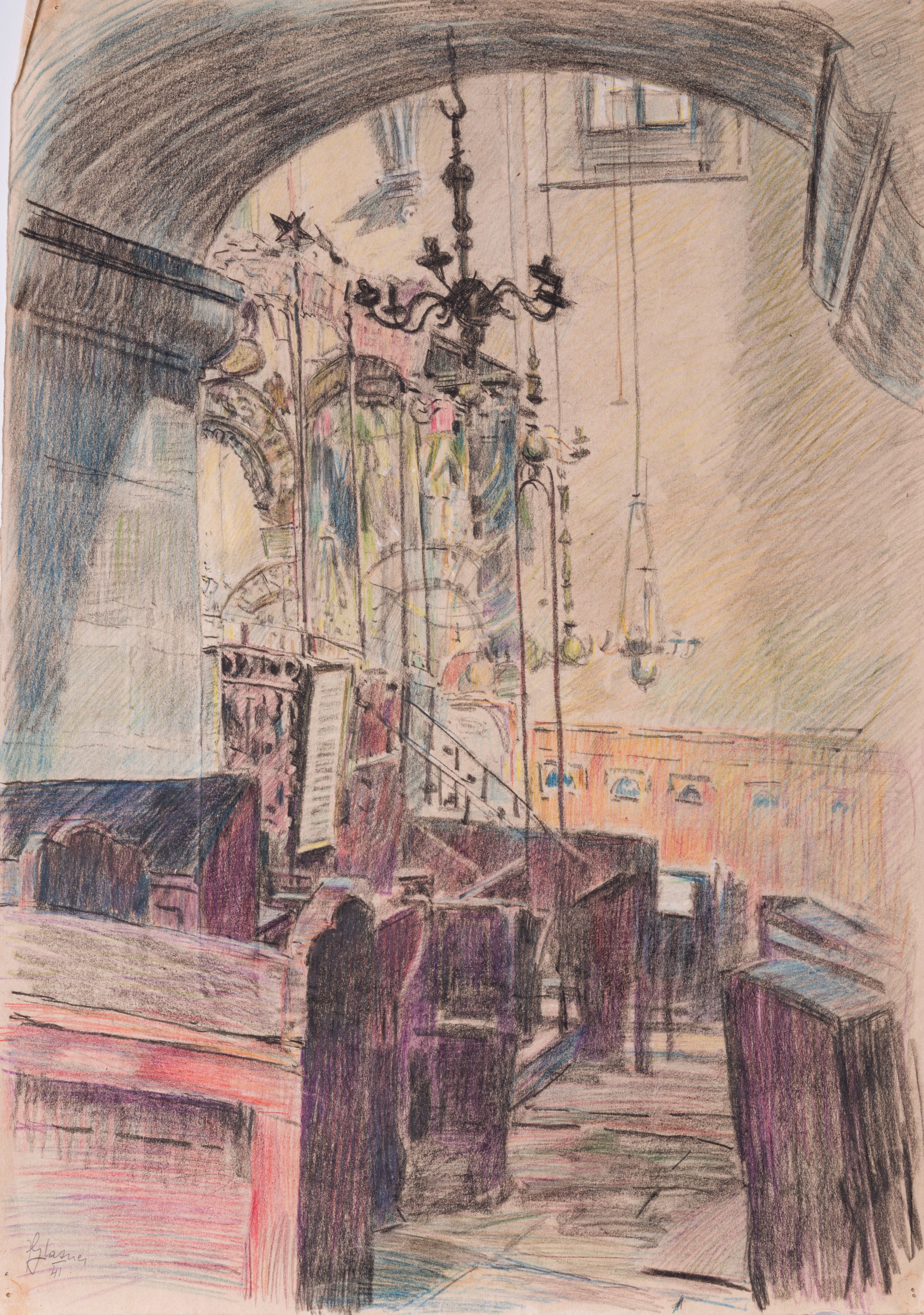
Interior of the Synagogue
Jakub Glasner
Basic information
- ID
- Г-V-420
- Author
- Jakub Glasner
- Name
- Interior of the Synagogue
- Country
- the Ukrainian SSR
- Technique
- drawing
- Material
- paper
- Dimensions
- 44 x 41.2 cm (height x width)
Additionally
- Type
- graphic art
- Genre
- indoor scene
- Plot
- Architecture
- Provenance
- Collection of Jakub Glasner
Information about author
Object description
The drawing depicts a fragment of the interior of the Golden Rose Synagogue in Lviv. Through the arched passageway, one can see the ornate metal bimah bathed in sunlight; above it, in the background, is the lower part of the window and the impost from which the ribs of the vault spring. Massive wooden benches stand below. Lamps hang from the ceiling. The work is rendered in warm pastel tones.
The Turei Zahav Synagogue (later known as Reiza Zahav – the Golden Rose) is the most famous synagogue in Lviv and a monument of Renaissance architecture. In August 1941, it was destroyed by the Nazis. This drawing is the last known depiction of the synagogue, executed by Jakub Glasner shortly before the Nazi occupation in the summer of 1941.
The Turei Zahav Synagogue (later known as Reiza Zahav – the Golden Rose) is the most famous synagogue in Lviv and a monument of Renaissance architecture. In August 1941, it was destroyed by the Nazis. This drawing is the last known depiction of the synagogue, executed by Jakub Glasner shortly before the Nazi occupation in the summer of 1941.
Inscriptions
At the bottom, in pencil: "J. Glasner/41".
Legal regulation
Borys Voznytskyi Lviv National Art Gallery