Back

Baroque Altar

Stanislaw Noakowski
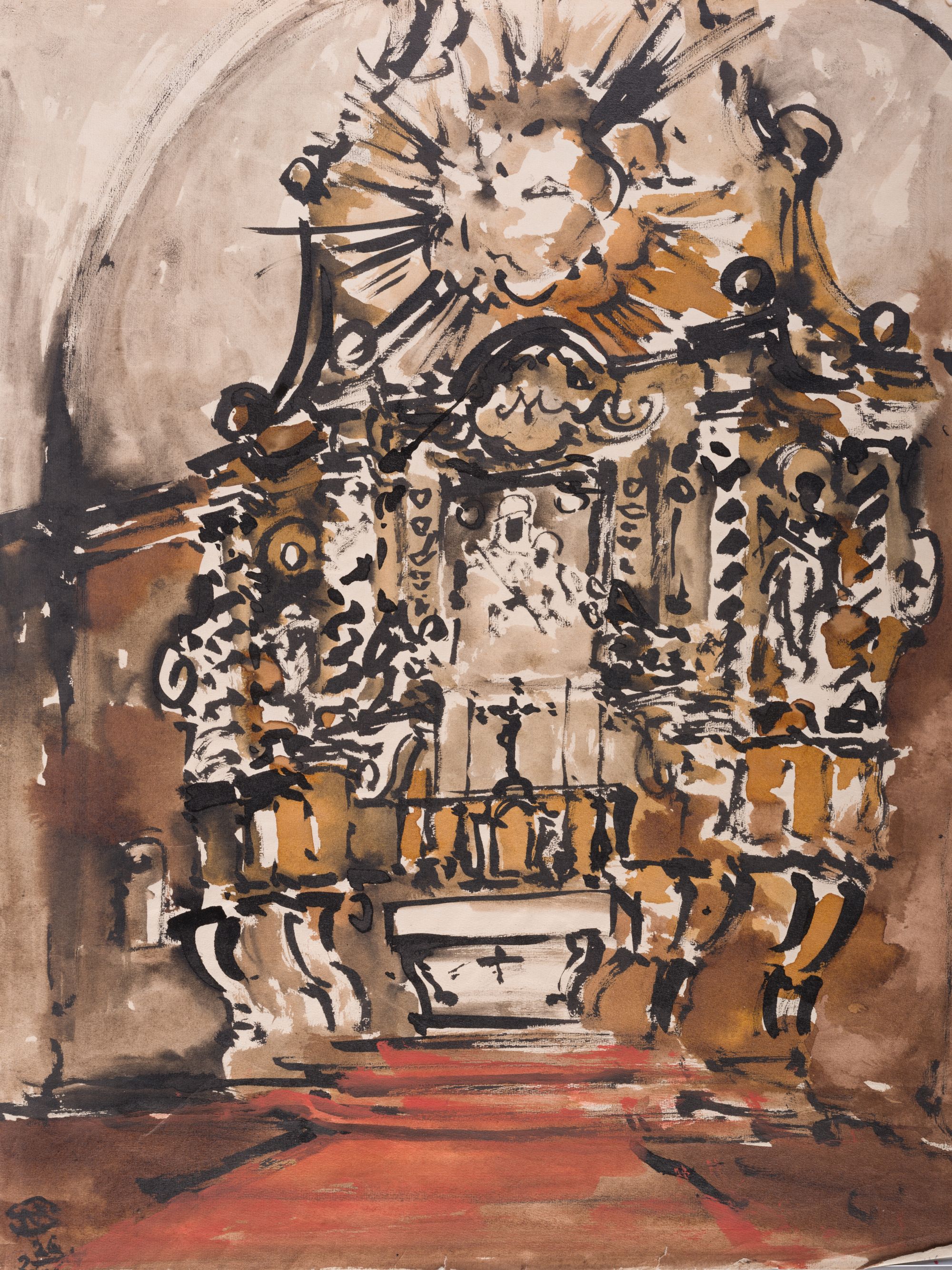
  • Baroque Altar
Basic information
ID
Г-I-675
Author
Stanislaw Noakowski
Name
Baroque Altar
Date of creation
1920s
Country
Poland
Material
paper watercolour
Dimensions
63.3 x 48 cm (height x width)
Information about author
Author
Stanislaw Noakowski
Author in the original
Stanisław Noakowski
Artist's lifetime
1867–1928
Country
Poland
Biography
Stanisław Noakowski (1867, Nieszawa – 1928, Warsaw) – a Polish architect, painter, graphic artist and art historian. The son of a district notary. In his youth, he took drawing lessons at the real school in Włocławek, and later at the grammar school in Łowicz. Between 1886 and 1898, he studied architecture at the Imperial Academy of Arts in St Petersburg. In 1895, as a scholar of the Academy, he travelled across Europe. After obtaining his degree in architecture, Noakowski began teaching.
In 1906, he was appointed professor at the Moscow School of Painting, Sculpture and Architecture. In 1908, he joined the Society of Polish Artists "Sztuka" (Towarzystwo Artystów Polskich "Sztuka"). He later became an honorary member of the St Petersburg Academy of Arts. In the autumn of 1918, he returned to Poland. He was appointed professor of the history of modern architecture at the Faculty of Architecture of the Warsaw University of Technology, and from 1923 onwards served as a professor at the Warsaw School of Fine Arts (Szkoła Sztuk Pięknych). In the 1920s, he exhibited his graphic works and paintings at exhibitions in London, Paris, Prague, Vienna, Budapest and Amsterdam.
Noakowski created colour drawings on the theme of European architecture from various eras and styles. He drew in ink, sepia or watercolour. The artist loved to create architectural fantasies, in which he depicted various real-life objects within an imaginary historical context. He believed that architecture was the most expressive of all art forms, as it best conveys the history and essence of a particular civilisation. The influence of Art Nouveau is evident in his work, particularly in his designs for country estates and park mausoleums, as well as in the ornamentation of his bookplates.
Noakowski died suddenly in 1928, leaving behind thousands of sketches. A large collection of his works is held by the National Museum in Warsaw (Muzeum Narodowe w Warszawie). A rich collection of drawings and memorabilia relating to the artist is also housed in the Stanislaw Noakowski Museum in Nieszawa. It is situated in a small 19th-century manor house, where the artist's family settled shortly after his birth.
Object description
The work was completed following the artist's return to Poland in 1918. It depicts one of the altars in a Catholic church. The artist emphasises its opulent Baroque decoration: twisted side columns with stylised figures of saints between them, the rays of the cartouche at the top, and volute pedestals at the bottom. The altar's rich decoration draws attention to the central image – an icon of the Crowned Mother of God with the Child. Beneath it, the church mensa is highlighted in a light tone, upon which stands a cross with the Crucifixion. The composition is rendered in a warm colour scheme. The depiction of the altar is dominated by an ochre-brown palette in blurred light and dark tones. At the top, the vault rib is outlined in a semicircle. At the bottom, a carpet is highlighted in bright orange, with a wide strip leading towards the altar and covering the steps near the altar table.
Inscriptions
Artist's monogram and date bottom right: "SN" (letters superimposed) "2 26/V". On the reverse: inventory numbers and a round stamp bearing the inscription "Fundusz Kultury Narodowej".
Legal regulation
Borys Voznytskyi Lviv National Art Gallery
Link copied