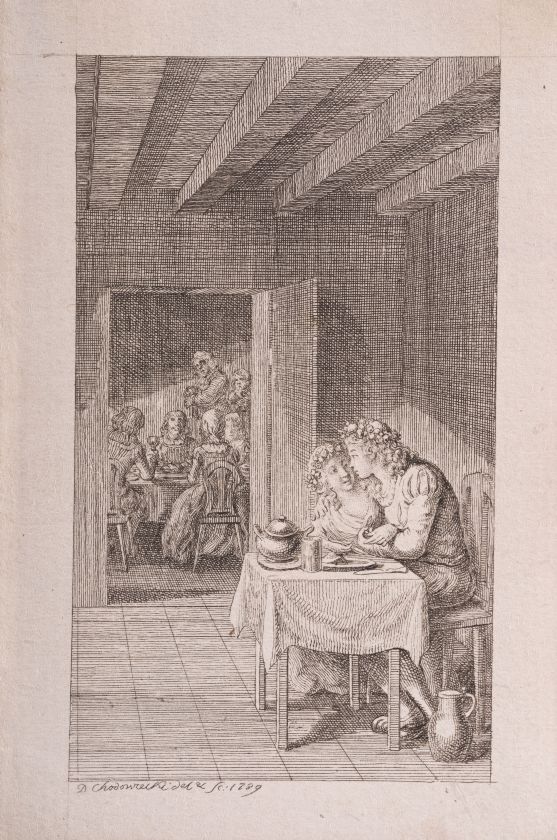
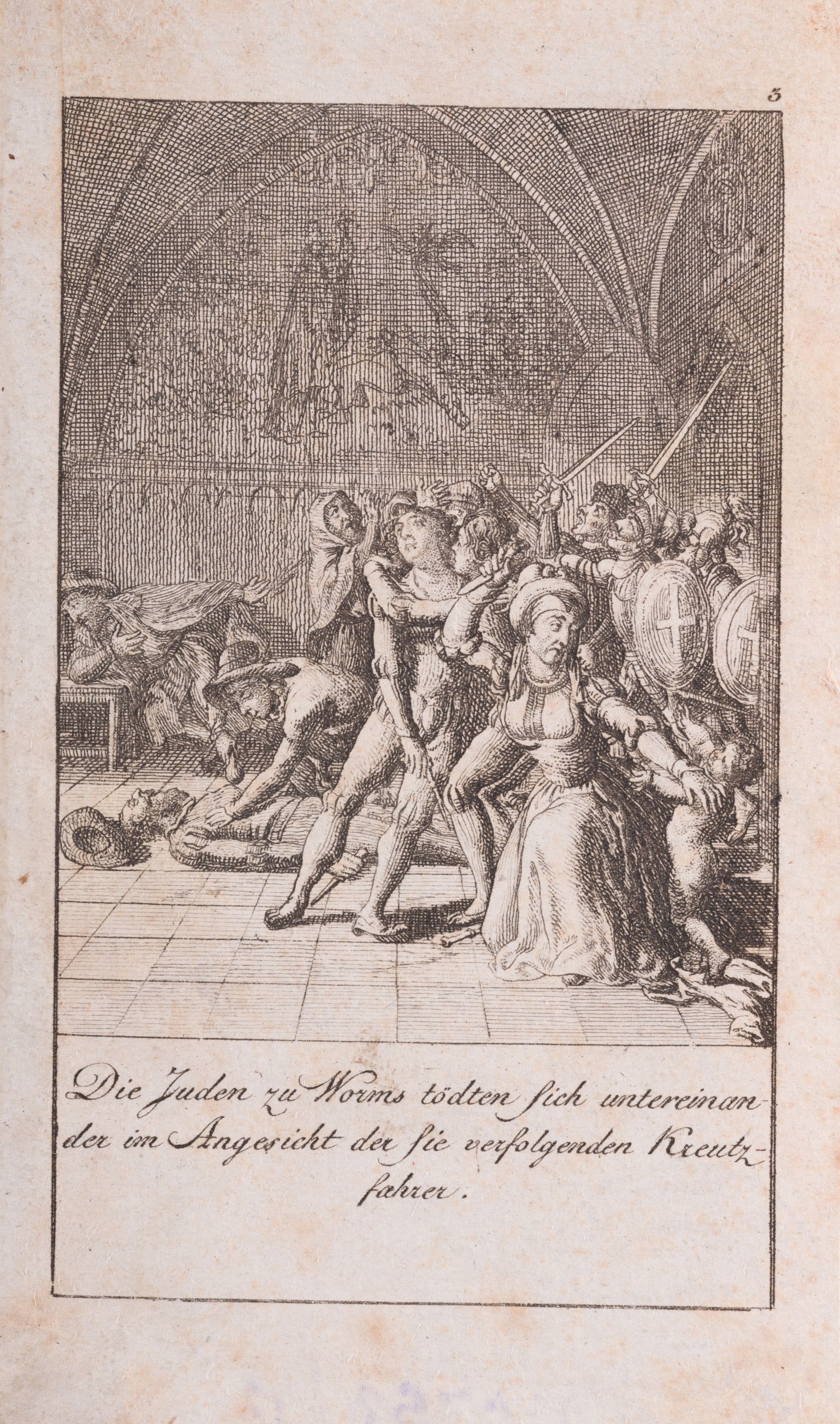
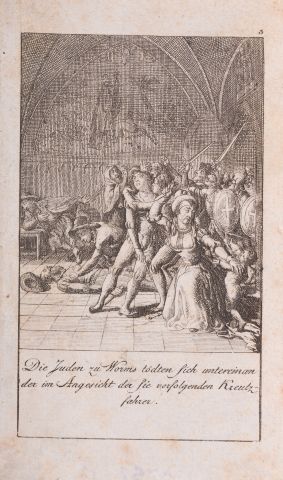
Scene Depicting the Crusades (Jews in Worms Committing Murder and Suicide in the Face of Pursuing Crusaders)
Daniel Chodowiecki
Basic information
- ID
- Г-IV-1212
- Author
- Daniel Chodowiecki
- Name
- Scene Depicting the Crusades (Jews in Worms Committing Murder and Suicide in the Face of Pursuing Crusaders)
- Date of creation
- late 18th c.
- Country
- Germany
- Technique
- сopper engraving
- Material
- paper
- Dimensions
- 9.7 x 5.7 cm (height x width)
Additionally
Information about author
Object description
In May 1096, the forces of the Peasants' Crusade arrived in the city of Worms (in the historic region of the Palatinate in Germany). There, false rumours immediately began to circulate that the Jews were poisoning the wells. This provoked an attack on the Jewish community. Some of the Jews sought refuge in the palace of the local bishop. When the crusaders stormed the palace, the Jews were faced with a choice: convert to Christianity or die. Many of them chose a martyr's death. To prevent their children from falling prey to the crusaders – who would subject them to forced baptism or brutal murder – fathers and mothers killed their own children with their own hands, and then took their own lives.
The engraving depicts a room with a vaulted ceiling and faintly visible wall paintings. On the right, knights are shown storming into the palace, holding shields bearing crosses and raising their swords aloft. On the left is a scene depicting the suicides and the killings of their loved ones by the Jews. In the foreground on the right, the focus is on the figure of a woman raising a knife above a small, naked child.
The engraving depicts a room with a vaulted ceiling and faintly visible wall paintings. On the right, knights are shown storming into the palace, holding shields bearing crosses and raising their swords aloft. On the left is a scene depicting the suicides and the killings of their loved ones by the Jews. In the foreground on the right, the focus is on the figure of a woman raising a knife above a small, naked child.
Inscriptions
Below the image is the inscription: "Die Juden zu Worms tödten sich untereinan-/der im Angesicht/der sie verfolgenden Kreutz-/fahrer". On the reverse, at the top, are the inventory numbers of the Lviv Picture Gallery. Below, in the centre, are the inscriptions: "Do wypraw Krzyżowych", "Jacob. 945/ E. 945/ 3615/S.O.". At the bottom left is the round seal of the Lviv State Republican Historical Museum's holdings; on the right – the historical museum's inventory number.
Legal regulation
Borys Voznytskyi Lviv National Art Gallery