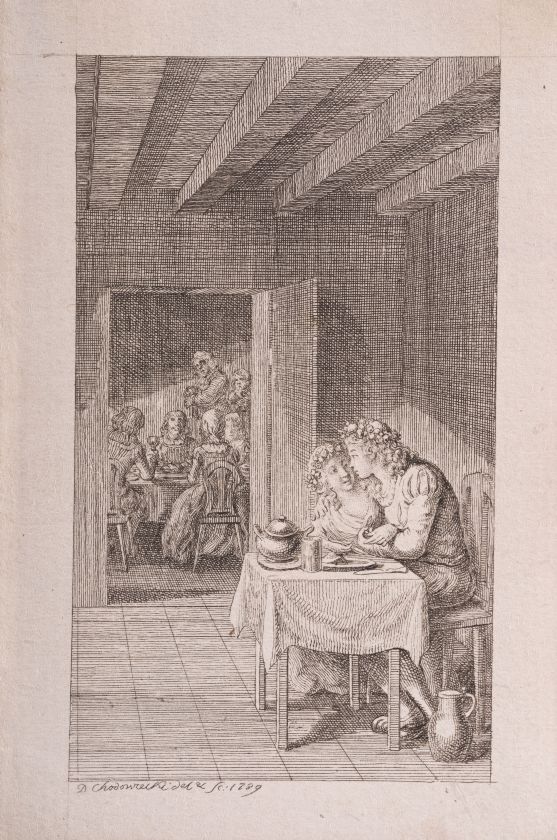
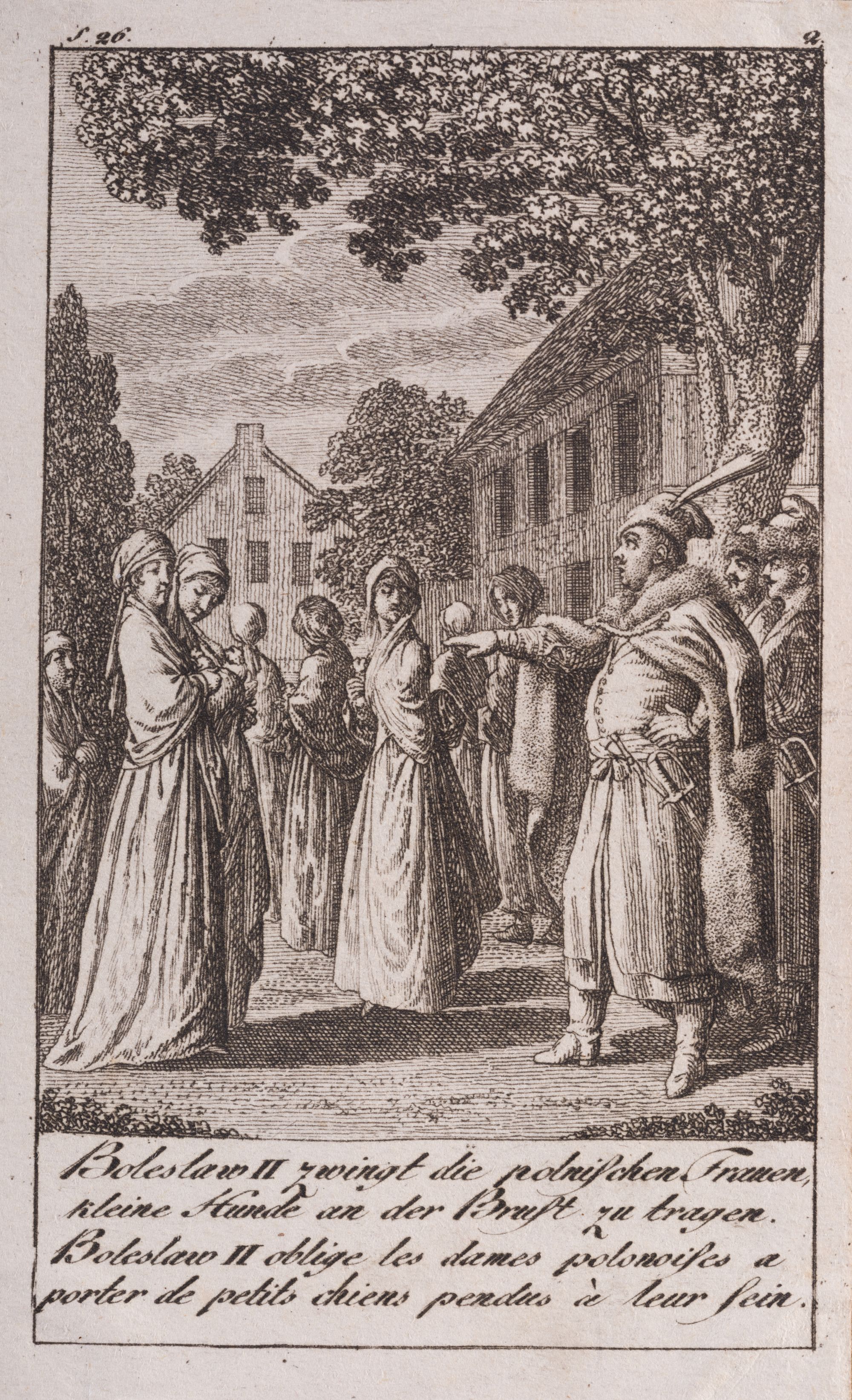
Boleslaw II Orders Polish Ladies to Hold Puppies to Their Breasts
Daniel Chodowiecki
Basic information
- ID
- Г-IV-2702
- Author
- Daniel Chodowiecki
- Name
- Boleslaw II Orders Polish Ladies to Hold Puppies to Their Breasts
- Country
- Germany
- Technique
- etching
- Material
- paper
- Dimensions
- 8.4 x 5 cm (height x width)
Additionally
- Type
- graphic art
- Genre
- history painting
- Provenance
- Purchased from O. Bushel, 1977
Information about author
Object description
The artist has illustrated one of the controversial episodes in ancient Polish history, as described in the chronicles of Wincenty Kadłubek (12th–13th centuries) and Jan Długosz (15th century). King Boleslaw II the Bold, having returned with his army from yet another campaign against Rus, learnt that his warriors' wives had been unfaithful to them and, whilst their husbands were away for a long time, had given birth to children out of wedlock. The king then ordered the women to tie puppies to their breasts and feed them with their milk instead of their own children. The engraver depicted this cruel punishment as a domestic scene. In the foreground on the right, the king extends his right hand, giving orders to the women standing on the left. Their expressions are calm and composed. The monarch, however, with soldiers depicted behind him, looks flamboyant. The scene is set against a backdrop of stone buildings, in front of which trees grow. Chroniclers embellished the bloodthirsty myths and gruesome tales of Boleslaw II's tyranny in the late Middle Ages and early Modern period to emphasise his cruelty and immorality.
This illustration forms part of the "Historical and Genealogical Calendar for the Leap Year 1796" (Historisch-genealogischer Kalender auf das Schalt-Jahr 1796), published in Berlin by Johann Friedrich Unger in collaboration with the Royal Prussian Calendar Deputation (Königl. Preuß. Kalender-Deputation).
This illustration forms part of the "Historical and Genealogical Calendar for the Leap Year 1796" (Historisch-genealogischer Kalender auf das Schalt-Jahr 1796), published in Berlin by Johann Friedrich Unger in collaboration with the Royal Prussian Calendar Deputation (Königl. Preuß. Kalender-Deputation).
Inscriptions
Below the image is the title of the work in German and French: "Boleslaw II zwingt die polnischen Frauen, / kleine Hunde in der Brust zu tragen. / Boleslaw II oblige les dames polonoises à / porter de petit chiens pendus à leur sein". Above the print, on the right and left, are illegible letters and numbers engraved by the artist. On the reverse, at the bottom – the inventory number of the Lviv Picture Gallery written in pencil.
Portrayed person
- The name of the person portrayed
- Bolesław II, Polish King
Legal regulation
Borys Voznytskyi Lviv National Art Gallery