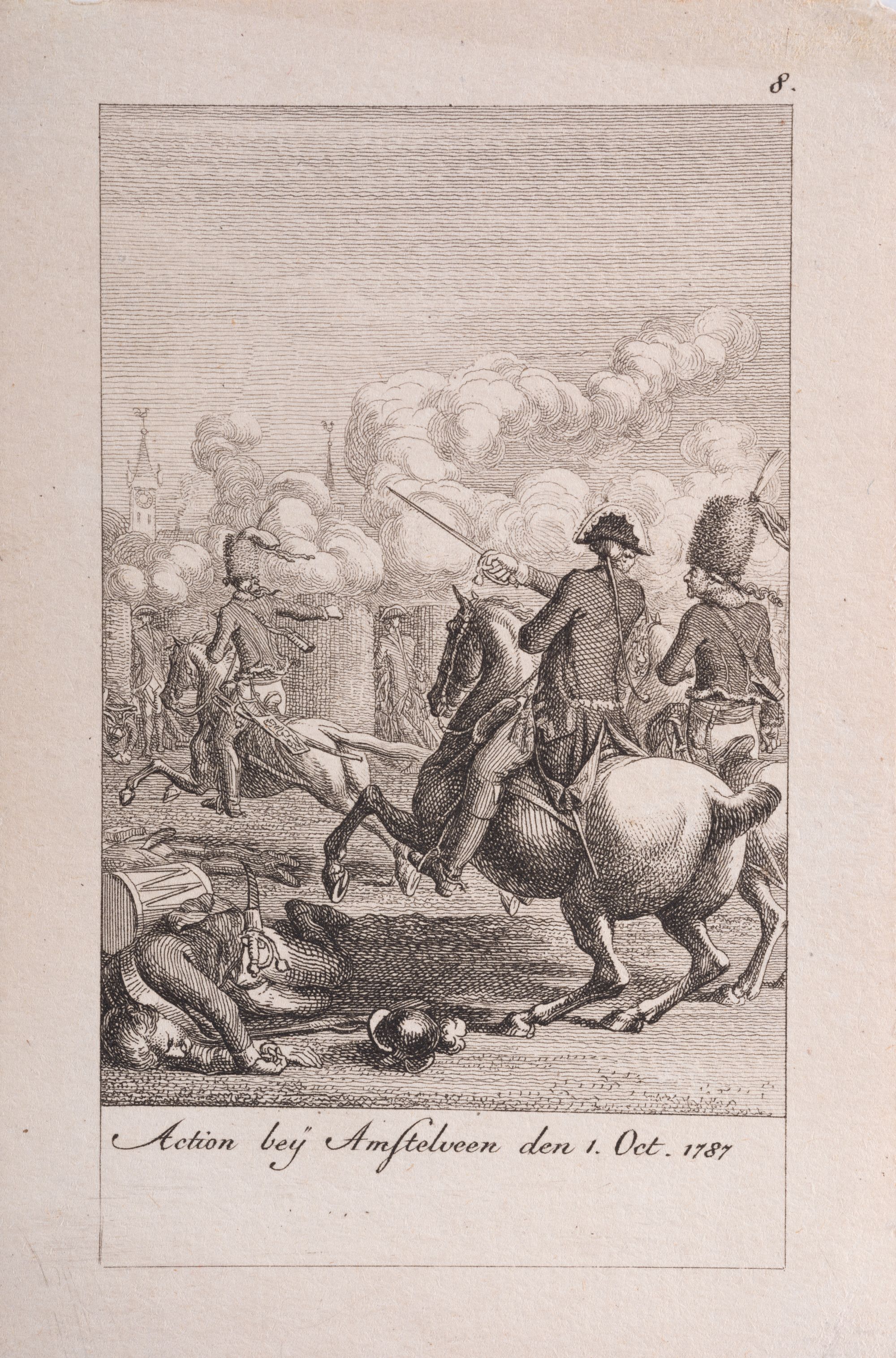
Battle of Amstelveen on 1 October 1787
Daniel Chodowiecki
Basic information
- ID
- Г-IV-2703
- Author
- Daniel Chodowiecki
- Name
- Battle of Amstelveen on 1 October 1787
- Country
- Germany
- Technique
- etching
- Material
- paper
- Dimensions
- 7.4 x 5.1 cm (height x width)
Additionally
- Type
- graphic art
- Genre
- battle painting
- Plot
- Battle
- Provenance
- Purchased from O. Bushel, 1977
Information about author
Object description
The artist has depicted the decisive battle between the Prussian troops, who supported the restoration to power in Holland of Stadtholder William of Orange, and the democratic rebels who opposed him. The battle took place near the town of Amstelveen, located a few kilometres from Amsterdam. The print depicts a dynamic battle scene, with two cavalrymen in the foreground. Leading them is likely the commander of the Prussian army – Karl Wilhelm Ferdinand, Duke of Brunswick. On a rearing white horse and wearing a bicorn hat, he has stretched out his arm with a sword, calling to battle. The horseman galloping to his right is depicted wearing a long cap. Perhaps this is how the Dutch soldiers – supporters of the Orangists – looked. On the left is another cavalryman wearing a similar headdress, riding towards the enemy. In the background, clouds of smoke can be seen, through which the slender tower of a Protestant church, topped with a weathercock, emerges in the distance. On the ground to the left lies a dead or wounded warrior, with a drum and pieces of equipment beside him. The battle ended in victory for the Prussians and the Orangists. William V of Orange returned to power, albeit briefly.
The number "8" in the top right corner indicates the serial number in the printed series of one of the German almanac calendars, such as the "Gothaischer Hofkalender". This print is known, in particular, from the collection of the Rijksmuseum in Amsterdam
The number "8" in the top right corner indicates the serial number in the printed series of one of the German almanac calendars, such as the "Gothaischer Hofkalender". This print is known, in particular, from the collection of the Rijksmuseum in Amsterdam
Inscriptions
Below the image is the title of the work in German: "Action bey Amstelveen den 1. Oct. 1787". In the top right, the number "8" is engraved. On the reverse, at the bottom – the inventory number of the Lviv Picture Gallery written in pencil.
Legal regulation
Borys Voznytskyi Lviv National Art Gallery