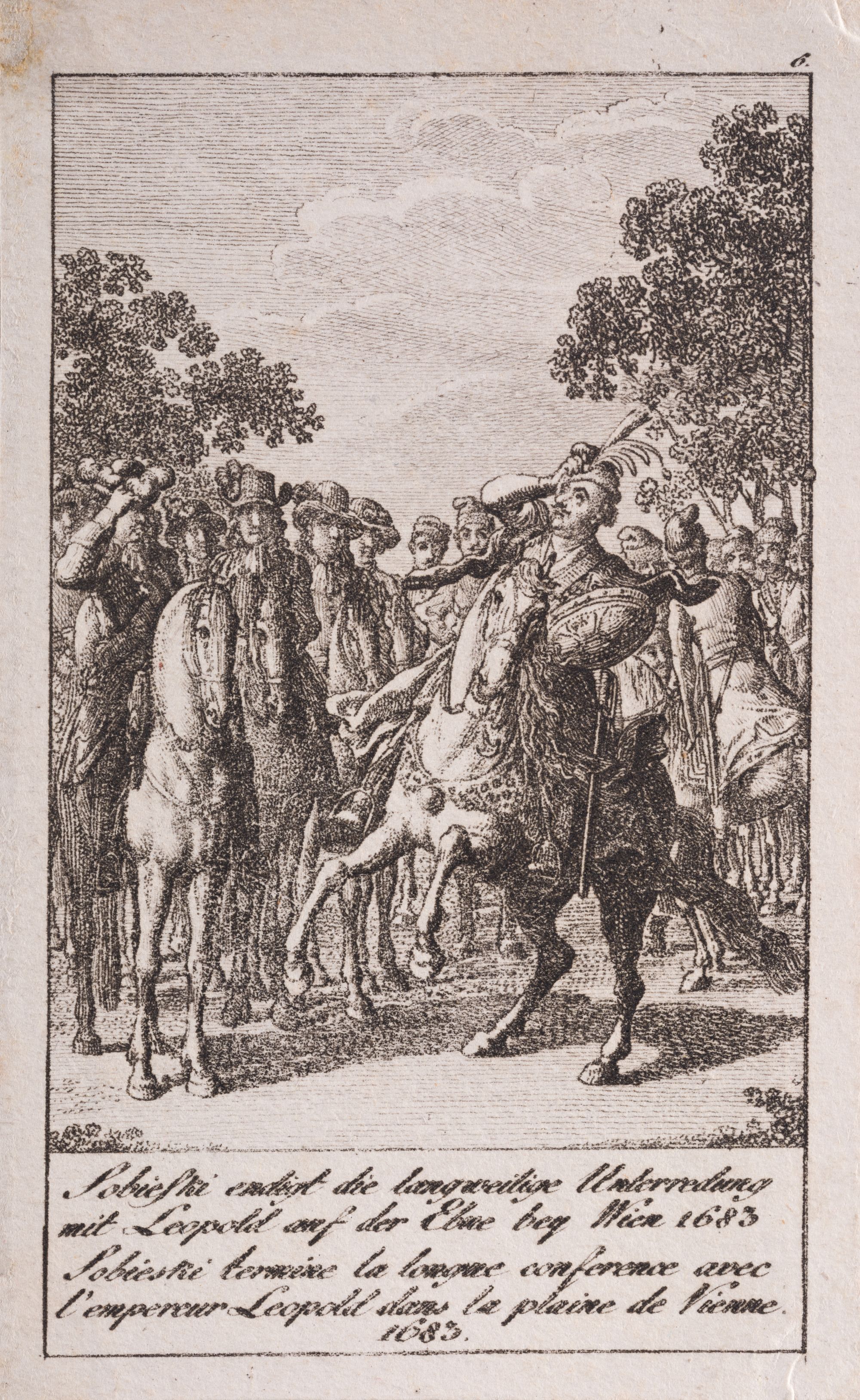
Sobieski Concludes His Lengthy Conversation with Leopold on the Plain Near Vienna in 1683
Daniel Chodowiecki
Basic information
- ID
- Г-IV-2705
- Author
- Daniel Chodowiecki
- Name
- Sobieski Concludes His Lengthy Conversation with Leopold on the Plain Near Vienna in 1683
- Country
- Germany
- Technique
- etching
- Material
- paper on cardboard
- Dimensions
- 8.4 x 5 cm (height x width)
Additionally
- Type
- graphic art
- Genre
- history painting
- Provenance
- Purchased from O. Bushel, 1977
Information about author
Object description
This work represents one of the episodes for the "History of Poland" theme, illustrated in the Berlin "Historisch-genealogischer Kalender auf das Schalt-Jahr 1796" (Historical and Genealogical Calendar for the Leap Year 1796). The artist's illustrations specifically for this historical theme are currently held in leading global collections, including the Albertina (Vienna), the National Museum in Kraków, the Dresden Kupferstich-Kabinett and the British Museum.
The event depicted took place after the victorious battle over the Turks near Vienna in September 1683. Jan III Sobieski, monarch of the Polish–Lithuanian Commonwealth, and Leopold I of Habsburg, Holy Roman Emperor, met near Schwechat. Their meeting was tense due to court etiquette and political differences, which was later ironically reflected in Daniel Chodowiecki's multi-figure composition. In the right foreground, the king is depicted on a galloping horse, dressed in traditional Polish attire. He holds a shield in his left hand and has raised his right hand holding a scroll. In contrast to the expressive king, the emperor on horseback on the left ceremonially raises his hand to his feathered hat. Beside the Habsburg monarch, his subordinate riders look equally joyless. Behind the king, his soldiers are animatedly discussing something.
Below the image, the inscriptions are engraved in German and French: "Sobieski endigt die langweilige Unterredung mit Leopold auf der Ebne bey Wien 1683/ Sobieski termine la longue conférence avec l'empereur Leopold dans la plaine de Vienne 1683". The translated texts show noticeable discrepancies: "Sobieski ends a boring conversation with Leopold on the plain near Vienna 1683" (German text) – "Sobieski ends a long conference with Emperor Leopold in the plain of Vienna 1683" (French text).
Inscriptions
Below the image, the inscriptions are engraved in German and French: "Sobieski endigt die langweilige Unterredung mit Leopold auf der Ebne bey Wien 1683/ Sobieski termine la longue conférence avec l'empereur Leopold dans la plaine de Vienne 1683". In the top right, above the print, the number "6" (or "8") is engraved. On the reverse, at the bottom – the inventory number of the Lviv Picture Gallery written in pencil.
Portrayed person
- The name of the person portrayed
- Jan III Sobieski, monarch of the Polish–Lithuanian Commonwealth, King of Poland, Grand Duke of Lithuania and Grand Duke of Rus; Leopold I of Habsburg, Holy Roman Emperor
- Lifetime of the person portrayed
- 1629–1696 – Jan Sobieski; 1640–1705 – Leopold I
Legal regulation
Borys Voznytskyi Lviv National Art Gallery