Meeting. An Illustration for A. Lafontaine's Work "Out of Pride and Love" ("Aus Stolz und Liebe von Lafontaine")
Daniel Chodowiecki
Basic information
- ID
- Г-IV-2838
- Author
- Daniel Chodowiecki
- Name
- Meeting. An Illustration for A. Lafontaine's Work "Out of Pride and Love" ("Aus Stolz und Liebe von Lafontaine")
- Previous attributions
- Parting
- Country
- Germany
- Technique
- etching
- Material
- paper
- Dimensions
- 8.9 x 6 cm (height x width)
Additionally
- Type
- graphic art
- Genre
- history painting
- Provenance
- Purchased from O. Bushel, 1977
Information about author
Object description
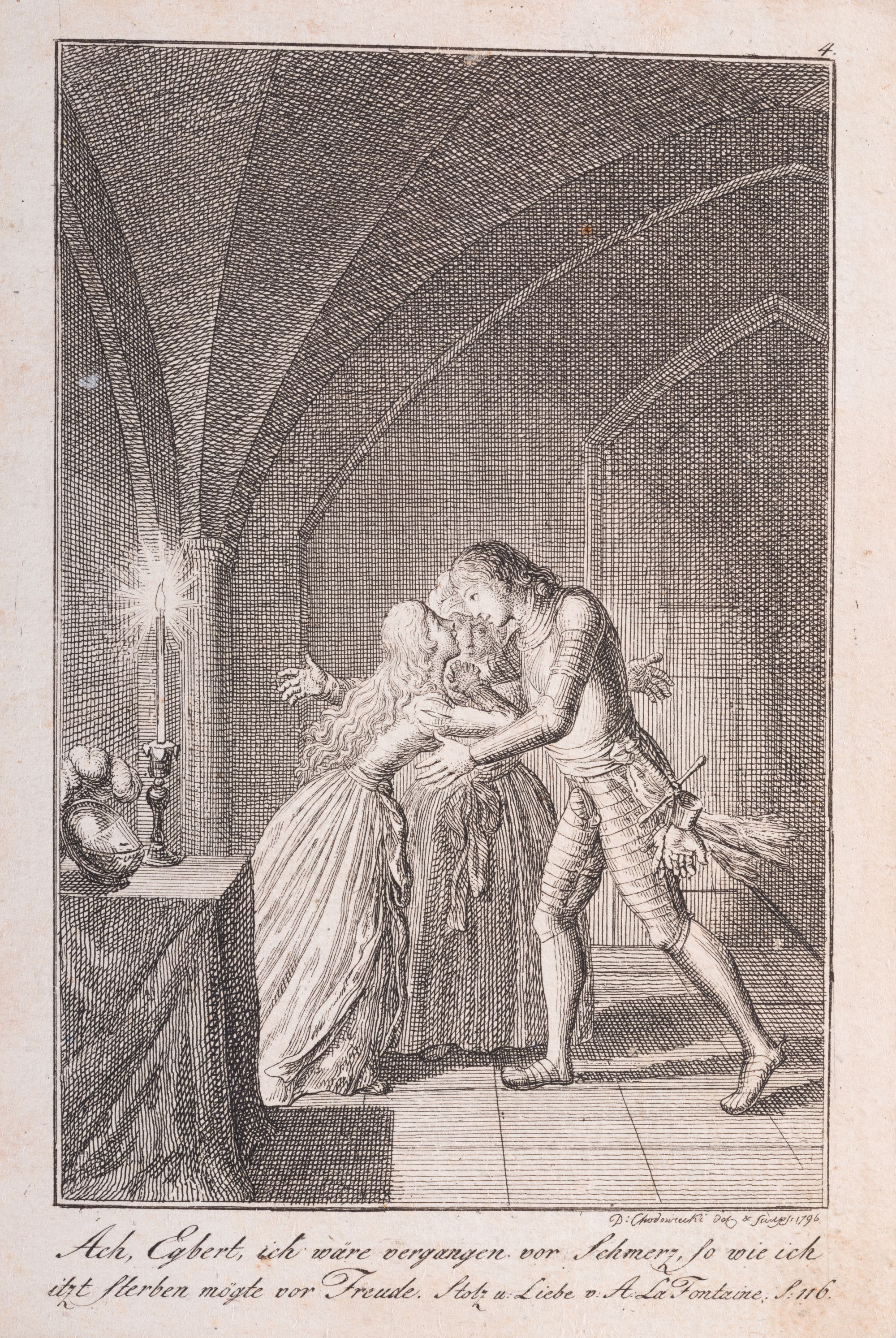
An illustration for the work by the German sentimentalist writer August Heinrich Julius Lafontaine (1758–1831) (not to be confused with the French fabulist Jean de La Fontaine) "On Dignity and Love". The work forms part of the "Pocket Almanac for Sociable Leisure" for the year 1797 ("Almanach Taschenbuch zum geselligen Vergnügen für das Jahr 1797"), published alongside Lafontaine's text by Wilhelm Becker's publishing house. The engravings in this series highlighted the popularity of the writer's works, which placed great emphasis on moral values and profound emotions.
The composition depicts a couple in love – a knight in armour and a young woman – who have been reunited after a long separation. These are characters from Lafontaine's works – Egbert and Agnes (or Bertha in another version). The scene unfolds in a gloomy room with a vaulted ceiling, reminiscent of a hall in a Gothic castle. The room is dimly lit by a candle standing on the table to the left, creating a chiaroscuro effect. Next to the candlestick on the table lie a headdress with feathers and items of military or travelling kit. Behind the girl stands another woman with her arms spread wide in joy. She has presumably secretly led the knight to his beloved. The inscription beneath the image reveals their tender feelings: "Ach Egbert, ich wäre vergangen vor Schmerz, so wie ich jetzt sterben möchte vor Freude. Stolz u. Liebe v. A. La Fontaine. p. 116" – [Oh, Egbert, I nearly died of grief, just as I am now ready to die of joy / from A. La Fontaine. P. 116] .
This engraving is known, in particular, from the collection of the Rijksmuseum in Amsterdam.
Inscriptions
At the bottom right, beneath the image, the artist's signature and the date are engraved: "D. Chodowiecki del. u. sculpsit 1796". At the top, to the right of the frame, is the number "4".
Legal regulation
Borys Voznytskyi Lviv National Art Gallery