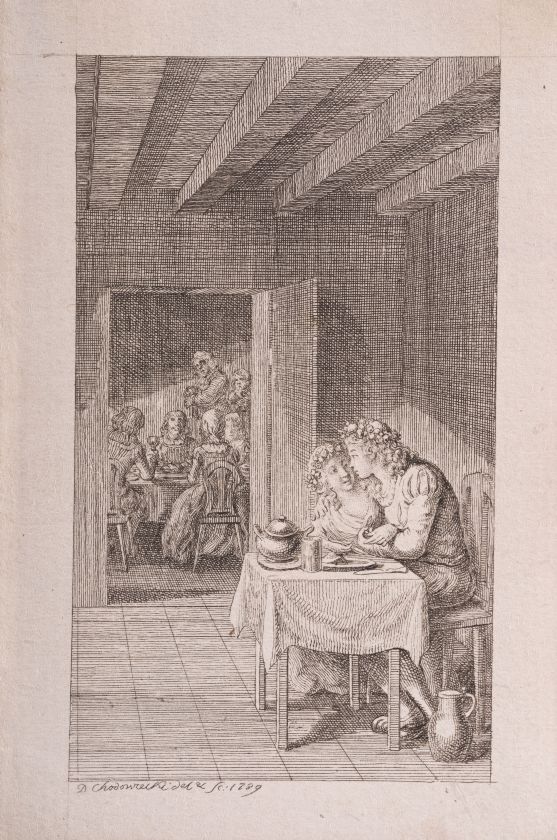
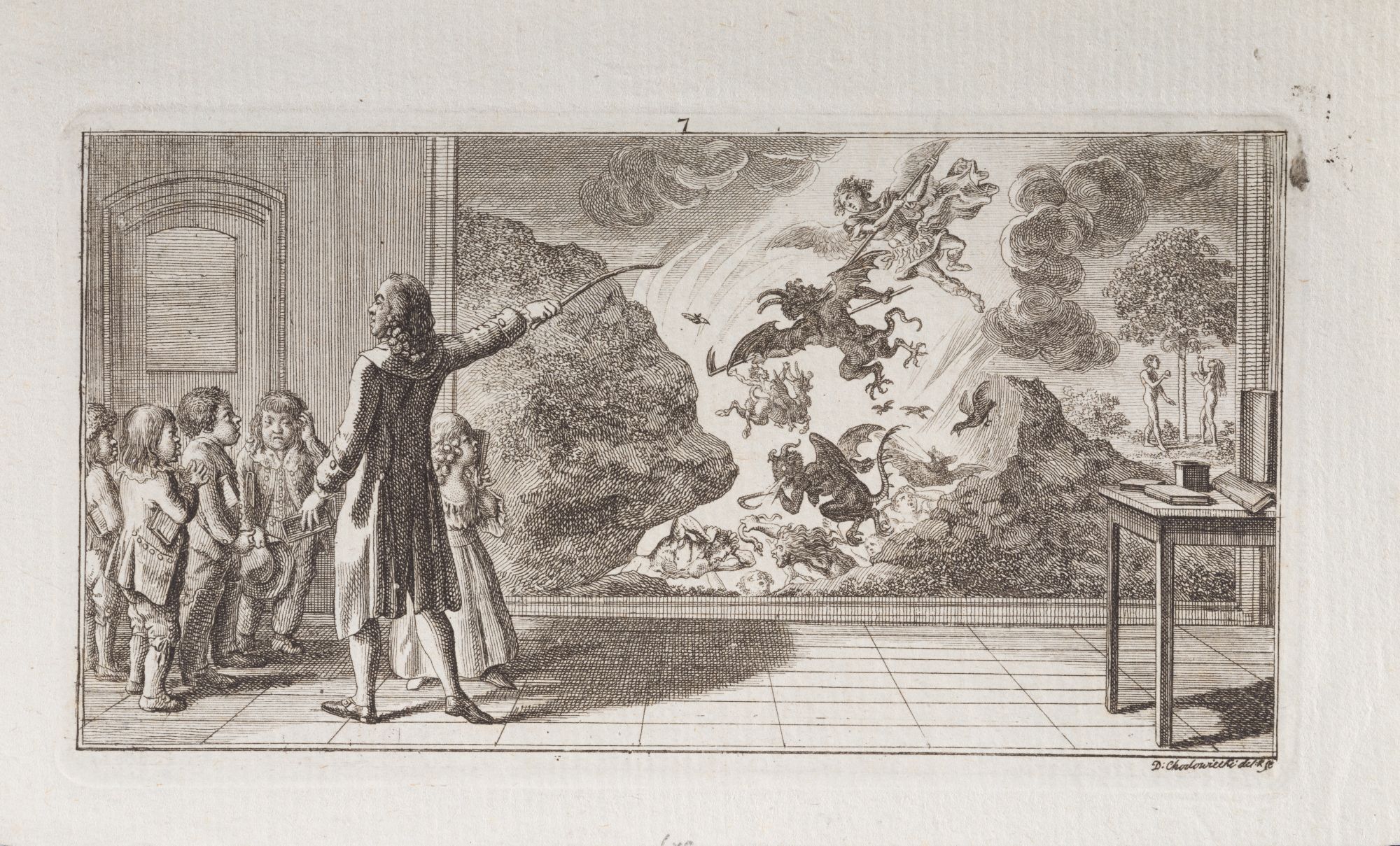
In the Schoolmaster's Room. An Illustration for F. H. Ziegenhagen's Philosophical Work
Daniel Chodowiecki
Basic information
- ID
- Г-IV-2841
- Author
- Daniel Chodowiecki
- Name
- In the Schoolmaster's Room. An Illustration for F. H. Ziegenhagen's Philosophical Work
- Previous attributions
- By the Picture
- Country
- Germany
- Technique
- etching
- Material
- paper
- Dimensions
- 7.4 x 13.7 cm (height x width)
Additionally
- Type
- graphic art
- Genre
- genre art
- Provenance
- Purchased from O. Bushel, 1977
Information about author
Object description
This work is the seventh of eight illustrations for the book by the German philosopher and philanthropist Franz Heinrich Ziegenhagen "Doctrine on the Right Relationship to the Creations of Nature and the Universal Happiness of Mankind, Which Can Be Achieved Solely Through Their Public Implementation" ("Lehre vom richtigen Verhältnisse zu den Schöpfungswerken, und die durch öffentliche Einführung derselben allein zu bewürkende algemeine Menschenbeglükkung"), published in Hamburg in 1792.
In the foreground on the left, a schoolmaster is depicted pointing his pupils – small, frightened children – to a picture that occupies the central and right-hand parts of the entire engraving. It reproduces the scene "The Fall of the Rebel Angels", in which the Archangel Michael expels the fallen angels from heaven with a spear. Although, according to tradition, the rebels transform into demons only upon reaching the earth, in the picture they become horrific devils while still in mid-flight. Below, several figures depicted near a huge stone – part of a split rock face – watch this process with horror. On the right, in the background, Adam and Eve are shown by the tree of knowledge of good and evil.
The artist approaches this scene with irony. The children are not so much frightened as they are awed by the scale of the image on the wall. In the bottom right corner of the composition, a cylindrical object stands on a small table. This is an optical device called the Laterna Magica (Magic Lantern). Therefore, the projection on the wall is an optical illusion by which the schoolmaster attempts to manipulate the children.
Inscriptions
At the bottom right is the artist's signature: "D. Chodowiecki del.& sc". In the centre, above the frame of the image, the number "7" is engraved.
Legal regulation
Borys Voznytskyi Lviv National Art Gallery