Illustrated Plate No. 1 for Erasmus of Rotterdam's Treatise "Praise of Folly"
Daniel Chodowiecki
Basic information
- ID
- Г-IV-2842
- Author
- Daniel Chodowiecki
- Name
- Illustrated Plate No. 1 for Erasmus of Rotterdam's Treatise "Praise of Folly"
- Country
- Poland
- Technique
- etching
- Material
- paper
- Dimensions
- 16 x 9.8 cm (height x width)
Additionally
- Type
- graphic art
- Genre
- allegory
- Provenance
- Purchased from O. Bushel, 1977
Information about author
Object description
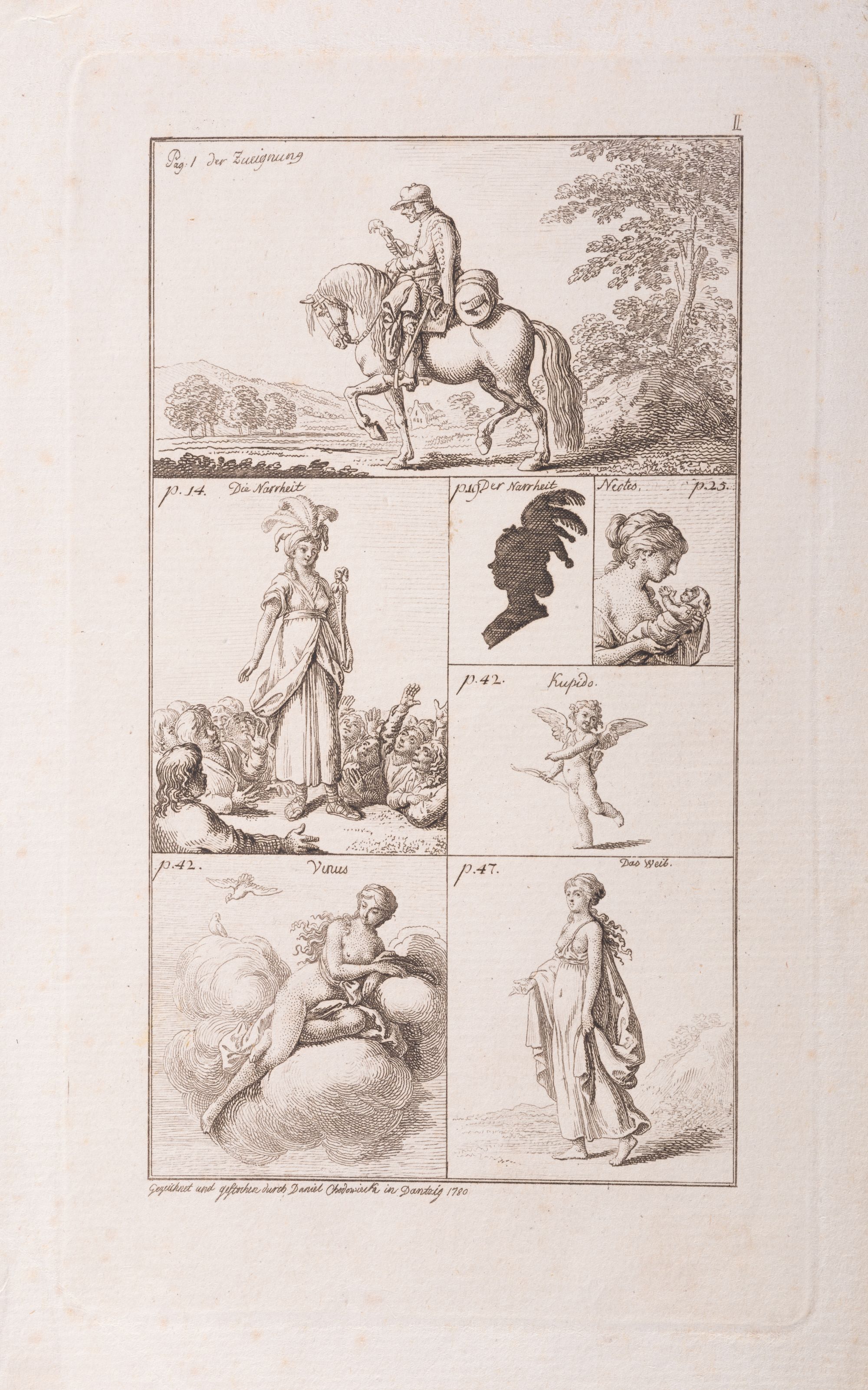
This work is the first illustrated plate (Tafel I) for the satirical treatise by Erasmus of Rotterdam "Praise of Folly" of 1509. In the original Ancient Greek – "Μωρίας ἐγκώμιον"; in Latin – "Moriae encomium"; in the later German version – "Lob der Narrheit".
It includes seven registers with allegorical images. The upper horizontal register depicts a traveller on horseback holding a staff with a small figure of a jester in his hand. At the top left is the inscription: "Pag 1 der Zueigung" – "Dedication" (Erasmus dedicated his treatise to Thomas More, in whose house he worked on this piece). Below is a vertical register, the central part of which is occupied by a full-face figure of a woman wearing a headdress decorated with feathers. In her hand, she holds a staff topped with a bust of a jester. At the bottom, a crowd of people is shown joyfully welcoming this woman – the personification of Folly. At the top left is the inscription: "p. 14. Die Narrheit" – "Folly". To the right of this register are three smaller ones, two of which are vertical. The left one features a black silhouette bust of a woman with feathers on her head. At the top left is the inscription: "p. 10. Der Narrheit" – "Folly" (noun in the genitive case). The right register contains a profile bust portrait of a woman with an infant. At the top left is the inscription: "Neotes" – "Youth", and on the right – "p. 25". In the register below these two, Cupid is depicted with a bow. At the top left is "p. 42.", and in the centre above the image – "Kupido". The bottom left register depicts a naked woman sitting on clouds, with two doves on a cloud to the left. At the top left is "p. 42.", and written in the centre above the image is "Venus". The bottom right register reproduces a full-length image of a woman in a long tunic walking to the left. At the top left is "p. 47.", and in the centre above the image – "Das Weib" ("Woman"). In Erasmus's treatise, she brings the joy of existence and saves Humanity from grim rationalism.
It includes seven registers with allegorical images. The upper horizontal register depicts a traveller on horseback holding a staff with a small figure of a jester in his hand. At the top left is the inscription: "Pag 1 der Zueigung" – "Dedication" (Erasmus dedicated his treatise to Thomas More, in whose house he worked on this piece). Below is a vertical register, the central part of which is occupied by a full-face figure of a woman wearing a headdress decorated with feathers. In her hand, she holds a staff topped with a bust of a jester. At the bottom, a crowd of people is shown joyfully welcoming this woman – the personification of Folly. At the top left is the inscription: "p. 14. Die Narrheit" – "Folly". To the right of this register are three smaller ones, two of which are vertical. The left one features a black silhouette bust of a woman with feathers on her head. At the top left is the inscription: "p. 10. Der Narrheit" – "Folly" (noun in the genitive case). The right register contains a profile bust portrait of a woman with an infant. At the top left is the inscription: "Neotes" – "Youth", and on the right – "p. 25". In the register below these two, Cupid is depicted with a bow. At the top left is "p. 42.", and in the centre above the image – "Kupido". The bottom left register depicts a naked woman sitting on clouds, with two doves on a cloud to the left. At the top left is "p. 42.", and written in the centre above the image is "Venus". The bottom right register reproduces a full-length image of a woman in a long tunic walking to the left. At the top left is "p. 47.", and in the centre above the image – "Das Weib" ("Woman"). In Erasmus's treatise, she brings the joy of existence and saves Humanity from grim rationalism.
Inscriptions
At the bottom left, below the frame, is the artist's signature: "Gezeichnet und geätzt durch Daniel Chodowiecki in Dantzig 1780". At the top right, above the frame, is the number "I".
Legal regulation
Borys Voznytskyi Lviv National Art Gallery