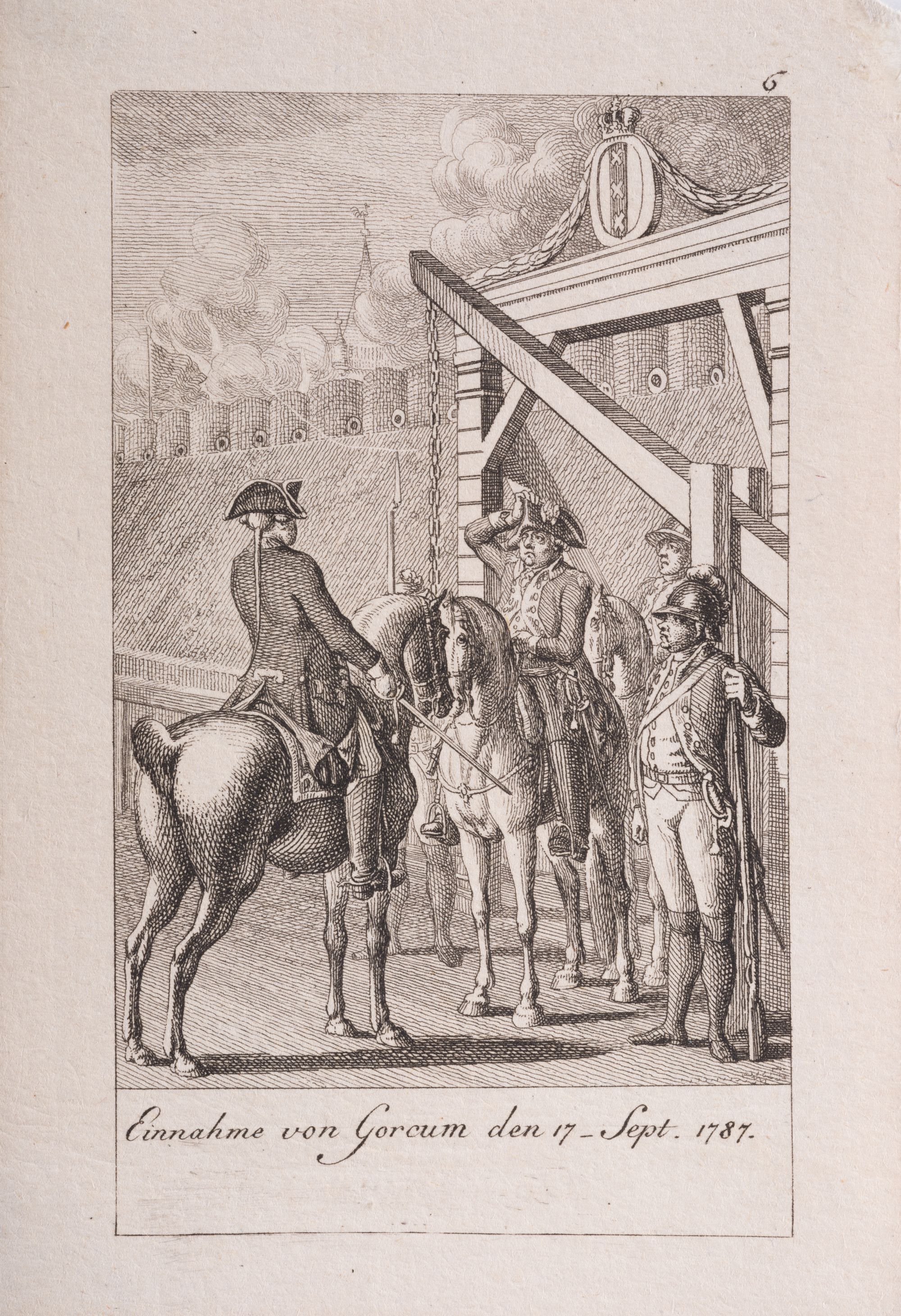
Capture of the Fortress of Gorcum on 17 September 1787. From the "History of the Dutch War" ("Geschichte des holländischen Krieges") Series
Daniel Chodowiecki
Basic information
- ID
- Г-IV-2847
- Author
- Daniel Chodowiecki
- Name
- Capture of the Fortress of Gorcum on 17 September 1787. From the "History of the Dutch War" ("Geschichte des holländischen Krieges") Series
- Country
- Germany
- Technique
- etching
- Material
- paper
- Dimensions
- 5 x 8.7 cm (height x width)
Additionally
- Type
- graphic art
- Genre
- history painting
- Provenance
- Purchased from O. Bushel, 1977
Information about author
Object description
The historical background to the event dates back to the Batavian Revolution, when Dutch patriot-democrats rose up against the rule of William of Orange, the stadtholder of the Netherlands (the United Provinces). Prussia came to the aid of the Orangists, whose troops won one victory after another over the "patriots". The decisive event was the Prussian capture of the fortress of Gorcum (Gorinchem) on 17 September 1787. The "patriots" were not prepared to defend the fortress against a first-rate army and surrendered.
The artist has depicted the surrender of the fortress. In the foreground is a gathering of cavalrymen in typical European military uniform of the second half of the 18th century (characterised by tricorne hats and uniforms). One of them is General Knobelsdorf, Commander-in-Chief of the Prussian Army. The other is the commander of the fortress's defences, who, whilst seated on his horse, has placed his hand on his hat to remove it before the victor and declare his surrender. The scene takes place on a drawbridge in front of the city gate, above which an oval shield bears a heraldic emblem in the form of a vertical stripe with three diagonal crosses – the coat of arms of Amsterdam. Beyond the city walls, plumes of smoke can be seen, between which the tower of a Protestant church, topped with a weathercock, is visible.
The "History of the Dutch War" ("Geschichte des holländischen Krieges") series of illustrations was produced for contemporary pocket almanacs, in particular the "Berliner Genealogischer Kalender" and the "Göttinger Taschenkalender" for 1789.
Inscriptions
The number "6" appears above the border on the right. Below the image is the caption: "Einnahme von Gorcum den 17. Sept. 1787.".
Legal regulation
Borys Voznytskyi Lviv National Art Gallery