New Gate and Slawkowska Gate in Krakow (K. W. Kielisinski's Album)
Kajetan Kielisinski
Basic information
- ID
- Г-IV-1059_4_5
- Author
- Kajetan Kielisinski
- Name
- New Gate and Slawkowska Gate in Krakow (K. W. Kielisinski's Album)
- Technique
- etching
- Material
- paper
- Dimensions
- 27.5 x 35.3 cm (height x width)
Additionally
Information about author
Object description
Kajetan Kielisiński created numerous etchings and drawings dedicated to folklore, the life of Polish villages and towns, historical monuments, and landscapes. In 1853, the Poznań publisher Jan Konstanty Żupański issued "Kielisiński's Album", gathering the artist's scattered works, most of which had remained unpublished during his lifetime. Two years later, in 1855, Żupański released a supplementary volume to complement the previous edition, which included etchings depicting coins and seals, figures in historical costumes, alongside rural and urban landscapes.
The presented etching belongs to the graphic sheets published within this 1855 supplement.
Г-IV-1059_4
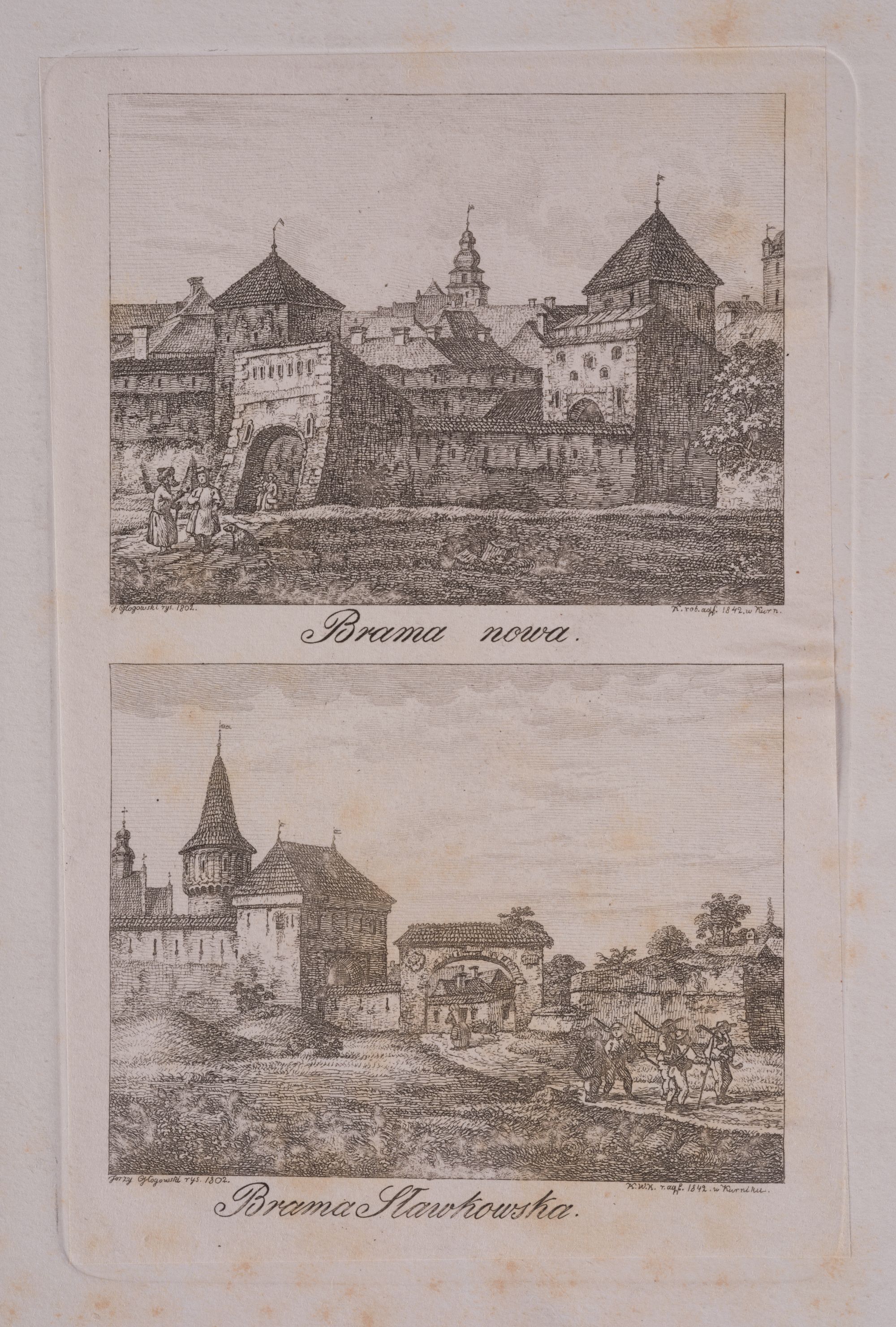
The etching located at the top of the sheet reproduces a panoramic view of the city's defensive fortifications, featuring a massive entrance gate, two stone towers, and a wall. In the background, behind the defensive walls, the roofs of town residential houses are visible. In the centre, in the distance against the clear sky, rises the slender, multi-tiered Town Hall Tower. The foreground of the composition is occupied by a wide square overgrown with grass. The space is enlivened by staffage figures of peasants and townsfolk engaged in their everyday activities. In the middle of the lower white margin, the name of the object is inscribed in a calligraphic script in Polish: "Brama nowa".
The New Gate in Krakow – a 14th-century defensive structure that was part of the complex of Krakow's eight main city fortifications. It received the name "New" as the latest built among Krakow's gates. Beside it rose the Bakers' Tower. The defense of the site was initially provided by the butchers' guild, and from the 16th century, this function passed to the bakers' guild. The gate was demolished in 1812 along with the adjacent fortifications.
Г-IV-1059_5
The etching located at the bottom of the sheet reproduces a view of one of Krakow's defensive fortifications – the Slawkowska Gate (Brama Sławkowska). On the left, against the clear sky, rises a round tower under a conical tented roof with a weather vane. Beside it, the building of a church is visible. In the centre of the composition is the entrance gate itself, shaped as an arch under a tiled roof, adorned with heraldic cartouches on the facade. In the right foreground, a staffage group of peasants is depicted, holding walking sticks and carrying bags on their backs, walking along a dirt road away from the city. In the middle of the white margin below the image, the name of the historical object is inscribed in an elegant calligraphic script in Polish: "Brama Sławkowska".
The Slawkowska Gate (Tailors' Gate) – one of the first defensive structures in Krakow, built at the turn of the 13th and 14th centuries. At the beginning of the 19th century, the gate, along with its adjacent towers, was demolished.
Inscriptions
Г-IV-1059_4
Beneath the image, the artist's inscriptions read: on the left – "J. Głogowski rys. 1802." [Drawn by Jerzy Głogowski. 1802]; and on the right – "K. rob. aqf. 1842. w Kurn." [Executed in etching by K. 1842 in Kórnik].
Г-IV-1059_5
Beneath the image, the artist's inscriptions read: on the left – "Jerzy Głogowski rys. 1802." [Drawn by Jerzy Głogowski. 1802]; and on the right – "K.W.K. r. aqf. 1842. w Kurniku" [Executed in etching by K.W.K. 1842 in Kórnik].
Legal regulation
Borys Voznytskyi Lviv National Art Gallery