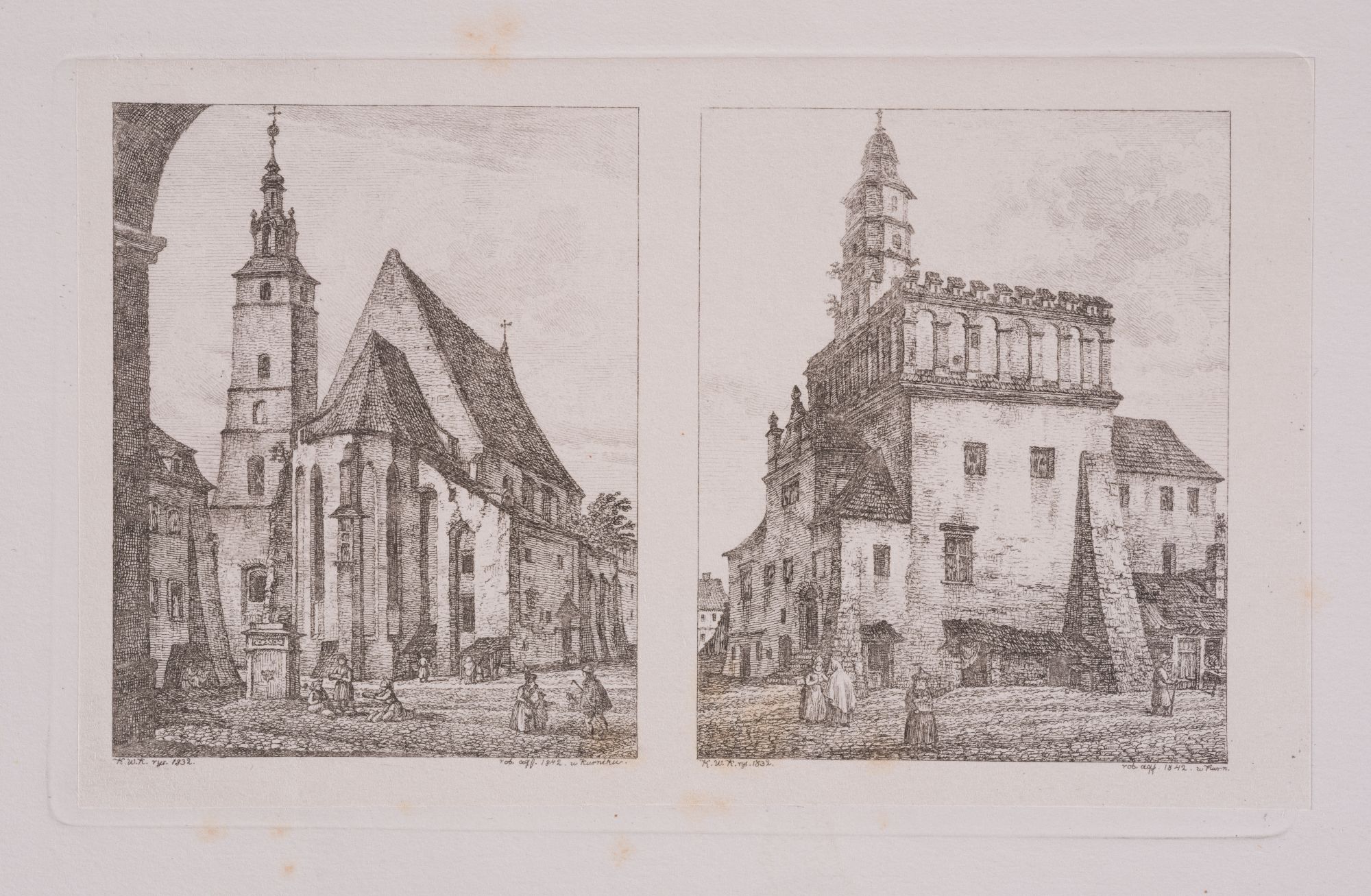
Corpus Christi Church and Town Hall in Kazimierz (K. W. Kielisinski's Album)
Kajetan Kielisinski
Basic information
- ID
- Г-IV-1059_6_7
- Author
- Kajetan Kielisinski
- Name
- Corpus Christi Church and Town Hall in Kazimierz (K. W. Kielisinski's Album)
- Technique
- etching
- Material
- paper
- Dimensions
- 27.5 x 35.3 cm (height x width)
Additionally
Information about author
Object description
Kajetan Kielisiński created numerous etchings and drawings dedicated to folklore, the life of Polish villages and towns, historical monuments, and landscapes. In 1853, the Poznań publisher Jan Konstanty Żupański issued "Kielisiński's Album", gathering the artist's scattered works, most of which had remained unpublished during his lifetime. Two years later, in 1855, Żupański released a supplementary volume to complement the previous edition, which included etchings depicting coins and seals, figures in historical costumes, alongside rural and urban landscapes.
The presented etching belongs to the graphic sheets published within this 1855 supplement.
Г-IV-1059_6
On the graphic sheet on the left, a view of a city square from the early 19th century is reproduced. In the centre of the composition rises a Gothic church with a high, steep roof and massive buttresses. To the left of the nave, a multi-tiered bell tower rises, topped with a Baroque lantern and a cross. On the left side of the sheet, the composition is framed by a high stone archway, creating the effect of looking at the square from an internal passageway. Behind the arch, part of a three-storey residential house with dormer windows and high buttresses is visible. Staffage figures of townsfolk in contemporary urban attire move across the square. The print depicts the 15th-century Roman Catholic parish Corpus Christi Church (Kościół Bożego Ciała), located in Kazimierz, Krakow.
Г-IV-1059_7
On the graphic sheet on the right, a view of the Renaissance city town hall with a high decorative attic and massive buttresses, situated on the market square, is reproduced. Against the sky behind the building rises a slender, multi-tiered tower topped with a spire. The entrance gate is located on the left side of the facade. Low outbuildings nestle against the walls of the town hall. On the wide cobbled square, several staffage figures of townsfolk are depicted, engaged in their everyday activities. The print depicts the Kazimierz Town Hall (Polish: Ratusz Kazimierski) – a historical and architectural monument of Krakow, built in the 14th century. Currently, the Ethnographic Museum is housed in the building.
Both works are distinguished by the precision of architectural detail reproduction, as well as the masterful chiaroscuro rendering of the stone walls and the texture of the cobblestones.
Inscriptions
Г-IV-1059_6
Beneath the image, the artist's inscriptions read: on the left – "K.W.K. rys. 1832." [Drawn by K.W.K. 1832]; and on the right – "rob. aqf. 1842. w Kurniku" [Executed in etching. 1842 in Kórnik].
Г-IV-1059_7
Beneath the image, the artist's inscriptions read: on the left – "K.W.K. rys. 1832." [Drawn by K.W.K. 1832]; and on the right – "rob. aqf. 1842. w Kurn." [Executed in etching. 1842 in Kórnik].
Legal regulation
Borys Voznytskyi Lviv National Art Gallery