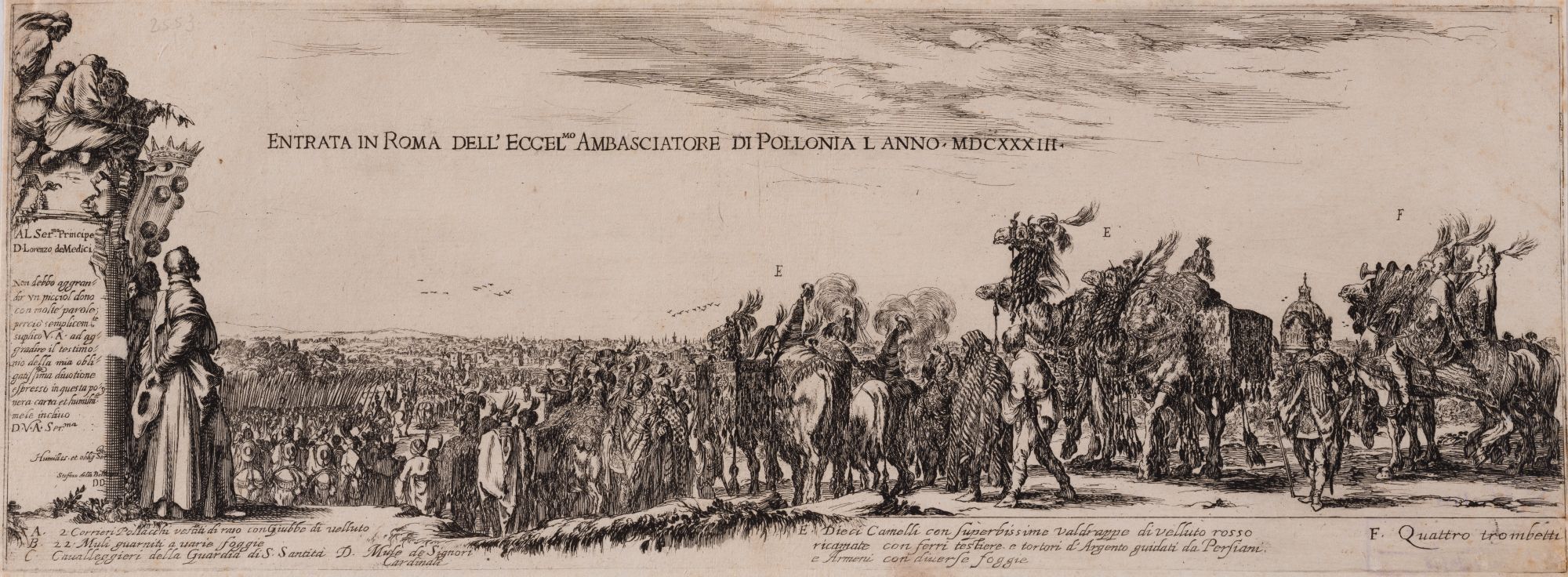
Solemn Entry of Polish Ambassador into Rome in 1633. Title Page (Plate I)
Stefano della Bella
Basic information
- ID
- Г-IV-851
- Author
- Stefano della Bella
- Name
- Solemn Entry of Polish Ambassador into Rome in 1633. Title Page (Plate I)
- Country
- Italy
- Technique
- etching
- Material
- paper on cardboard
- Dimensions
- 15.8 x 43 cm (height x width)
Additionally
- Type
- graphic art
- Genre
- history painting
- Provenance
- Received from the Lviv Historical Museum, 1954
Information about author
Object description
The title page of a frieze-panorama consisting of six engravings. The work is dedicated to the magnificent diplomatic procession of Jerzy Ossoliński, Grand Chancellor of the Crown of the Polish-Lithuanian Commonwealth, to Pope Urban VIII in 1633. The engraving features a multi-figure composition: a long procession of mounted and foot travellers moves from the right side of the sheet into the background along the centre. A panorama of the city opens up in the distance.
Against the sky above the panorama, the title of the work is inscribed in capital letters: "ENTRATA IN ROMA DELL'ECCELmo AMBASCIATORE DI POLLONIA L ANNO MDCXXXIII" [Entry into Rome of His Excellency the Ambassador of Poland in 1633]. In the foreground on the left, near a stone stele ledge decorated at the top with a crowned coat of arms, the figure of a man is depicted in profile. He wears a long cloak, with a hat hanging behind his back. This is presumably Prince Lorenzo de' Medici. This is further supported by the Medici coat of arms with six balls and the inscription on the tablet attached to the stele ledge.
The upper part of the tablet reads: "AL Ser.mo Principe / D·Lorenzo deMedici" [To the Most Serene Prince Don Lorenzo de' Medici]. In the text, the artist addresses the prince with the words: "Non debbo aggrandir vn picciol dono con molte parole; perciò semplicem.te suplico V. A. ad aggradire il testimonio della mia obligatiss.ima diuotione espresso in questa pouera carta et humilm.te mele inchino D. V. A. S. Ser.ma" [I must not enlarge a small gift with many words; therefore I simply implore Your Highness to accept the testimony of my most bounden devotion expressed on this poor paper, and I humbly bow to Your Most Serene Highness].
Below on the tablet, the artist inscribed his name: "Humiliss. et oblig.mo Ser.re / Stefano della Bella / DD" (Humilissimo et obligatissimo Servitore / Stefano della Bella / Dono Dedicavit) [Most humble and most bounden servant / Stefano della Bella / Dedicated and presented as a gift]. Above, on the stone ledge, several figures are depicted watching the procession. A woman stands behind the prince, possibly his wife.
Below the stele ledge and the figure of the ruler are inscriptions in Old Italian: "A. 2 Corrieri Pollachi vestiti di raso con Giubbe di velluto" [Two Polish couriers dressed in satin with velvet robes]; "B. 22 Muli guarniti a varie foggie" [22 mules adorned in various manners]; "C. Cavalleggieri della Guardia di S. Santità" [Light cavalry of His Holiness's Guard]; "D. Mule de Signori Cardinali" [Mules of the Eminent Cardinals]. These inscriptions refer to the images in the middle ground and background.
On the right in the foreground of the engraving, under the letter "E", camels and figures in Eastern attire are depicted. Below them is the inscription: "E Dieci Camelli con superbissime valdrappe di velluto rosso ricamate con ferri testiere e tortori d'Argento guidati da Persiani. e Armeni con diverse foggie" [And ten camels with magnificent embroidered caparisons of red velvet, with iron headpieces and silver neck collars, led by Persians and Armenians in diverse attire].
On the right, four mounted trumpeters close the composition (letter "F"). Below the image is the inscription: "Quattro trombetti" [four trumpeters]. Between them and the Eastern group stands a nobleman in a feathered hat, leaning on his sword. In the middle ground behind him, the dome of a church is depicted – likely St Peter's Basilica in Rome.
Inscriptions
Engraved with the artist's signature on a tablet attached to a stone stele ledge on the left: "Humiliss. et oblig.mo Ser.re/ Stefano della Bella/ DD". On the cardboard mount lower left, inventory number: "№ Г-IV-851/ ЛДКГ".
Legal regulation
Borys Voznytskyi Lviv National Art Gallery