Solemn Entry of Polish Ambassador into Rome in 1633. Final Page (Plate VI)
Stefano della Bella
Basic information
- ID
- Г-IV-855
- Author
- Stefano della Bella
- Name
- Solemn Entry of Polish Ambassador into Rome in 1633. Final Page (Plate VI)
- Country
- Italy
- Technique
- etching
- Material
- paper on cardboard
- Dimensions
- 15.8 x 43 cm (height x width)
Additionally
- Type
- graphic art
- Genre
- history painting
- Provenance
- Received from the Lviv Historical Museum, 1954
Information about author
Object description
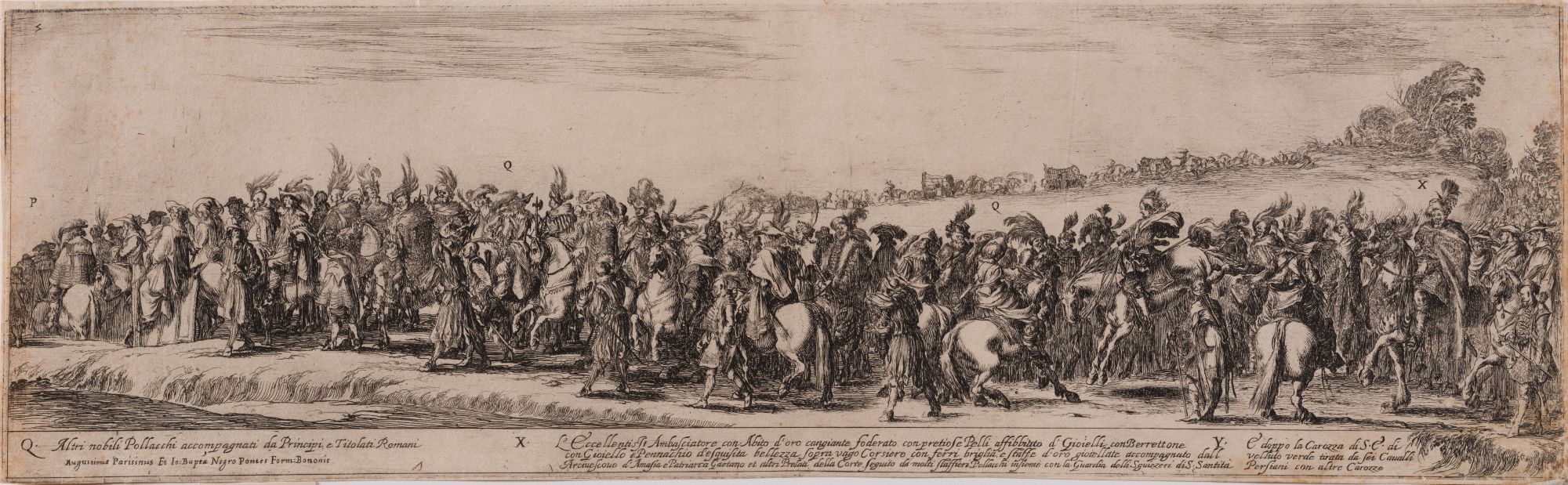
This is the final plate of a frieze-panorama consisting of six engravings, marked with the letters "P–Y". It continues the composition of the previous plates. The work is dedicated to the magnificent diplomatic procession of Jerzy Ossoliński, Grand Chancellor of the Crown of the Polish-Lithuanian Commonwealth, to Pope Urban VIII in 1633.
The figures are mentioned in the legend of the previous fifth engraving (under the letter "P"): "P. Seguino altri Cavalieri franzesi e Camerieri di S. Santità" [Following are other French horsemen and chamberlains of His Holiness]. The main space of the composition is occupied by mounted and foot attendants, all in magnificent attire. They are noted in the legend under the letter "Q": "Q. Altri nobili Pollacchi accompagnati da Principi, e Titolati Romani" [Other Polish nobles accompanied by Roman princes and lords].
To the right of this group, under the letter "X", is a rider on a horse – Jerzy Ossoliński. Next to him on the right are several foot and mounted figures. Below is the inscription: "L'Eccellentiss: Ambasciatore con Abito d'oro cangiante foderato con pretiose Pelli affibbiato d'Gioielli con Berrettone | con Gioiello d Pennachio d'esquisita bellezza sopra vago Corsiero con ferri briglia, e staffe d'oro gioiellate accompagnato dall | Arciuescouo d'Amasia e Patriarca Gaetano et altri Prelati della Corte, seguito da molti stassieri Pollacchi insiemé con la Guardia delli Sguizzeri di S. Santita" [His Excellency: The Ambassador, dressed in a golden shot-silk robe (with a shifting tint of colour) lined with precious fur, in a large headdress with a jewel and a plume of exquisite beauty, seated on a beautiful steed with gold horseshoes, a bridle, and stirrups decorated with jewels, accompanied by the Archbishop of Amasia, Patriarch Gaetano, and other prelates of the court, followed by numerous Polish footmen (stassieri) together with the Swiss Guard of His Holiness].
The letter "Y" is not marked on the engraving itself. The inscription under it appears only in the legend: "Y. E doppo la Carozza di S.E. di | velluto verde tirata da sei Caualli | Persiani con altre Carozze" [And after the carriage of His Excellency of green velvet drawn by six Persian horses come other carriages]. In the background, a processional train consisting of covered wagons and horsemen is depicted, bringing the ceremonial procession to a close. In the lower left, below the inscription for the letter "P", is the text about the publisher: "Augustinus Parisinus Et Io:Bapta Negro Pontes Formi:Bononie" [Printed in Bologna by Agostino Parisini and Giovanni Battista Negroponte]. The inscription on the label below the engraving, which attests to the original presence of the print and presumably the entire cycle in the collection of the King of Portugal, confirms the high provenance of this series.
Inscriptions
Below the engraving on the cardboard mount right, a paper label inscribed in italics: "Collection du Roi de Portugal" [Collection of the King of Portugal]. On the left, a label inscribed: "25", followed by an illegible inscription. On the cardboard mount lower left, inventory number: "№ Г-IV-855/ ЛДКГ".
Legal regulation
Borys Voznytskyi Lviv National Art Gallery