Clovis and Clotilde
Stefano della Bella
Basic information
- ID
- Г-IV-862
- Author
- Stefano della Bella
- Name
- Clovis and Clotilde
- Date of creation
- c. 1657
- Country
- Italy
- Technique
- etching engraving
- Material
- paper on cardboard
- Dimensions
- 30.3 x 21.5 cm (height x width)
Additionally
- Type
- graphic art
- Genre
- history painting mythological painting
- Provenance
- Received from the Lviv Historical Museum, 1954
Information about author
Object description
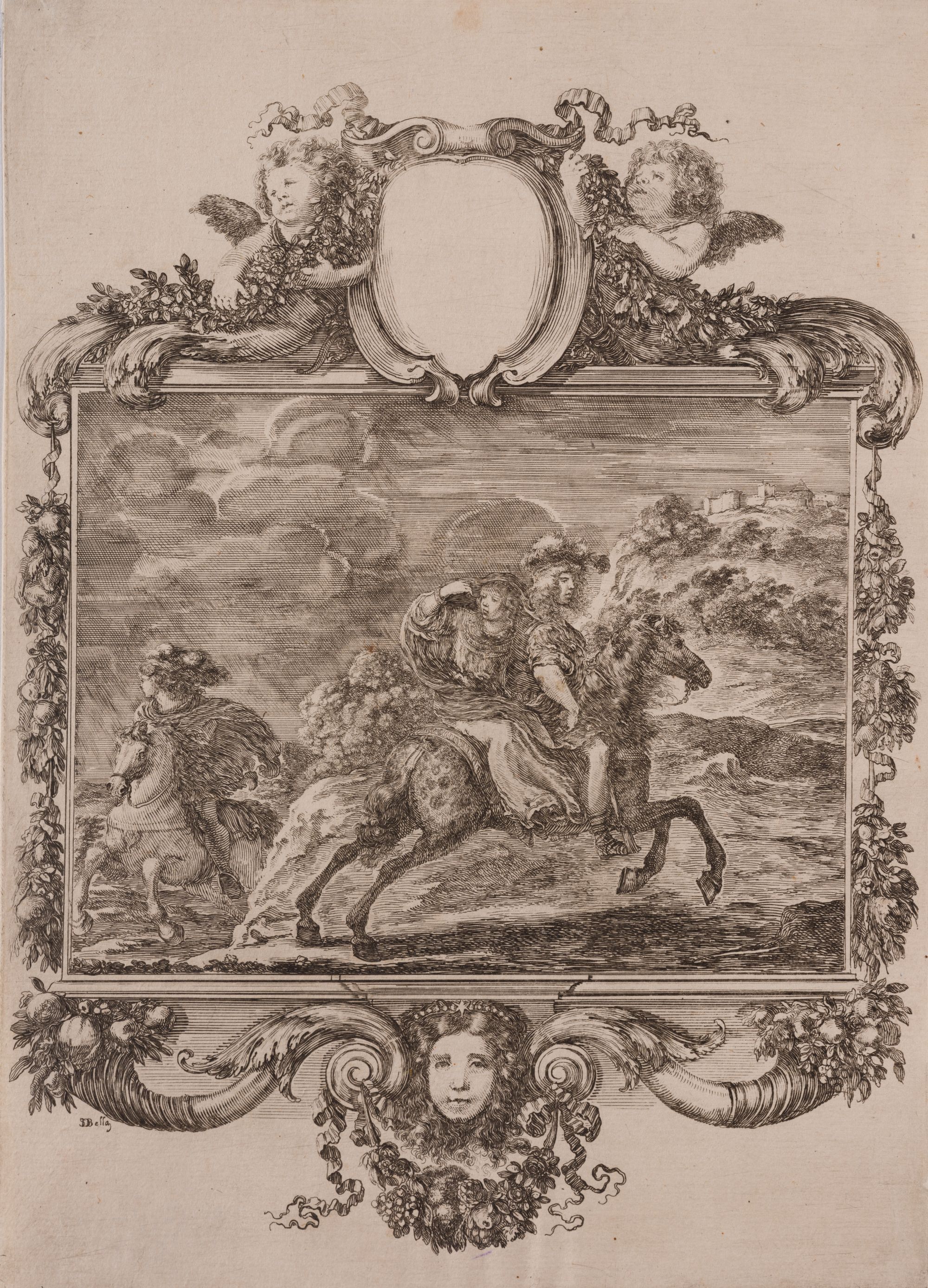
A rectangular frame features a historical and mythological scene at the centre. It is dedicated to the Frankish King Clovis I and his wife Clotilde – a Burgundian princess. Clovis carried her off to his kingdom despite her father's resistance. Later, it was owing to Clotilde that the King of the Franks converted to Christianity. Depicted in the engraving, Clovis and Clotilde gallop swiftly on horseback under a cloudy sky. They move to the right across a hilly terrain. Clotilde sits on her horse in the traditional female posture – sideways.
Slightly behind them, on the left side, they are accompanied by another rider. The composition is set within an elaborate Baroque cartouche. In its upper part, an oval shield is positioned, supported by two putti. Flanking the sides are lush garlands of flowers and fruit. Below, at the centre of the decorative intertwining of the frame, a mascaron is depicted in the form of a detailed, finely rendered face of a young woman. It is adorned from below with a heavy botanical garland. On both sides of the woman's head are two Baroque cornucopias filled with fruit and flowers. Stefano della Bella was a prominent master of ornament, and such motifs are frequently found throughout his series of cartouches, friezes, and grotesques.
Slightly behind them, on the left side, they are accompanied by another rider. The composition is set within an elaborate Baroque cartouche. In its upper part, an oval shield is positioned, supported by two putti. Flanking the sides are lush garlands of flowers and fruit. Below, at the centre of the decorative intertwining of the frame, a mascaron is depicted in the form of a detailed, finely rendered face of a young woman. It is adorned from below with a heavy botanical garland. On both sides of the woman's head are two Baroque cornucopias filled with fruit and flowers. Stefano della Bella was a prominent master of ornament, and such motifs are frequently found throughout his series of cartouches, friezes, and grotesques.
Inscriptions
The author's initials are at the bottom left of the print, near the cornucopia: "SDB (D encompasses the letters on both sides) ella". On the backing cardboard, underneath the sheet on the left, there is a label with a seal of Lviv Historical Museum and a numbered stamp; above it – Lviv National Art Gallery inventory number in pencil: "№ Г-IV-862/ ЛДКГ".
Portrayed person
- The name of the person portrayed
- Clovis I – Founder of the Kingdom of the Franks.
Legal regulation
Borys Voznytskyi Lviv National Art Gallery