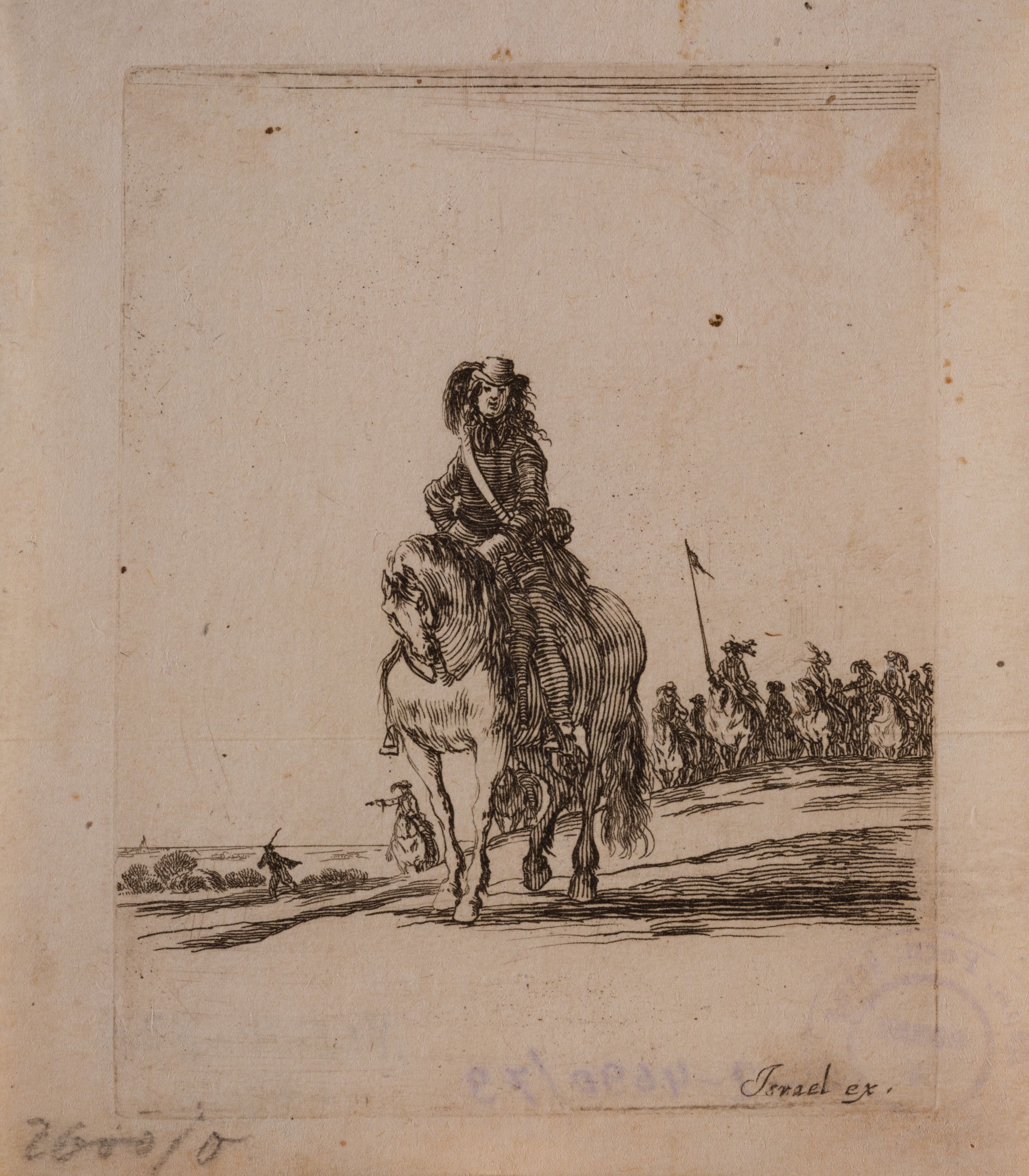
Horseman Seen from the Front. From the "Various Cavalry Exercises" Suite
Stefano della Bella
Basic information
- ID
- Г-IV-876
- Author
- Stefano della Bella
- Name
- Horseman Seen from the Front. From the "Various Cavalry Exercises" Suite
- Country
- France
- Technique
- etching
- Material
- paper on cardboard
- Dimensions
- 8.7 x 6.7 cm (height x width)
Additionally
- Type
- graphic art
- Genre
- battle painting
- Provenance
- Received from the Lviv Historical Museum, 1954
Information about author
Object description
In the foreground, in the centre, a cavalryman in characteristic 17th-century European military attire, with a hat on his head, is depicted in detail. The figure of the rider on the horse is shown in a frontal view. In the background on the right, a group of other horsemen receding into the distance is indicated with hatching. One of them holds a military banner.
The work demonstrates della Bella's fine mastery in rendering chiaroscuro, the texture of clothing, and the anatomy of the horse through delicate hatching.
The print was published in Paris by the artist's close friend and regular publisher, Israël Henriet. This is evidenced by a characteristic engraved inscription in the bottom right corner of the impression below the image: "Israеl ex.", which is an abbreviation for "Israel excudit" – [Israel published it].
Similar prints are held in the collection of the Metropolitan Museum of Art (New York) and other major graphic collections.
Inscriptions
Engraved bottom right below the image is the name of the suite's publisher: "Israеl ex". Inscribed in pencil on the left of the sheet is "2600/ 0". Inscribed in pencil on the mounting board on the left is the gallery's inventory number: "№ Г-IV-876/ ЛДКГ". On the right is an impression of a seal and an inscription on a label from the reverse side of the sheet.
Legal regulation
Borys Voznytskyi Lviv National Art Gallery