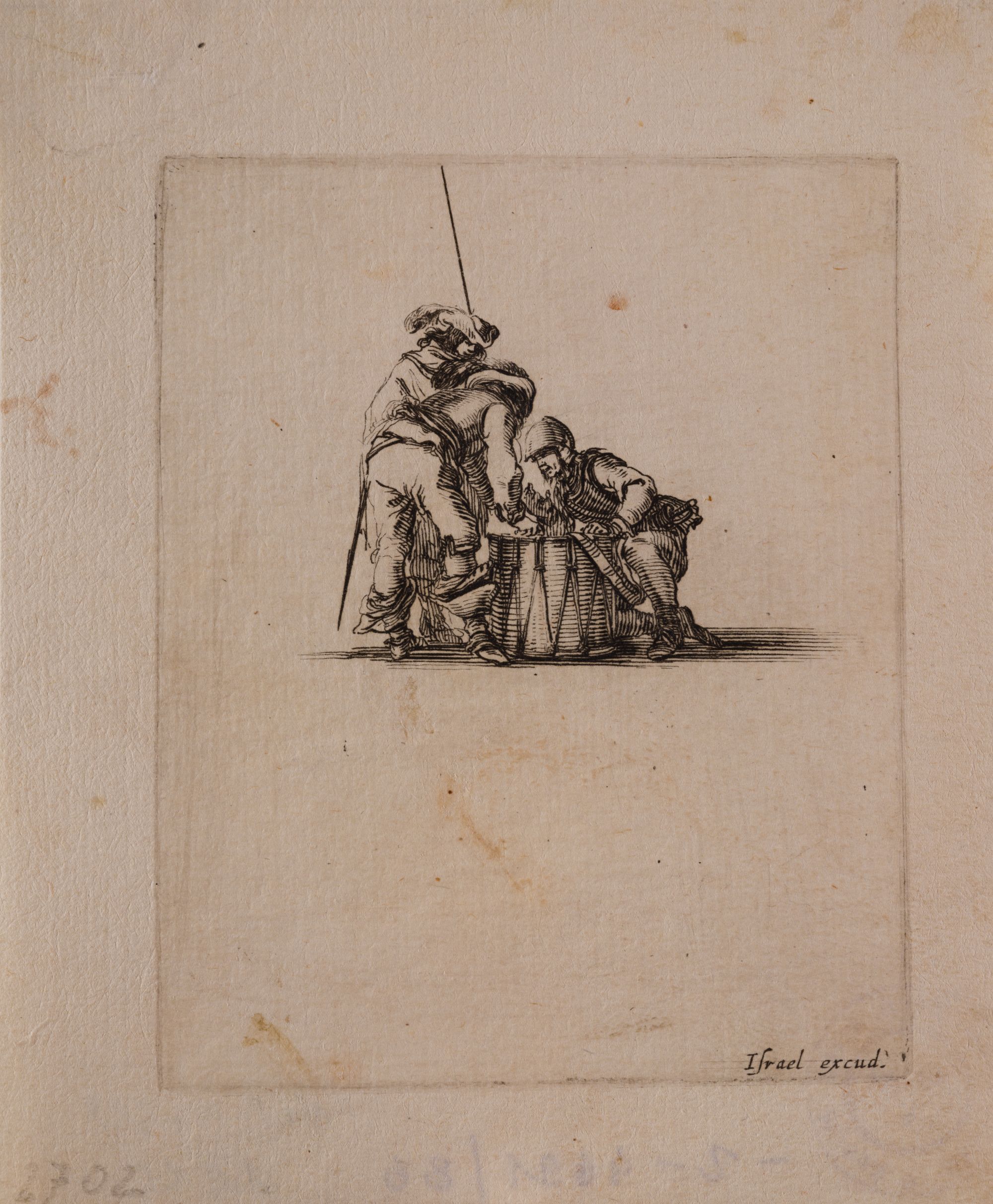
Three Soldiers Playing Dice on a Drum. From the "Collection of Various Pieces Very Necessary for Fortification" Suite
Stefano della Bella
Basic information
- ID
- Г-IV-888
- Author
- Stefano della Bella
- Name
- Three Soldiers Playing Dice on a Drum. From the "Collection of Various Pieces Very Necessary for Fortification" Suite
- Country
- France
- Technique
- etching
- Material
- paper on cardboard
- Dimensions
- 8.2 x 6.8 cm (height x width)
Additionally
- Type
- graphic art
- Genre
- genre art
- Provenance
- Received from the Lviv Historical Museum, 1954
Information about author
Object description
The work is part of a military and educational suite titled "Recueil de Diverses Pièces Très Nécessaires à la Fortification" ("Collection of Various Pieces Very Necessary for Fortification"), published in 1638–1643. This Parisian period of della Bella's oeuvre is the most productive in his career.
The print depicts in detail three military men – two musketeers and a drummer, who are entertaining themselves during a rest by playing dice on a drum. They are dressed in military costumes and armour of the Thirty Years' War era.
The author masterfully uses fine hatching to render the volume of the figures, the folds of historical clothing, and soft shadows, which lend realism and dynamics to the scene.
The print was published in Paris by the artist's close friend and regular publisher, Israël Henriet. This is evidenced by a characteristic engraved inscription in the bottom right corner of the impression below the image: "Israеl excud.", which is an abbreviation for "Israel excudit" – [Israel published it]. During his Parisian period, della Bella himself did not sign his works with his Italian monogram. This was probably because in France his name was known in its local version as Étienne de la Belle.
Similar prints are held in the collection of the Metropolitan Museum of Art (New York) and other major graphic collections.
Inscriptions
Engraved bottom right below the image is the name of the suite's publisher: "Israеl excud.". Inscribed in pencil in the bottom left corner of the sheet is "2702". On the backing cardboard below the print on the left, there is the gallery's inventory number in pencil: "№ Г-IV-888/ ЛДКГ".
Legal regulation
Borys Voznytskyi Lviv National Art Gallery