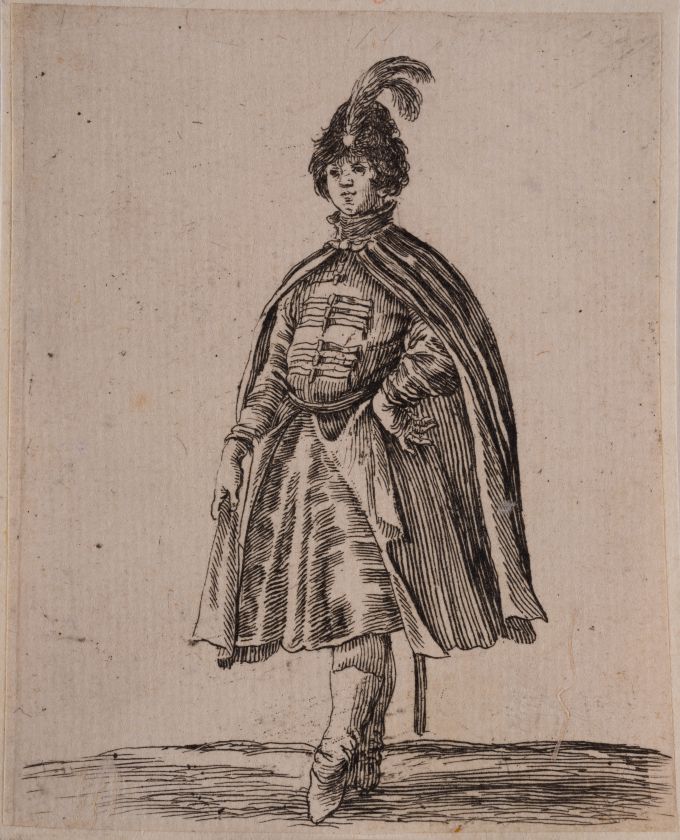
Women and Children. From the "Pleasing Variety of Figures / Collection of Various Caprices" Suite
Stefano della Bella
Basic information
- ID
- Г-IV-889
- Author
- Stefano della Bella
- Name
- Women and Children. From the "Pleasing Variety of Figures / Collection of Various Caprices" Suite
- Country
- France
- Technique
- etching
- Material
- paper on cardboard
- Dimensions
- 8.7 x 6.8 cm (height x width)
Additionally
- Type
- graphic art
- Genre
- genre art
- Provenance
- Received from the Lviv Historical Museum, 1954
Information about author
Object description
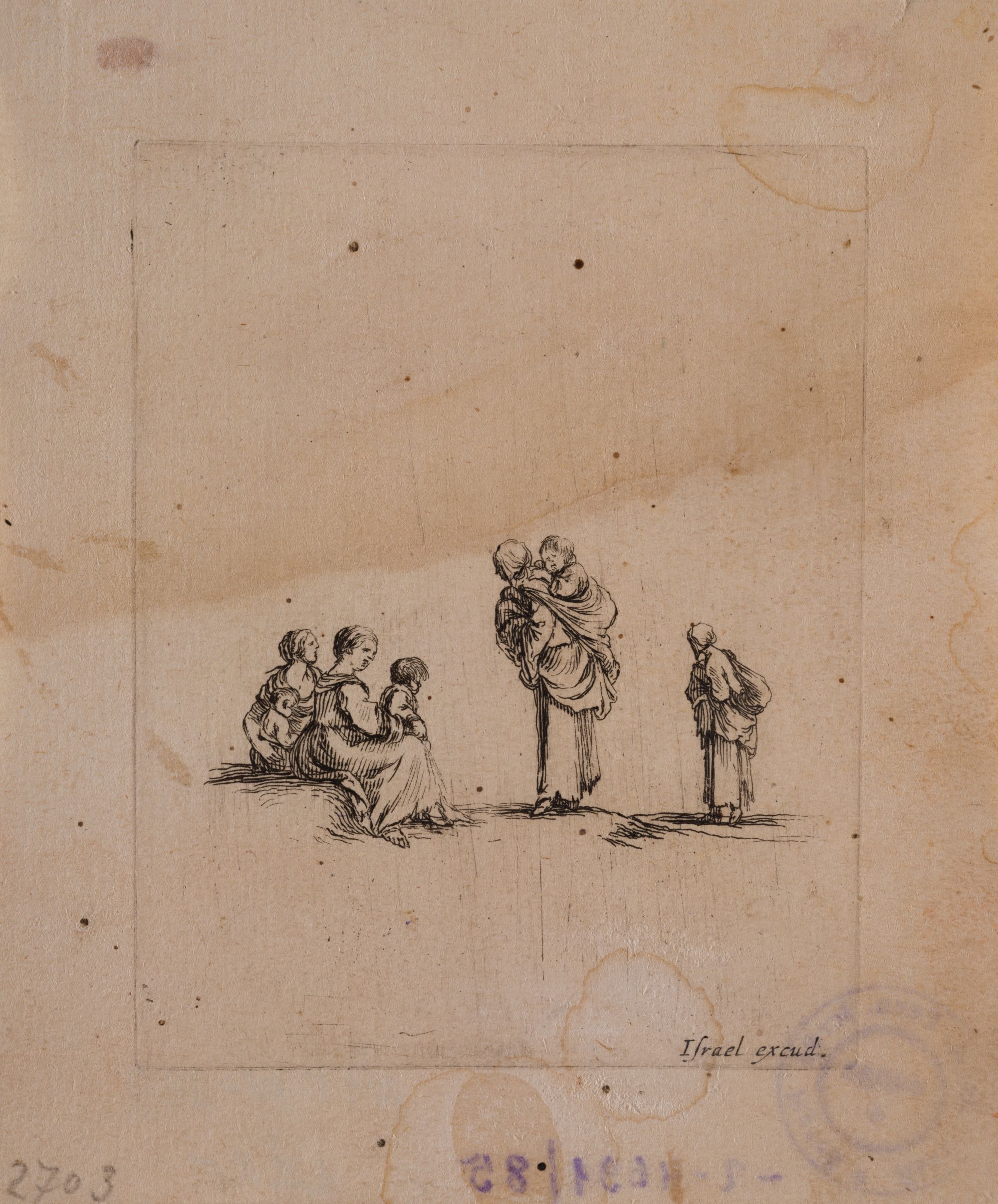
The work belongs to one of the numerous suites of small landscapes, pastoral or genre sketches from the lives of horsemen, hunters, and peasants, which the artist created during his Parisian period (1639–1650).
The multi-figure composition depicts two women sitting on the left directly on the ground, on a small rise. One of them holds an infant closely wrapped in swaddling clothes. Another child sits beside the women. In the centre, shown from behind, is a third woman carrying a swaddled child on her shoulders. Further to the right is a solitary figure, leaning slightly forward with a hunched posture, wrapped in a loose robe or a tattered cloak.
This work is distinguished by the lightness and "airiness" of the stroke. Della Bella used the finest needles and multiple bitings. This allowed him to render the most delicate nuances of light and air, the texture of fabrics, and the softness of children's skin. His manner of engraving anticipated the grace and refinement of the 18th-century Rococo style.
The print was published in Paris by the artist's close friend and regular publisher, Israël Henriet. This is evidenced by a characteristic engraved inscription in the bottom right corner of the impression below the image: "Israеl excud.", which is an abbreviation for "Israel excudit" – [Israel published it]. During his Parisian period, della Bella himself did not sign his works with his Italian monogram. This was probably because in France his name was known in its local version as Étienne de la Belle.
Similar prints are held in the collection of the Metropolitan Museum of Art (New York) and other major graphic collections.
Inscriptions
Engraved bottom right below the image is the name of the suite's publisher: "Israеl excud.". Inscribed in pencil on the left of the sheet is "2703". On the backing cardboard in the centre below the sheet, there is the gallery's inventory number in pencil: "№ Г-IV-889/ ЛДКГ".
Legal regulation
Borys Voznytskyi Lviv National Art Gallery