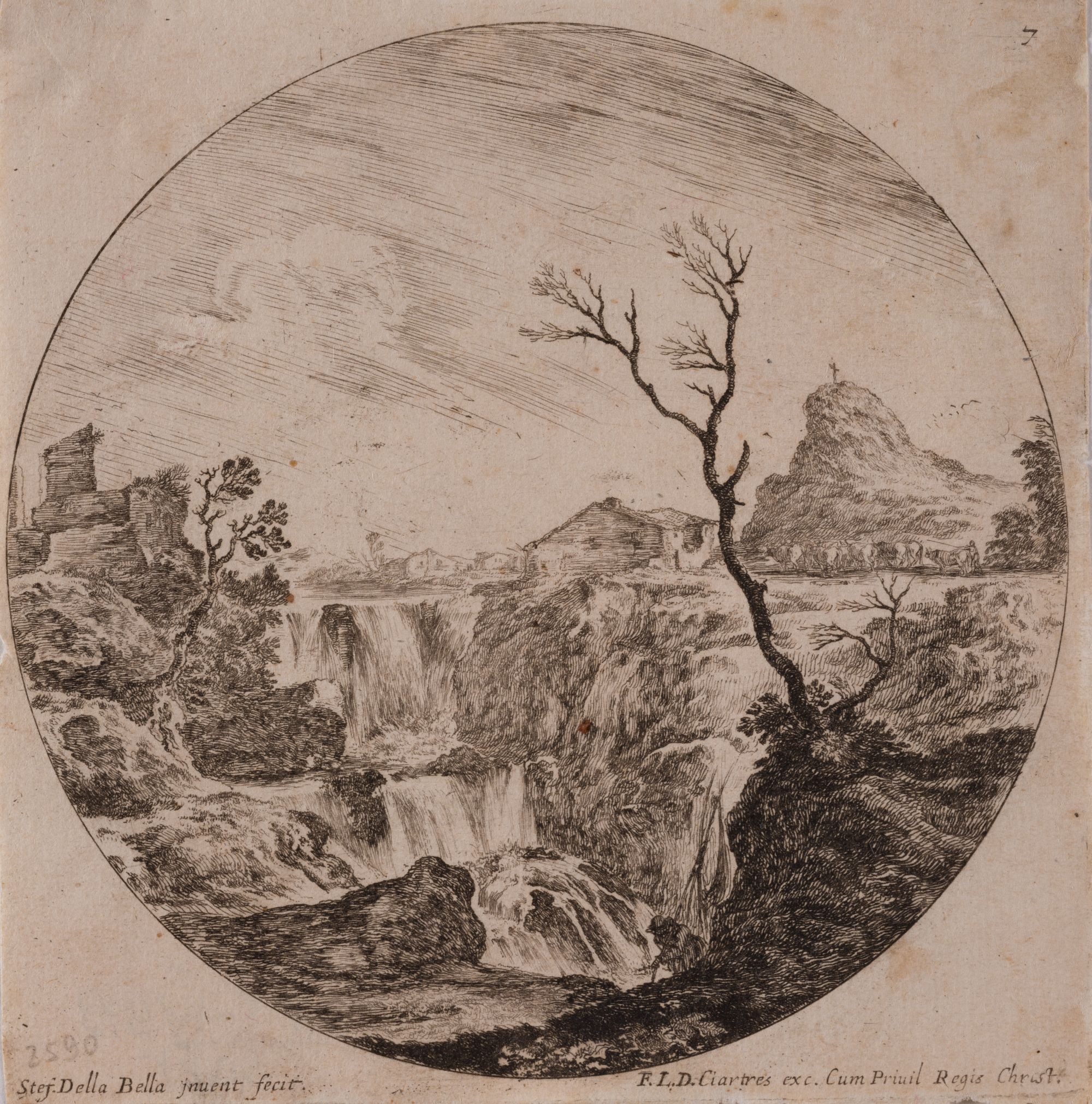
Triple Cascading Waterfall. From the "Round Landscapes" or "Roman Landscapes and Ruins" Series, Plate 7
Stefano della Bella
Basic information
- ID
- Г-IV-919
- Author
- Stefano della Bella
- Name
- Triple Cascading Waterfall. From the "Round Landscapes" or "Roman Landscapes and Ruins" Series, Plate 7
- Country
- France
- Technique
- etching
- Material
- paper
- Dimensions
- 13.5 x 13.5 cm (height x width)
Additionally
- Type
- graphic art
- Genre
- landscape
- Plot
- Landscape
- Provenance
- Received from the Lviv Historical Museum, 1954
Information about author
Object description
The work comes from the "Round Landscapes" series, created by the artist in Paris around 1646. The series consists of 13 prints. In many catalogued descriptions, the work appears as a piece from the "Roman Landscapes and Ruins" ("Paysages et ruines de Rome") series, plate 7. The publisher of this series of prints was François Langlois (1589–1647), known as Ciartres or Chartres. He is considered the first prominent publisher of the French Baroque era.
In this Parisian etching, della Bella demonstrates documentary accuracy in his depiction of the Italian landscape. The artist made sketches of the Apennine landscapes during his studies in Rome in 1633–1639. The print has the shape of a tondo – an experimental format characteristic of della Bella. The focal point of the composition is a turbulent cascading waterfall that flows in three tiers through a rocky riverbed. The dynamics of the flow are conveyed with fine, filigree hatching that creates a sense of movement. In the foreground on the right, the contour of an old, dry, leafless tree stands out clearly. Its dark silhouette contrasts with the light sky. In the distance behind the tree rises a high hill with a cross. At its foot, a herd of cows heads towards a low-built structure depicted in the centre above the waterfall. Beyond it, several similar structures can be seen in the distance. On the left, on a cliff, are the ruins of an ancient or medieval stone tower. Below, on a rocky precipice, trees and bushes are depicted, softening the harsh landscape.
The work demonstrates the author's masterly command of the etching technique. The artist uses parallel lines and delicate hatching to reproduce volumes and chiaroscuro. The contrasts of deep shadow in the foreground and light areas create a sense of spatial depth.
Inscriptions
At the bottom of the print on the left: "Stefano della Bella inuent. fecit.", on the right: "F. L. D. Ciartres exc. Cum Privil. Regis Christ." – [François Langlois, known as Ciartres, published with Royal privilege]. On the mounting cardboard on the left under the sheet, there is a sticker with the stamp of Lviv Historical Museum and the former inventory number of the engraving in ink: "Г-4690/61", above it in pencil, the current gallery collection number: "№ Г-IV-919/ ЛДКГ". Pencil marks on the mounting cardboard: on the left near the bottom corner of the engraving sheet – "94", on the right – "65".
Legal regulation
Borys Voznytskyi Lviv National Art Gallery