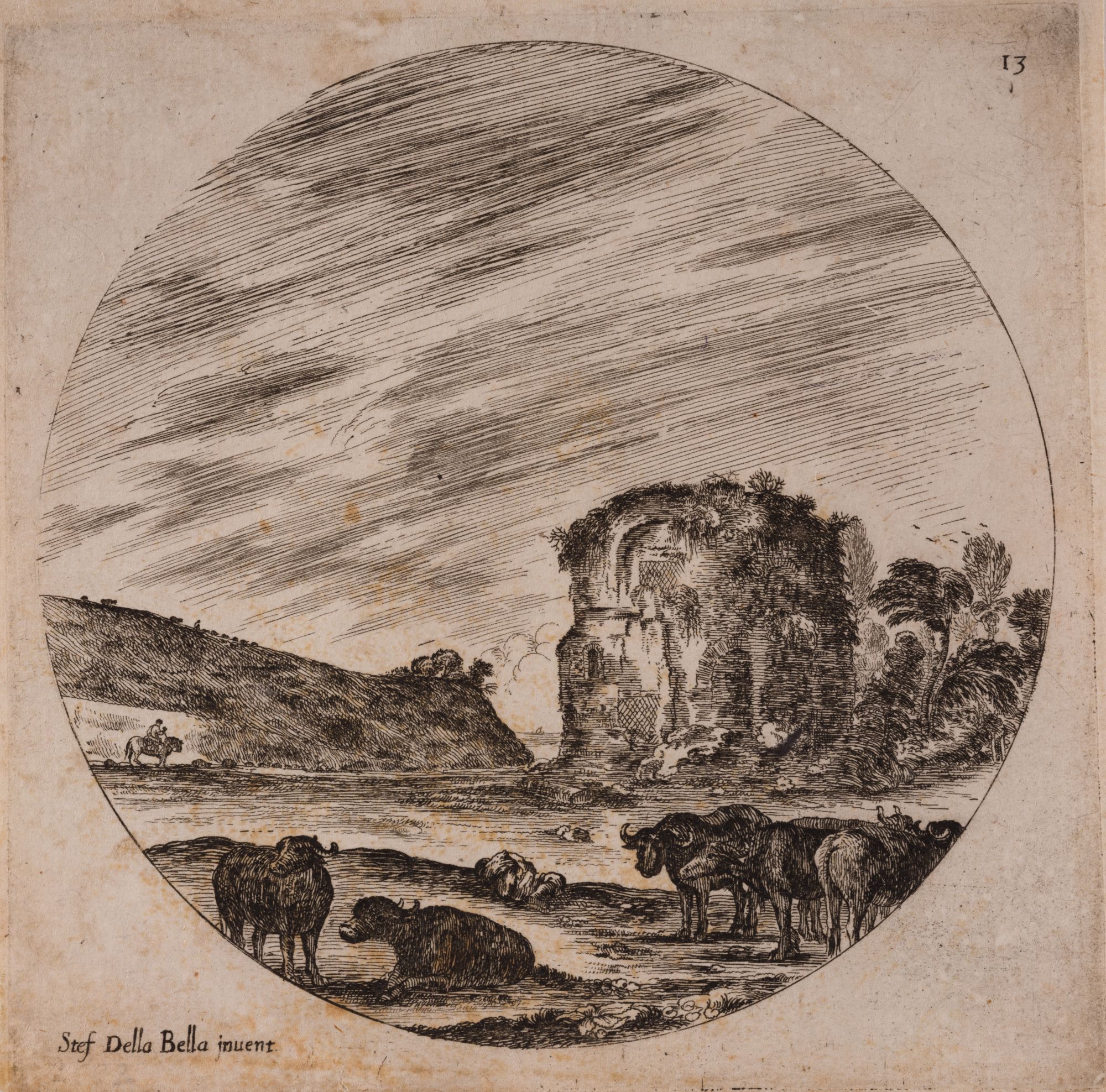
Cattle near the Ruins of an Ancient Temple. From the "Round Landscapes" or "Roman Landscapes and Ruins" Series, Plate 13
Stefano della Bella
Basic information
- ID
- Г-IV-926
- Author
- Stefano della Bella
- Name
- Cattle near the Ruins of an Ancient Temple. From the "Round Landscapes" or "Roman Landscapes and Ruins" Series, Plate 13
- Country
- France
- Technique
- etching
- Material
- paper
- Dimensions
- 13.5 x 13.5 cm (height x width)
Additionally
- Type
- graphic art
- Genre
- architectural landscape animal painting
- Plot
- Landscape
- Provenance
- Received from the Lviv Historical Museum, 1954
Information about author
Object description
The work comes from the "Round Landscapes" series, created by the artist in Paris around 1646. During this period, della Bella was under the patronage of Cardinal Richelieu. The series consists of 13 prints. In many catalogued descriptions, the work appears as a piece from the "Roman Landscapes and Ruins" ("Paysages et ruines de Rome") series, plate 13. The publisher of this series of prints was François Langlois (1589–1647), known as Ciartres or Chartres. He is considered the first prominent publisher of the French Baroque era.
The print has the shape of a tondo – an experimental format characteristic of della Bella.
In the foreground, a herd of buffaloes is depicted in the centre near the mouth of a river in the lowlands, against the backdrop of coastal hills. The animals are rendered with a profound knowledge of anatomy. One of the buffaloes lies on the ground, while the others are grouped near the water body. On the right, in the background, a figure of a rider moving along the hill is noticeable. The compositional dominance of the middle ground is a massive, semi-ruined tower of an ancient temple, rising on the left. It is overgrown with thick grass and shrubs. The ruin symbolises both the grandeur and transience of past eras.
The upper part of the tondo is occupied by the sky covered with light clouds, conveyed through fine parallel and cross-hatching. Deep, sharp strokes in the foreground gradually change into softer, blurred lines in the rendering of the ruin and the hill.
Lyricism, elegance of lines, and pastoral serenity, characteristic of the 17th-century Italian "idyllic landscape", are brought into this scenery.
The engraving is a mirror image of the print under No. Г-IV-925.
Inscriptions
At the bottom of the print on the left: "Stef. Della Bella jnuent". Top right on the sheet: "13". On the mounting cardboard on the left under the sheet, there is a sticker with the stamp of Lviv Historical Museum funds and the former inventory number of the engraving in ink: "Г-4690/55", above it in pencil, the current gallery collection number: "№ Г-IV-926/ ЛДКГ". Pencil marks on the mounting cardboard near the bottom corner of the engraving sheet: on the left – "100", on the right – "57".
Legal regulation
Borys Voznytskyi Lviv National Art Gallery