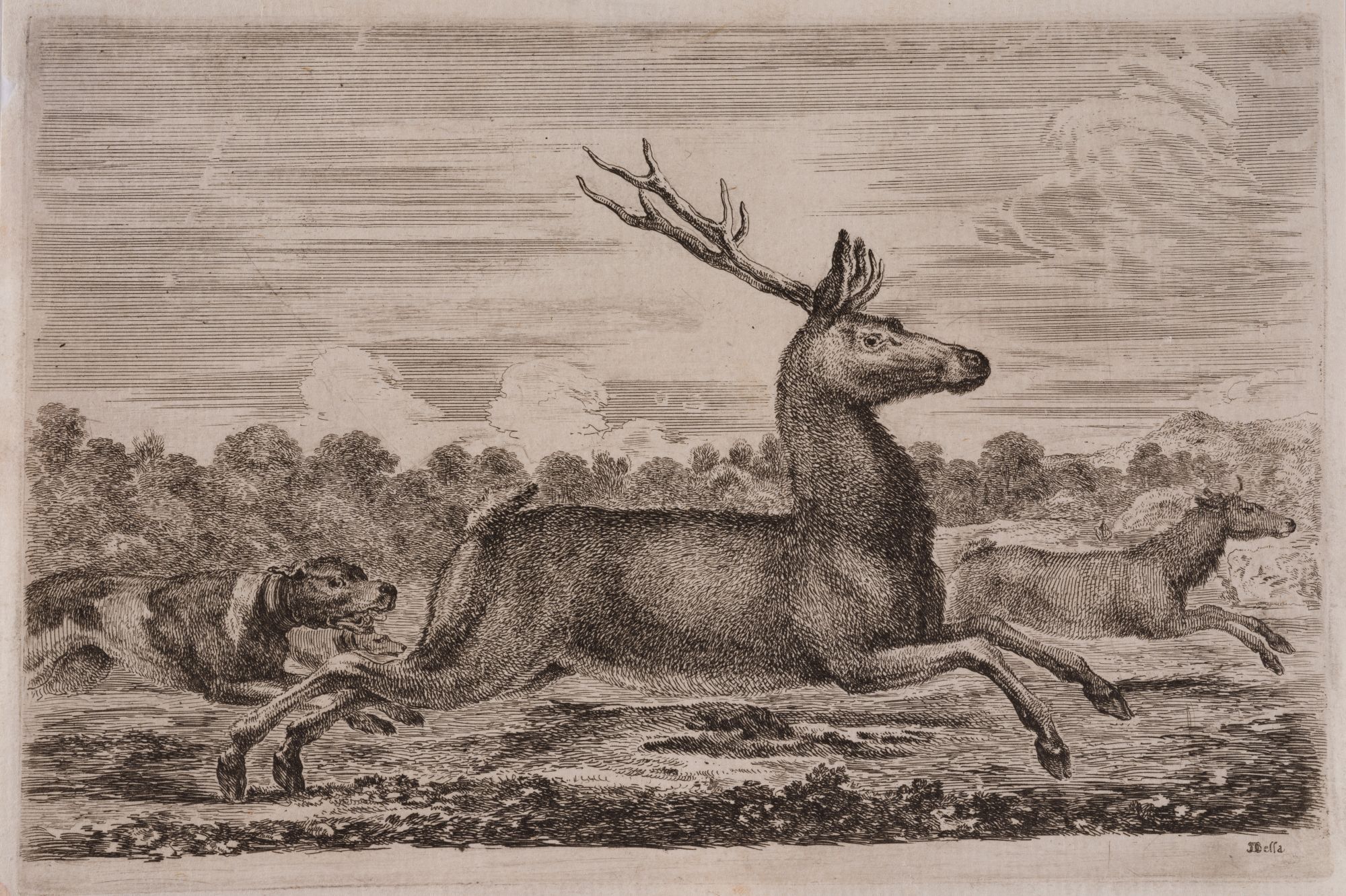
Stag and Hind Fleeing from Hounds. From the "Animal Hunts" Series
Stefano della Bella
Basic information
- ID
- Г-IV-930
- Author
- Stefano della Bella
- Name
- Stag and Hind Fleeing from Hounds. From the "Animal Hunts" Series
- Country
- Italy
- Technique
- etching
- Material
- paper
- Dimensions
- 15.1 x 22.8 cm (height x width)
Additionally
- Type
- graphic art
- Genre
- animal painting
- Provenance
- Received from the Lviv Historical Museum, 1954
Information about author
Object description
The work is part of the "Animal Hunts" series (French: "Chasses à différents animaux", Italian: "Cacce di diversi animali"), which consists of nine prints. The author created it shortly after returning to Florence from Paris.
The main space of the composition is occupied by an image of a red deer running swiftly to escape pursuit. It is depicted in a dynamic leap directed to the right. The animal's body is tense, and its hooves are lifted off the ground, which emphasises the maximum speed of movement. On the left, an infuriated spotted hound is catching up with the deer. Behind it, in the background, another hound is schematically depicted, pursuing a hind or a female deer shown on the right. The event takes place against the backdrop of an open landscape with a line of trees and thick bushes on the horizon. The sky above them is covered with voluminous clouds, adding emotional tension to the scene.
Della Bella devoted a significant part of his career to the study of nature. The anatomy of the deer, the turn of its head, the structure of the antlers, and the dynamics of the hounds' running are conveyed with naturalistic precision. This testifies to the artist's long-term observations of real animals and hunting processes during his stay at the Medici court in Florence and during his work in Paris.
Inscriptions
At the bottom of the print on the left, the author's engraved signature: "S. D. Bella f.".
Legal regulation
Borys Voznytskyi Lviv National Art Gallery