New Testament Trinity
unknown
Basic information
- ID
- С-II-850
- Author
- unknown
- Name
- New Testament Trinity
- Date of creation
- 18th c.
- Country
- Ukraine
- Technique
- carving polychromy tempera painting
- Material
- wood tempera
- Dimensions
- 73 x 113 cm (height x width)
Additionally
- Type
- painting
- Genre
- religious
- Provenance
- Radelychi village, Mykolaiv district, Lviv region
Information about author
Object description
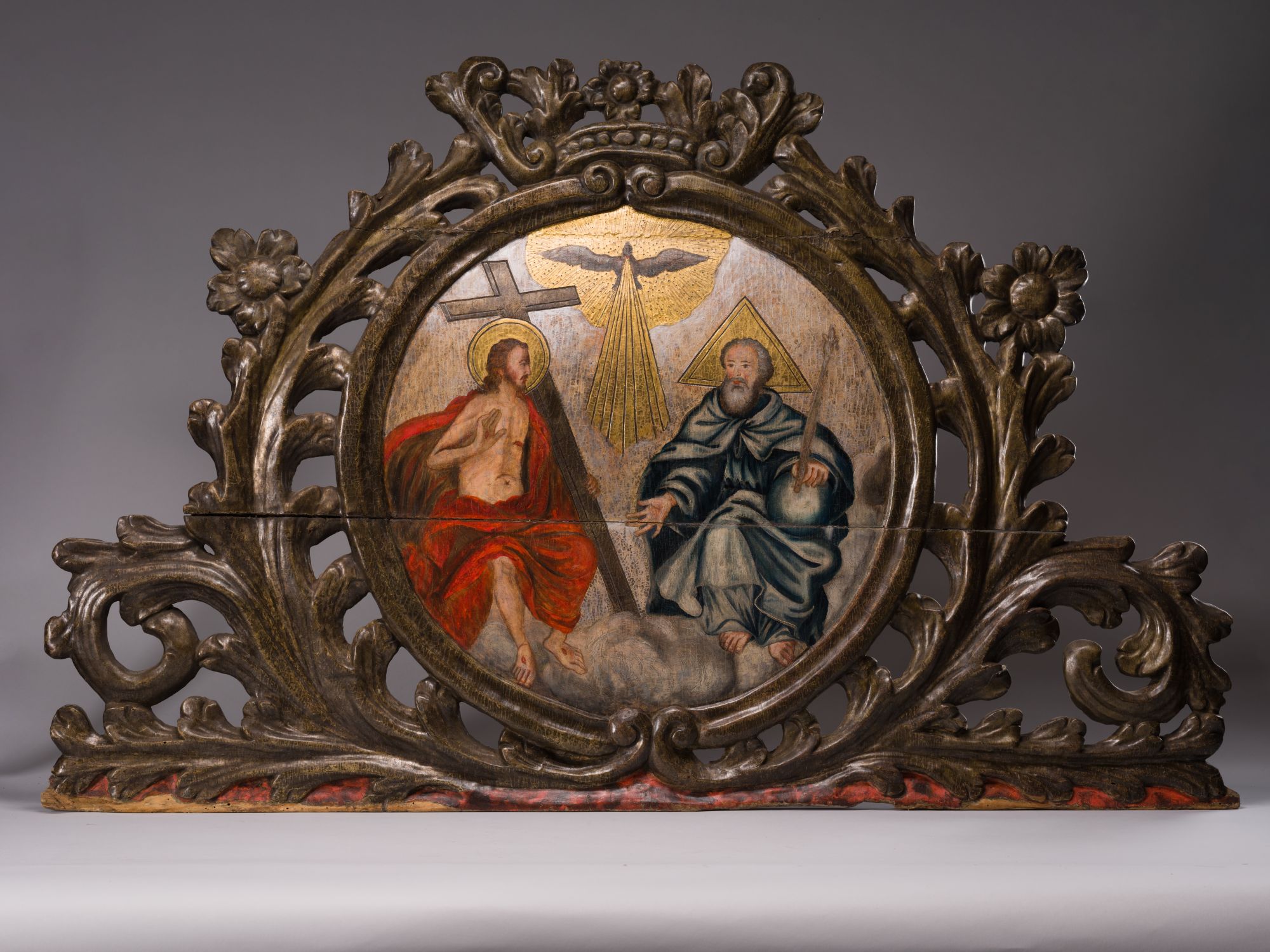
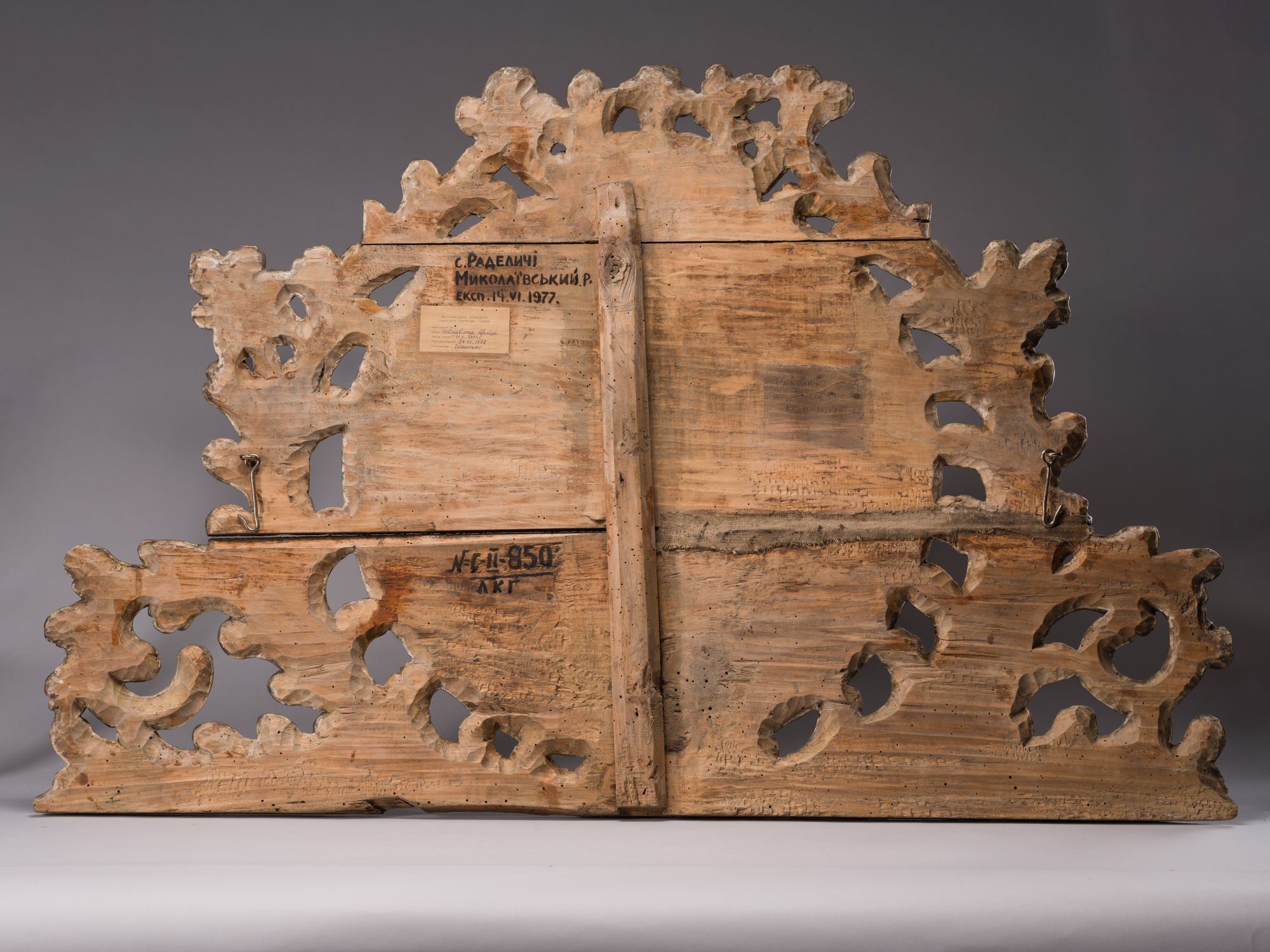
The "New Testament Trinity" belongs to the types of Trinity imagery that are Western European in origin yet deeply rooted in Ukrainian traditions. In contrast to the ancient "Old Testament Trinity", which was personified in the images of angels at the Oak of Mamre, here the Deity is presented in anthropomorphic figures. God the Father, as a rule, appears in the guise of a grey-haired old man, symbolising the eternity of the Creator; God the Son sits to the right of the Father as the Universal Judge with a cross and signs of the Passion sacrifice; and the Holy Spirit is depicted in the form of a dove that links both figures. This iconographic scheme reveals the dogma of the unity and indivisibility of the Trinity and emphasises the redemptive sacrifice of Jesus. It was this theological emphasis that determined the popularity of this iconographic type in the Baroque art of Ukraine, where a distinctive Eucharistic and Passion symbolism developed.
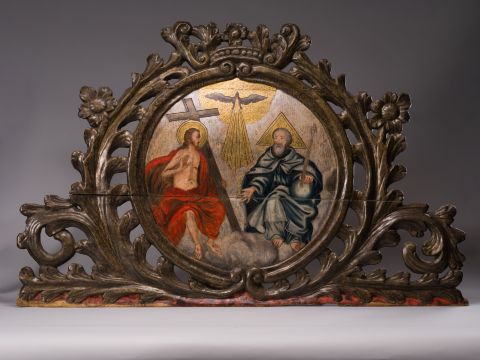
The painted image of the New Testament Trinity from the village of Radelychi is inscribed in a round medallion framed with decorative carving. The images fill almost the entire background of the icon. The figures are united by a common rhythm of lines modelling the folds of the garments and ornamental elements. The painter does not depart from the established canonical depiction of the scene. On a monotonous silvery background, two figures are presented sitting on clouds – God the Father with an orb and sceptre in a light-coloured himation and chiton wrapping around his entire body, and to his right, the Saviour with a cross in his left hand and a blessing gesture with his right. Above them rises a dove, from which radiant beams shine forth. The heads of the holy figures are crowned with haloes: a round one for Christ and a triangular one for the Creator. The polychromy that lends expressiveness to the work is built on the contrast of shades of red-brown and grey-blue in combination with gold, which gives the piece a solemn resonance. The author strives for anatomical accuracy in the treatment of the figures. Movement and dynamics can be traced in the modelling of the drapery folds of the holy figures' vestments, creating a play of light and shadow characteristic of the Baroque.
The plastic language of the painting, folk in its origin, lends sincerity and a tangible monumentality to the iconographic images. The somewhat generalised treatment of forms, expressiveness of gestures, and decorativeness of details testify to a connection with the local icon-painting and carving tradition of Galicia. The work combines the requirements of theological accuracy with the creative freedom of the master craftsman.
Legal regulation
Borys Voznytskyi Lviv National Art Gallery