Evangelist
unknown
Basic information
- ID
- С-II-870
- Author
- unknown
- Name
- Evangelist
- Date of creation
- 18th c.
- Country
- Ukraine
- Technique
- carving polychromy
- Material
- wood
- Dimensions
- 67 x 37 x 11.5 cm (height x width x depth)
Additionally
- Type
- sculpture
- Genre
- religious
- Plot
- Evangelist
Information about author
Object description
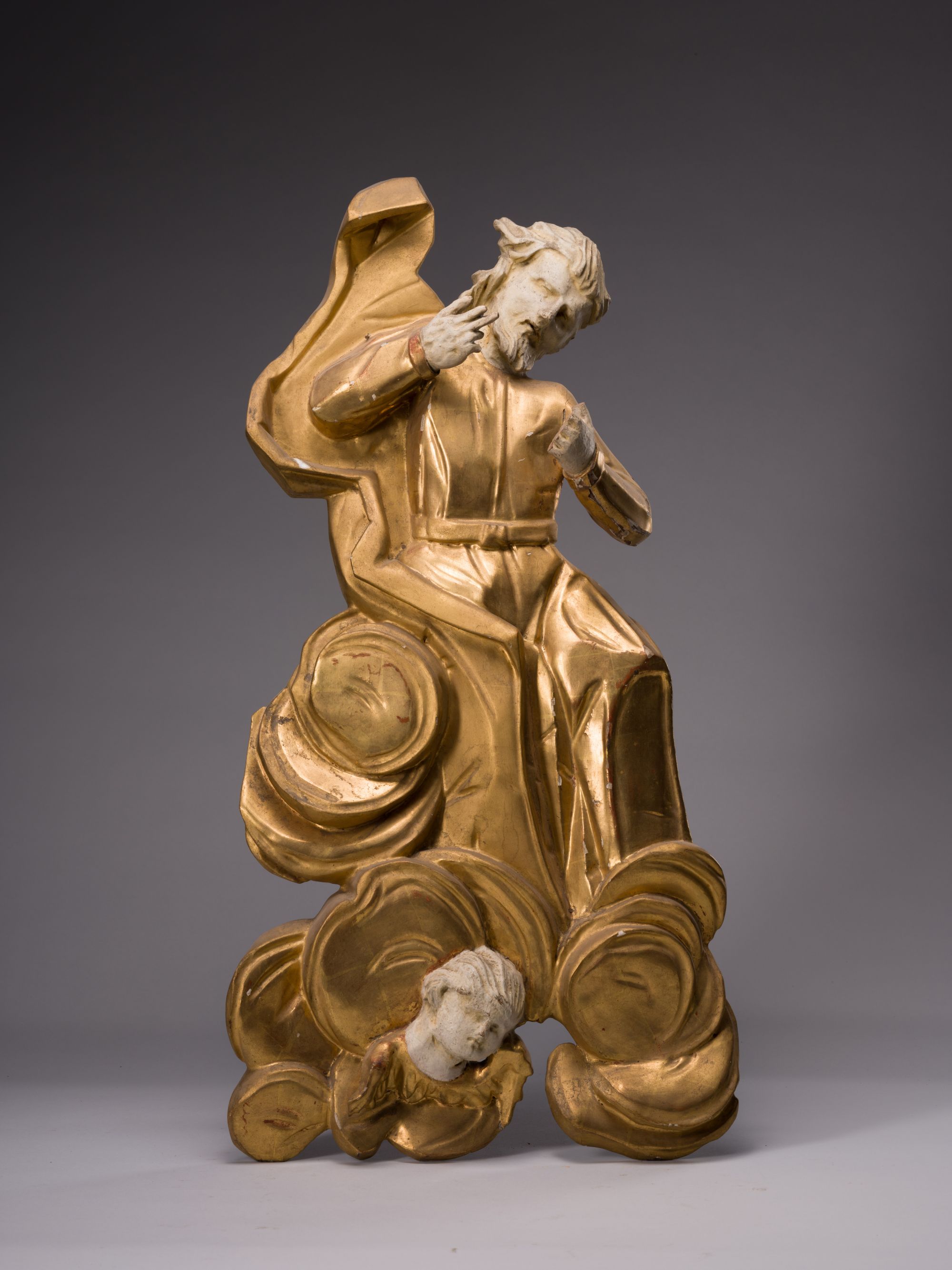
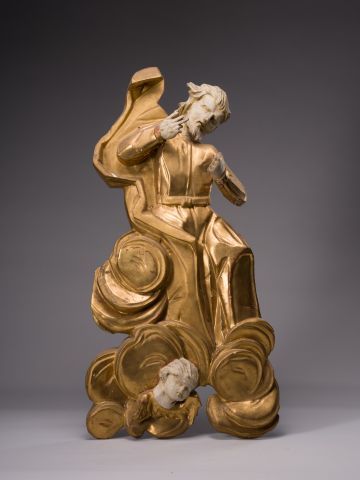
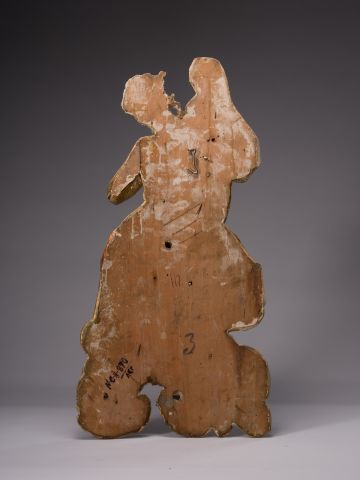
The relief image of the evangelist presents a dynamically treated figure placed on a massive compositional base that imitates clouds. The work follows Baroque sculpture style. The compositional solution is vertical with a distinct diagonal movement. The figure of the evangelist emerges from the clouds that envelop the lower part of the form. His head is tilted towards his left shoulder, and his arms are bent at chest level. The image of the saint is treated flatly, yet it is not intended for a purely frontal perception. The basis of the composition is the contrast between the almost static human body and the dynamic movement of the spiral-shaped cloud billows, which do not serve as a neutral pedestal – their plasticity is actively included in the overall dynamics of the composition. The image of the evangelist is not enclosed in a static frontal silhouette; he seems to have frozen in a moment of movement. The volumetric protrusions of the garments, arms, clouds, the cherub's head, and the billowing drapery create a complex system of light and shadow.
The master does not adhere to an anatomically correct rendering of the figure; a decorative-expressive manner prevails here. The shoulders, arms, and head create a kind of broken line that fills the image with inner tension. The face is modelled in greater detail than other parts of the figure. The ascetic image of the evangelist is emphasised by the expressive features of the face: a high forehead, low brow ridges over deeply set eyes, sunken cheeks, prominent cheekbones, and firmly closed lips framed by strands of a short beard. The head is tilted, and the gaze is directed downwards. This posture has an important psychological significance – the image does not enter into direct contact with the viewer but remains, as it were, in a state of inner experience, detachment, and prayerful contemplation. The evangelist is dressed in a long tunic, belted at the waist and rendered with wide, shallow folds that turn it into an independent sculptural element. In this work, the master applies a contrast between smooth and folded gold-covered surfaces, which enhance the Baroque theatricality of the form that changes depending on the lighting.
The clouds carved in the lower part of the work strip the figure of earthly presence and create an illusion of the sacredness of the image, which is characteristic of Baroque sculpture. The colour scheme of the work is based on a combination of gold and white, which stands out with particular expressiveness. Gold performs not only a decorative function, for in religious art this colour is associated with light, the heavenly sphere, and solemnity. The relief image of the evangelist is not merely a depiction of a saint, but a theatricalised image of heavenly presence, where gold becomes a metaphor for light, clouds a transformation of space, and the posture and gesture the embodiment of spiritual experience.
Legal regulation
Borys Voznytskyi Lviv National Art Gallery