The Passion of Christ
unknown
Basic information
- ID
- Ж-4493а_б_в
- Author
- unknown
- Name
- The Passion of Christ
- Date of creation
- 18th c.
- Country
- Ukraine
- Technique
- oil painting
- Material
- wood oil
- Dimensions
- 260.5 x 278 cm (height x width)
Additionally
- Type
- painting icon
- Genre
- religious
- Plot
- The Passion of Christ
- Provenance
- Teisariv village, Stryi district, Lviv region
Information about author
Object description
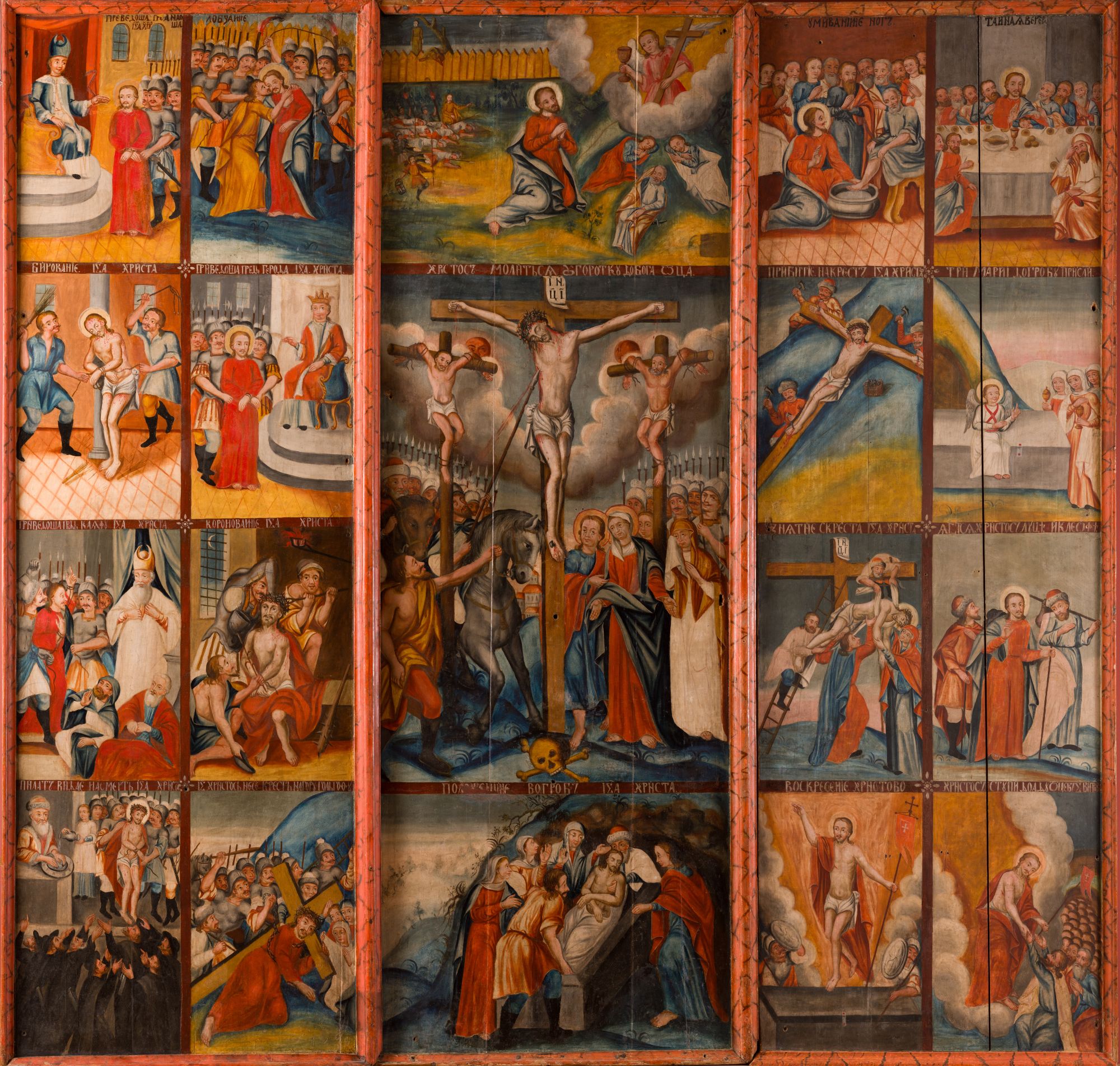
The "Passion of Christ" icon demonstrates a cycle of Gospel narratives depicting the final days of Jesus Christ's earthly life. Most frequently, the Passion cycle was positioned on the northern wall of the central nave, opposite the monumental composition of the "Last Judgment", and occasionally on the wall of the church narthex. These Passion scenes urged believers to contemplate the purpose of every human being on Earth. Each narrative is imbued with profound sorrow and the immense tragedy of the Saviour's earthly path.
The origins of the "Passion" iconography trace back to Early Christian art, where individual scenes of the passional cycle were first developed, such as the "Raising of Lazarus", the "Last Supper", and the "Trial of Pilate". The cycle reached its definitive formulation in Byzantium. In Ukraine, the iconography of the Passion has been known since the 15th century, as evidenced by extant iconographic monuments. Works of this theme are usually distinguished by their large dimensions. These subjects gained particular popularity in Ukrainian easel and monumental art starting from the 17th century.
The Passion of Christ icons of the 17th and early 18th centuries are multi-narrative monumental works that occupied a significant place in the church interior, closely resembling the wall paintings of wooden temples in their conceptual design. The presented Passion icon from the village of Teisariv consists of individual Gospel narratives, beginning with the scene "Christ Before Annas the High Priest" and concluding with the depiction of the "Descent into Hell". Each subject functions as a self-contained narrative icon that faithfully conveys the historical events described in the Gospels.
The piece possesses a clearly defined architectonic, tripartite structure (a) 260.5×95 cm; b) 259.5×93 cm; c) 260.5×90 cm), divided into horizontal registers. Compositionally, the work comprises 19 scenes separated from one another by a painted border. On these dividing bands, Old Church Slavonic explanatory inscriptions are applied in white paint for each subject, which was a characteristic feature of passional icons of the 17th and 18th centuries. The panels are arranged in four registers, dominated by an expanded central scene of the "Crucifixion with Attendant Figures" occupying the middle section of the icon. The crucified Christ towers over Golgotha, flanked by the two crucified thieves whose figures are plastically contorted, emphasising their earthly torment in contrast to the majestic and serene death of the Saviour. At the base of the cross, the skull of Adam is depicted alongside Longinus on horseback piercing Jesus' side with a spear, and the sorrowful figures of the Mother of God and John the Evangelist.
Starting from the upper register, reading clearly from left to right, the following scenes unfold: "Christ Before Annas the High Priest", "The Kiss of Judas", "The Agony in the Garden" ("The Sleep in the Gethsemane Garden"), "The Washing of Feet", "The Last Supper", "The Scourging of Christ", "Christ at the Court of King Herod", "The Trial of Christ Before Caiaphas", "The Crowning with Thorns", "The Trial Before Pilate" (Pilate washing his hands), "Christ Bearing the Cross", "The Nailing to the Cross", "The Myrrh-Bearing Women", "The Deposition from the Cross", "The Entombment", "The Appearance of Jesus to Two Disciples", "The Resurrection of Christ", and "The Descent into Hell".
The composition of each individual scene is densely packed, with figures positioned closely together, creating a sense of dramatic intensity and emotionally engaging the viewer in the sacred event. The figures are somewhat stocky, yet endowed with expressive, lively facial features and gestures that bring the Gospel narrative closer and make it more comprehensible to ordinary believers. Each scene is filled with vibrant energy felt in the characters' expressions, gestures, and postures. The work demonstrates an organic, refined synthesis of the high Byzantine canon and Western European Baroque influences, reinterpreted through the prism of Ukrainian folk painting.
In modelling the volumes, the iconographer employs a graphic linear drawing as a foundation, over which vivid blocks of colour are overlaid. The palette of the work relies on the contrast of local hues. Rich vermilion red, deep blue, ochre-gold shades, and accents of white dominate the composition. The symbolic weight of the red colour in the icon is perceived in a dual manner: on one hand, as the colour of regal majesty and the future Resurrection; on the other, as a symbol of the sacrificial blood of the Saviour. Overall, the coloristic solution is built upon the juxtaposition of deep earthly and radiant celestial tones.
Despite a certain imperfection in the anatomical rendering of the human body, the images possess an incredible power of emotional impact. The faces of the righteous radiate gentleness and quiet sorrow, whereas the countenances of the negative characters and executioners often take on a grotesque appearance.
This icon stands as a unique artistic artefact. It visually demonstrates how profound Byzantine theology and European engravings, which frequently served as iconographic sources for folk masters, were transformed within the Ukrainian milieu through the prism of the popular worldview, evolving into a highly distinctive, sincere art form that is truly monumental in spirit.
Legal regulation
Borys Voznytskyi Lviv National Art Gallery