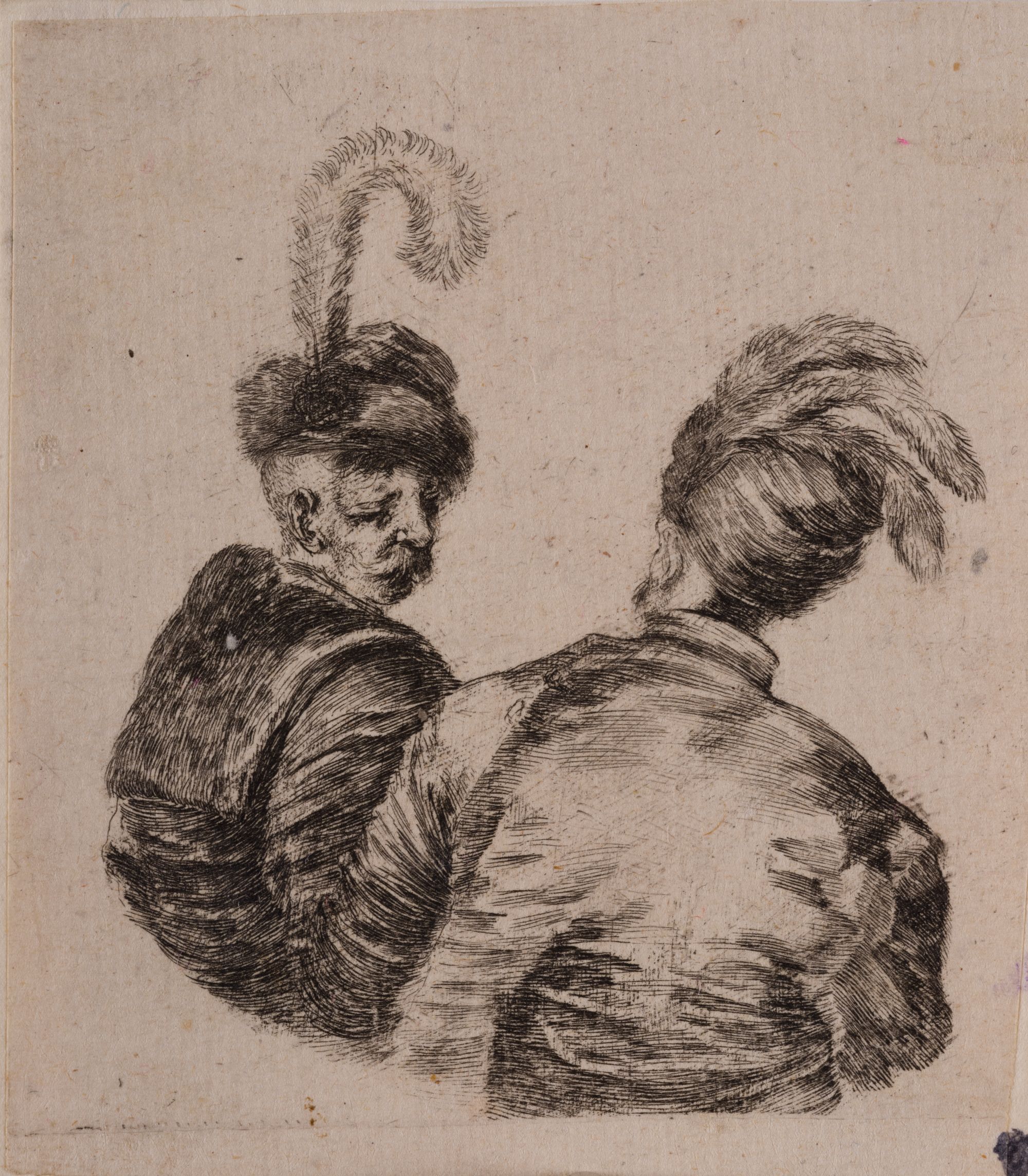
Two Polish Noblemen. From the "Polish and Hungarian Figures" Series
Stefano della Bella
Basic information
- ID
- Г-IV-947
- Author
- Stefano della Bella
- Name
- Two Polish Noblemen. From the "Polish and Hungarian Figures" Series
- Date of creation
- c. 1646
- Country
- France
- Technique
- etching
- Material
- paper on cardboard
- Dimensions
- 8.8 x 7.8 cm (height x width)
Additionally
- Type
- graphic art
- Genre
- portraiture
- Provenance
- Received from the Lviv Historical Museum, 1954
Information about author
Object description
The series titled "Polish and Hungarian Figures" was created in the 1640s. Within it, the artist captured elements of Oriental and "Sarmatian" costume, both exotic to Western Europe, including the traditional feathered headdresses depicted in this sketch.
Two Polish noblemen are depicted from behind in a three-quarter view. The composition is focussed on the details of their attire and distinctive headwear. The man on the left is of mature age, with a grey moustache; he wears a fur hat adorned with a curved feather and a thick tunicked coat with a wide collar. The nobleman on the right is likewise depicted from behind, his feathered headdress reminiscent of an Oriental turban.
Through a masterful hatching technique, the artist flawlessly conveys the volume of the figures, the interplay of light and shade, and the varying textures of materials – the softness of the fur, the fullness of the feathers, and the density of the garment fabric. The background remains neutral, concentrating the viewer's attention entirely on the characters and silhouettes of the figures.
Inscriptions
At the bottom of the backing cardboard, numbers and the gallery inventory number are marked in pencil.
Legal regulation
Borys Voznytskyi Lviv National Art Gallery