Assumption of the Virgin
unknown
Basic information
Additionally
- Type
- sculpture (relief)
- Genre
- religious
- Plot
- Virgin Mary
- Provenance
- Jesuit Church, Lviv city
Information about author
Object description
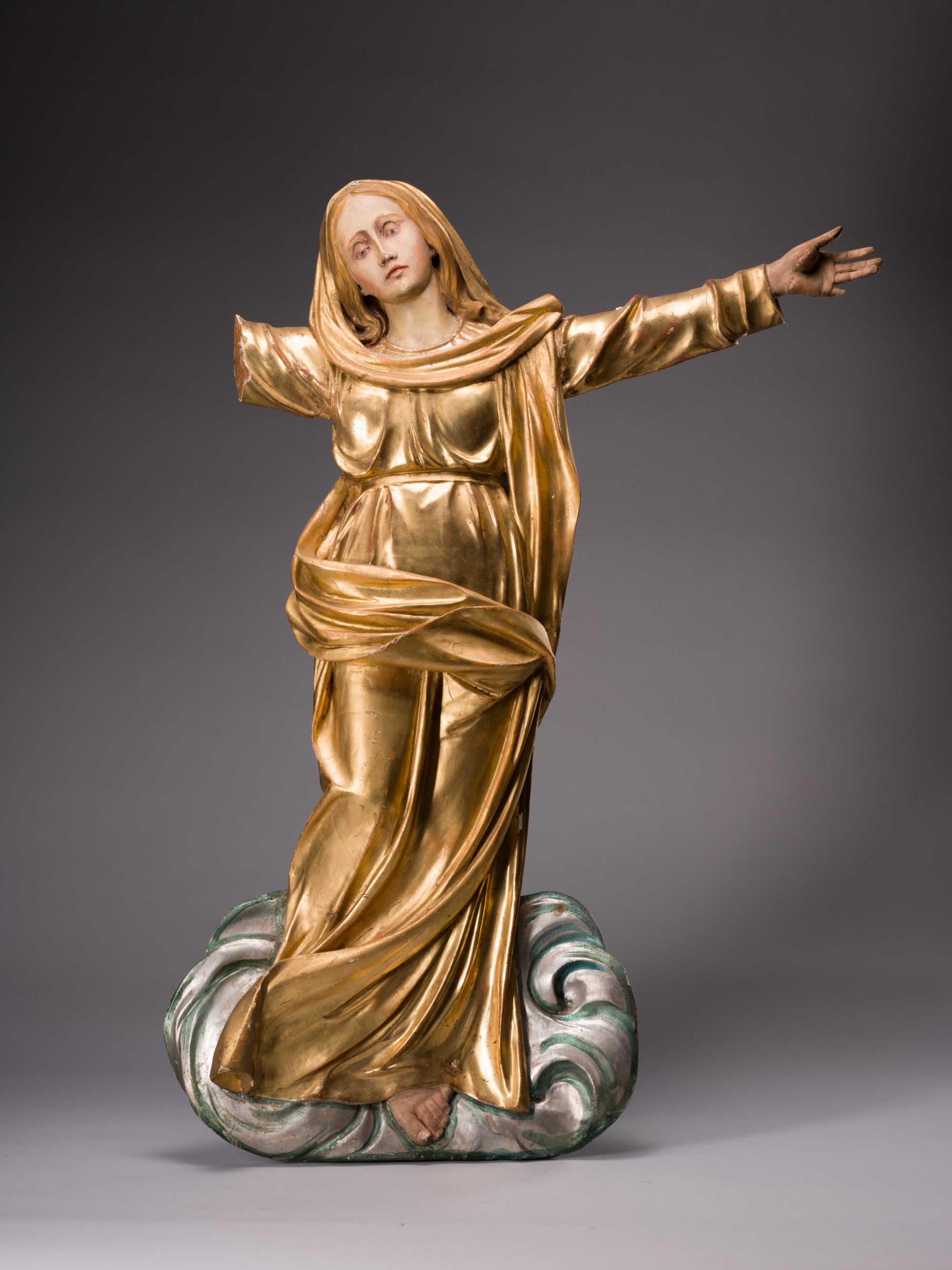
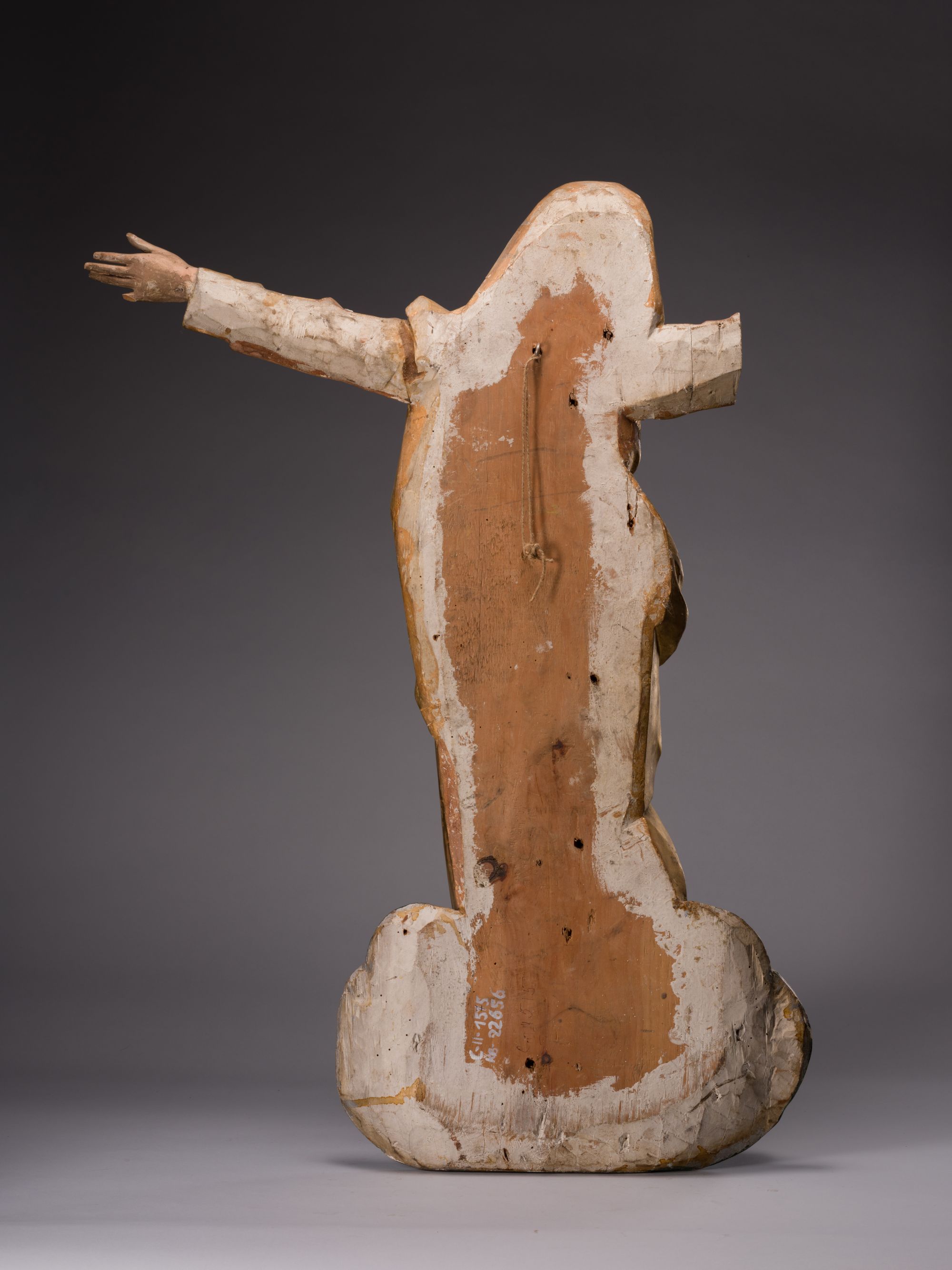
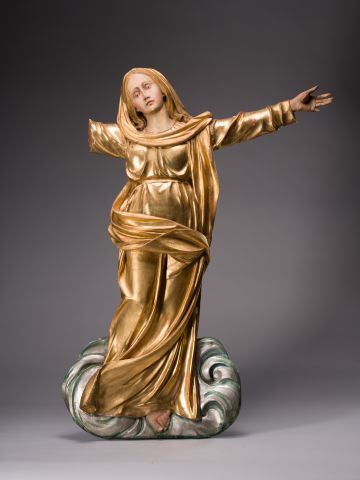
This relief carving illustrates one of the most widespread subjects of Western European sacred art from the Baroque era – the bodily assumption of the Virgin Mary into heavenly glory. According to religious tradition, following her death, the Virgin Mary was miraculously taken up to heaven, both body and soul. This event marks one of the twelve major feasts of the Orthodox and Greek Catholic Churches. In the Catholic tradition, it is celebrated as the Assumption (or the Taking Up of the Most Holy Theotokos into Heaven), while in the Byzantine tradition, it is known as the Dormition. The master craftsman captures the exact moment of elevation: the Virgin Mary appears as a solitary figure ascending into the sky upon a cloud. Her frontal, slightly contrapposto posture, with arms outstretched and raised high, is classic for altarpiece compositions. Such figures typically crowned the main structure of an altar or formed part of a multi-figure ensemble.
The slender form of the Virgin Mary, with a gently arched torso and outspread, upturned hands, evokes a sense of openness and upward movement, lending the image the solemnity characteristic of the Baroque period. The saint's head is slightly raised and tilted towards her right shoulder. Her gaze, shifting from beneath heavily lidded eyes, seems to dissolve into space, conveying an impression of profound spiritual contemplation.
The saint stands upon a cloud sculpted with soft, well-defined wavy forms that twist in circular scrolls. Beyond their structural function as a support, they carry symbolic weight, delineating the celestial path of the Virgin Mary. The Virgin's feet barely graze the clouds, underscoring the weightlessness and immateriality of her figure.
The primary expressive medium of the depiction is the drapery. The author treats the Mother of God's garments as a complex system of bold, high-relief folds that produce a rich interplay of light and shadow. The maphorion, draped over her head, cascades in massive torrents, enveloping her hips and intensifying the swirling motion with which the figure ascends to heaven. A slender belt accentuates her delicate waist, while the straight, vertical folds of her long tunic balance the dynamism of the upper section, imparting a sense of grace and monumentality to the figure. The sculpting of the drapery is multi-tiered. By blending flat surfaces with sharp, abrupt creases, the master makes the fabric of the saint's attire appear light and vibrant.
The colour scheme of the artwork relies on the contrast between gold, pastel flesh tones, and a striking silvery-green hue. Gilding covers the relief in smooth, lustrous planes, catching reflections within the curves of the folds to create an effect of inner radiance that symbolises heavenly glory and holiness. The face and hands are rendered in finely modelled polychrome flesh tones with a subtle blush, infusing the image with vital energy. The features of the Virgin Mary's countenance are softly and restrainedly sculpted, making her expression appear alive and enlightened. The cool, silvery-grey clouds, accented with greenish-blue undertones and highlighted scroll edges, offer a stark contrast to the warmth of the gilding. The combination of gold and polychromy is highly characteristic of the sculptural decoration of Baroque altars. The "Assumption of the Virgin Mary" sculpture (relief) is distinguished by its superb plastic quality, anatomically convincing volumes, and precise execution of details.
Legal regulation
Borys Voznytskyi Lviv National Art Gallery