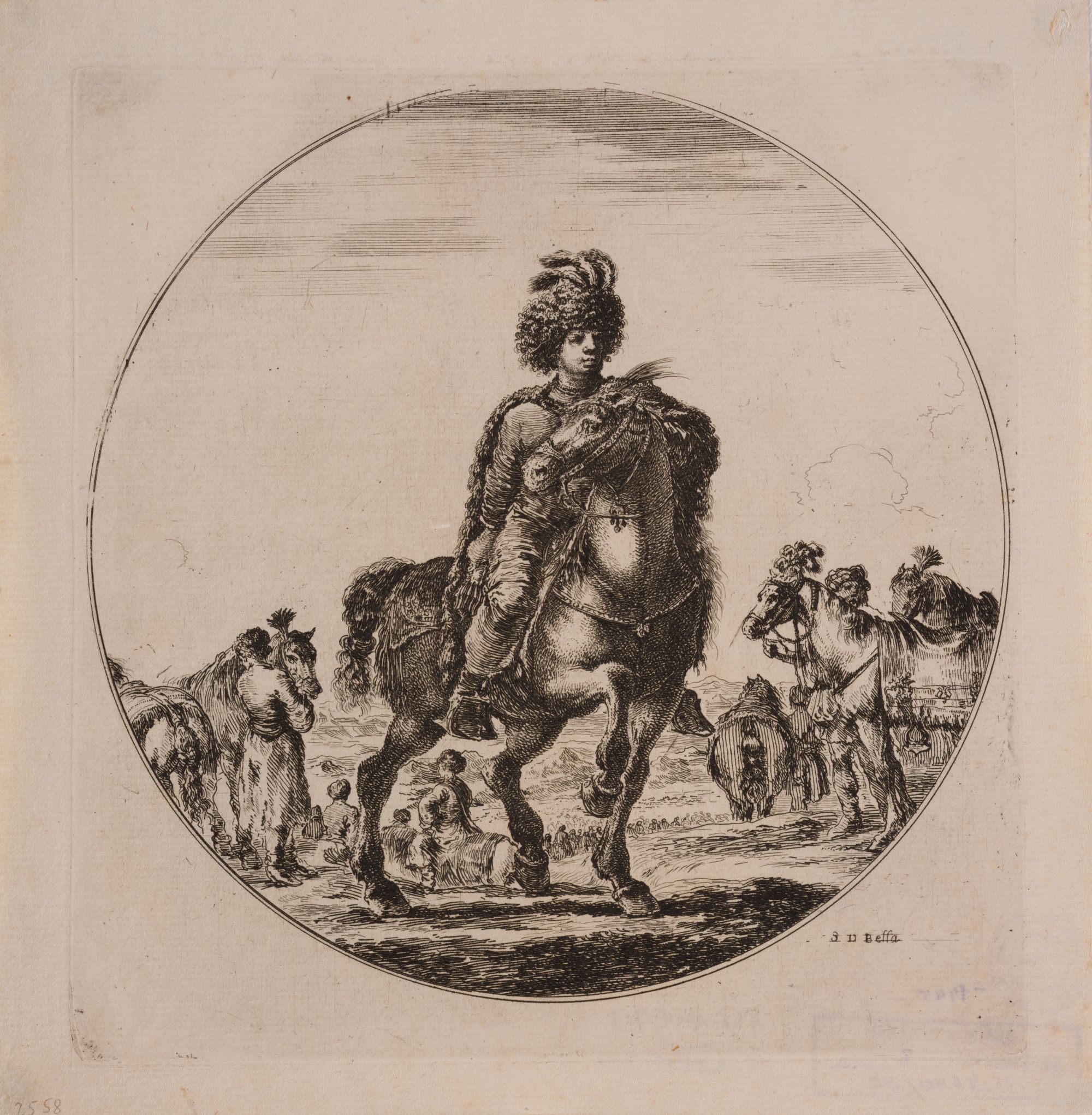
Polish Cavalier (in some catalogues – Hungarian or Wallachian Cavalier). From the "Moorish, Polish, and Hungarian Riders" Series
Stefano della Bella
Basic information
- ID
- Г-IV-973
- Author
- Stefano della Bella
- Name
- Polish Cavalier (in some catalogues – Hungarian or Wallachian Cavalier). From the "Moorish, Polish, and Hungarian Riders" Series
- Country
- France
- Technique
- etching
- Material
- paper
- Dimensions
- 18.7 x 18.3 cm (height x width)
Additionally
- Type
- graphic art
- Genre
- battle painting
- Provenance
- Received from the Lviv Historical Museum, 1954
Information about author
Object description
The artist's interest in depicting exotic warriors arose as early as 1633, when he witnessed and recorded the magnificent procession of the Polish ambassador. Later, while in France, the master recreated these cavalrymen across eleven tondi of a military series. These prints are highly valued by historians for their extraordinary precision in rendering the details of military attire, harness, equine anatomy, and weaponry – including karabela sabres, bows, and shields.
The artwork is rendered in the form of a tondo inscribed within a rectangular sheet. In the centre of the composition, the figure of a Polish cavalryman rises upon a horse that advances majestically. The circular frame focuses attention on the main protagonist, imparting a sense of dynamism and completion to the scene. The equestrian warrior is depicted in profile to the right. He is dressed in a "Sarmatian" military costume characteristic of the period, which includes a tall fur hat adorned with a lavish plume of feathers and a cloak (delia) draped over his shoulders with a fur trim. In the middle ground, behind the horse's hooves, figures of other individuals and riders resting during a campaign are visible. To the right, behind the horse's back, two more horses and a groom wearing a turban are depicted.
The work is executed using the pure etching technique – an intaglio print on metal made with acid etching. Stefano della Bella masterfully employs the finest hatching to convey the texture of the fur, the lustrous coat of the horse, and the interplay of light and shadow on the ground. The lower edge of the print is densely hatched, forming a stable shadow-base for the composition.
Inscriptions
Beneath the image on the bottom right of the sheet, the artist's signature is engraved: "S.D. Bella.". Pencil marks on the backing cardboard indicate the gallery inventory number "Г-IV-973" and the number "33".
Legal regulation
Borys Voznytskyi Lviv National Art Gallery