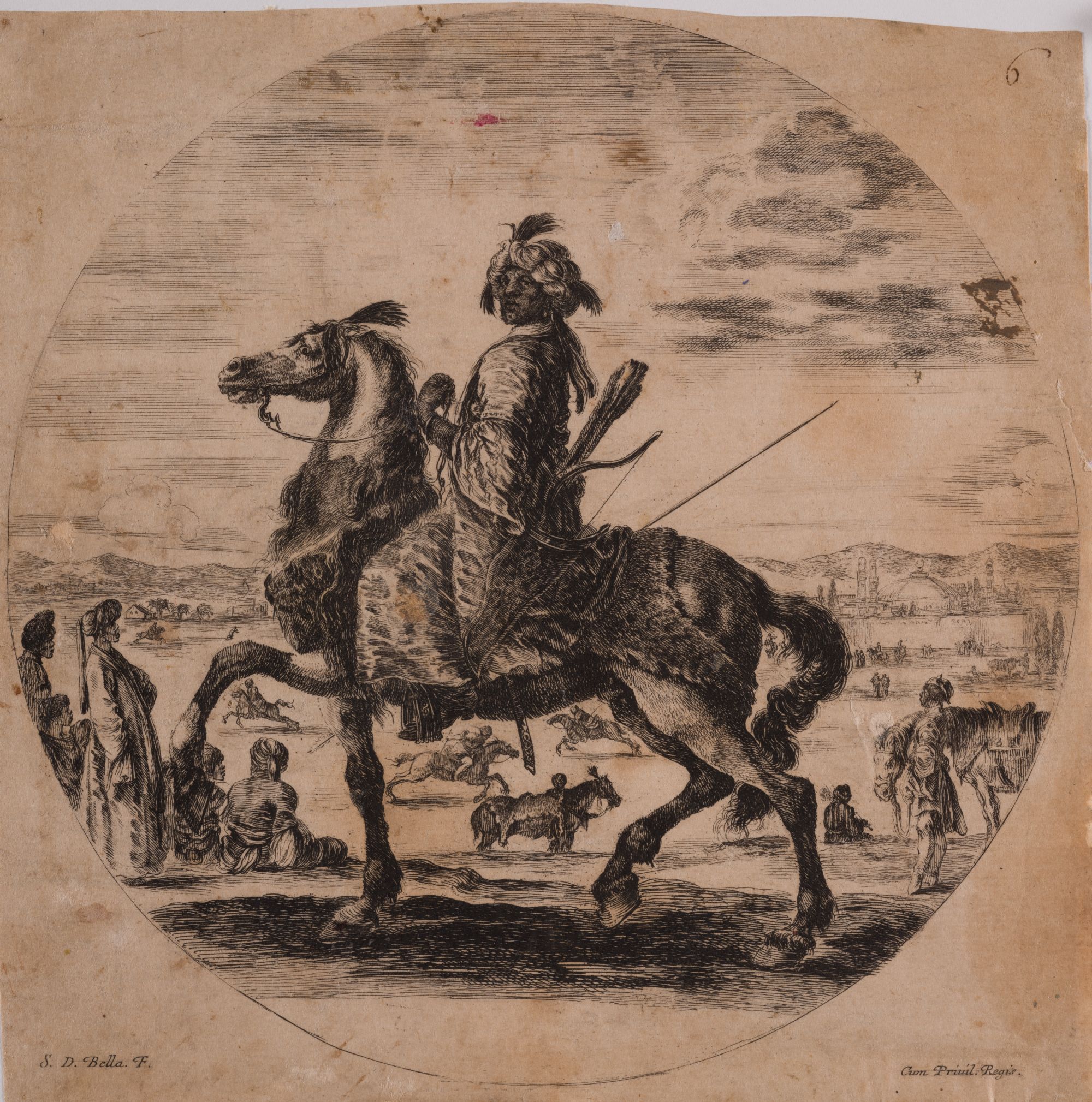
Moorish Warrior. From the "Moorish, Polish, and Hungarian Riders" Series
Stefano della Bella
Basic information
- ID
- Г-IV-978
- Author
- Stefano della Bella
- Name
- Moorish Warrior. From the "Moorish, Polish, and Hungarian Riders" Series
- Country
- France
- Technique
- etching
- Material
- paper
- Dimensions
- 18.7 x 18.3 cm (height x width)
Additionally
- Type
- graphic art
- Genre
- battle painting
- Provenance
- Received from the Lviv Historical Museum, 1954
Information about author
Object description
The artist's interest in depicting exotic warriors arose as early as 1633, when he witnessed and recorded the magnificent procession of the Polish ambassador. Later, while in France, the master recreated these cavalrymen across eleven tondi of a military series. These prints are highly valued by historians for their extraordinary precision in rendering the details of military attire, harness, equine anatomy, and weaponry – including karabela sabres, bows, and shields.
In the foreground, a dark-skinned Moorish warrior is depicted in elegant Oriental attire and a turban adorned with feathers. He is mounted upon a stately horse shown in a three-quarter view. Visible behind the rider's back are a quiver with arrows and a bow. In the middle ground and background, groups of Muslim warriors are positioned, among whom riders on spirited steeds stand out. Set against the backdrop is the silhouette of a Middle Eastern city, beyond which a mountain range rises.
Stefano della Bella demonstrates a masterly command of hatching, beautifully conveying the interplay of light and shadow, the texture of the warrior's garments, the horse's musculature, and the lightness of the clouds.
The work is analogous to the piece registered under No. Г-IV-970.
Inscriptions
Beneath the image on the bottom left of the sheet, the artist's signature is engraved: "S.D. Bella. F.", on the left the inscription: "Cum priuil. Regis" – [With the King's privilege]. On the backing cardboard, the gallery inventory number "Г-IV-978" is indicated.
Legal regulation
Borys Voznytskyi Lviv National Art Gallery