Plan of the Attack on the Fort and Port of Longone... 15 August 1650
Stefano della Bella
Basic information
- ID
- Г-IV-986
- Author
- Stefano della Bella
- Name
- Plan of the Attack on the Fort and Port of Longone... 15 August 1650
- Country
- Italy
- Technique
- etching
- Material
- paper
- Dimensions
- 44.2 x 56.6 cm (height x width)
Additionally
- Type
- graphic art
- Genre
- battle painting
- Provenance
- Received from the Lviv Historical Museum, 1954
Information about author
Object description
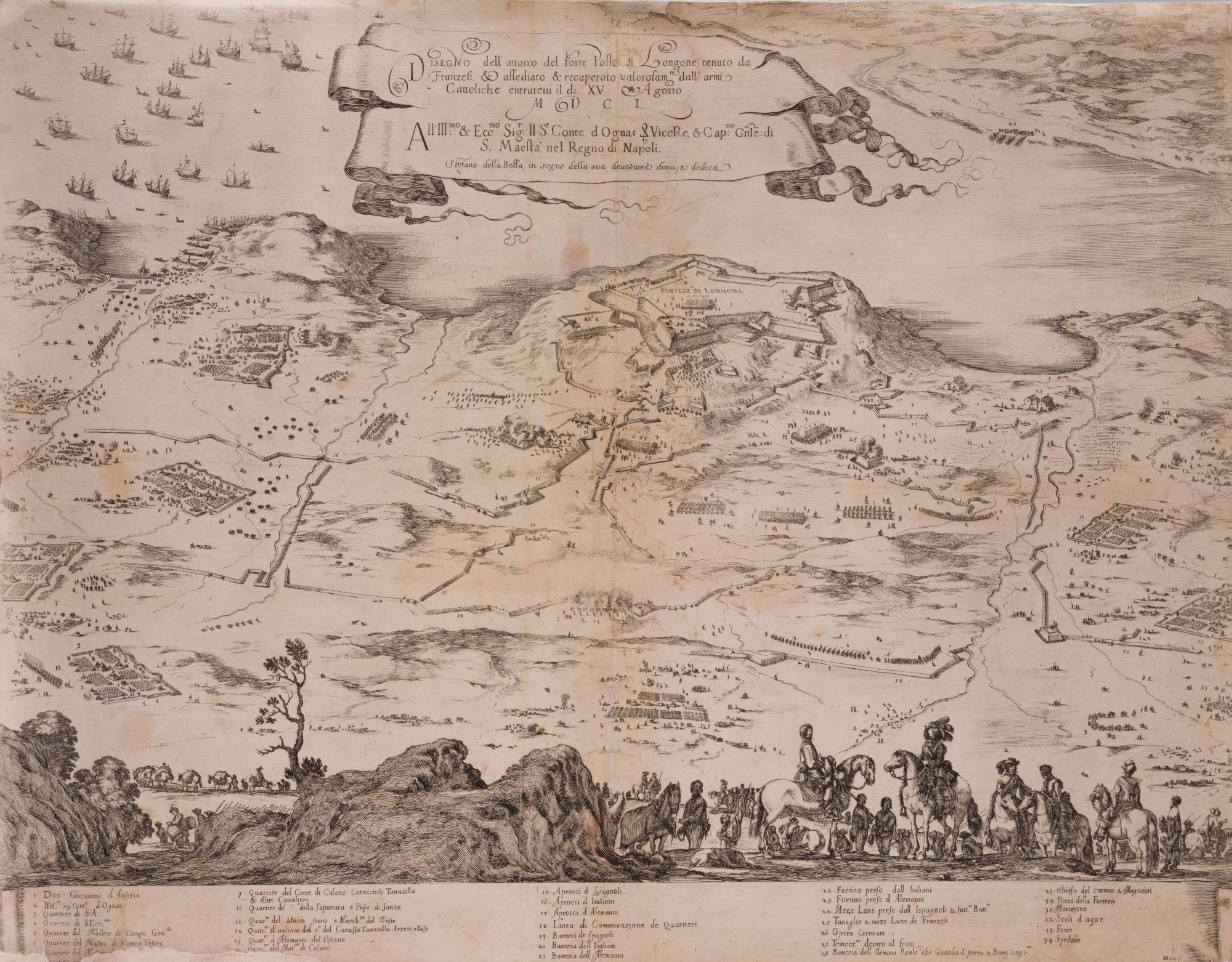
This historical print provides a detailed representation of the siege of the Porto Longone fortress (modern-day Porto Azzurro on the Italian island of Elba). The event took place during the Franco-Spanish War (1635–1659). The French garrison captured the fort in 1646, but in the summer of 1650, Spanish forces and their Italian allies, under the command of Don John of Austria (the Younger) and aided by German mercenaries, successfully recaptured the fortifications.
The etching meticulously reproduces a topographical plan featuring a panoramic view of the Elba coast and the outlines of the five-bastioned fortress, inscribed in the centre: "FORTEZZA DI LONGONE". The map includes a rendered relief of the terrain, roads, troop positions, and artillery salvos fired from the opposite Italian shore. The surrounding fortifications of the stronghold – bastions, ravelins, trenches, military camps, and redoubts – are rendered in comprehensive detail.
In the lower part of the print, Stefano della Bella employed his signature technique: combining precise cartography with a striking, expressive foreground. Along the bottom edge of the etching, a dynamic and intricately drawn multi-figure composition unfolds, depicting cavalry, generals, infantry, and horses, flanked by a rocky terrain on the left. The figures are executed in an elegant Early Baroque style. Placed centrally on horseback under number 1 is the Spanish commander, John Joseph of Austria. To his right, under number 2, is an equestrian depiction of the Viceroy of Naples, the Count of Oñate, to whom Stefano della Bella dedicated this print.
In the upper left section, a large scroll (cartouche) features the official description of the historical event, the course of military operations, and the dedication itself to the Count of Oñate in Old Italian: "DISEGNO Disegno dell' attacco del Forte, e Porto di Longone tenuto da Franzesi, & assediato & recuperato valorosamte dall' armi Cattoliche entrateui il di XV Agosto M D C L" – [Plan of the attack on the fort and port of Longone, held by the French, besieged and valiantly recovered by the Catholic forces who entered it on the 15th day of August MDCL (15 August 1650)]. Below reads: "All’Ill[ustrissi]mo & Ecc[ellentissi]mo Sig[no]r Il S[igno]r Conte d’ Ognat, ViceRe, & Cap[itano] Gen[era]le di S. Maestà nel Regno di Napoli" – [To his Illustrious and Most Excellent Lordship, the Count of Oñate, Viceroy and Captain General of His Majesty in the Kingdom of Naples]. Further down, in small lettering: "Stefano della Bella, in segno della sua deuotione, dona, e dedica" – [Stefano della Bella, as a sign of his devotion, presents and dedicates this].
The lower part of the print contains a numbered index of the military quarters (Quartieri) as well as the headquarters of the commanders-in-chief and colonels who participated in the campaign. Notable historical figures of the era mentioned include:
1. Don Giovanni d'Austria – Don John of Austria
2. l'Ecc.mo Sig.re Don d'Ognat – His Excellency Don d'Ognat
3. Quartier di S.A. – Quarters of His Highness (Sua Altezza)
4. Quartier di S. Ecc.za – Quarters of His Excellency (Sua Eccellenza)
5. Quartier del Mastro di Campo Gen.le – Quarters of the Maestro de Campo General (Commander-in-Chief)
6. Quartier del Mastro di Campo Vesino – Quarters of the Maestro de Campo Vesino
7. Quartier del Mastro di Campo Arrese – Quarters of the Maestro de Campo Arrese
8. Quartier del Gnale dell'Artig.ra – Quarters of the General of Artillery
9. Quartier del Conte di Celano Caracciolo Tutauilla & Altri Cavalieri – Quarters of the Count of Celano, Caracciolo, Tutavilla, and Other Cavaliers
10. Quartier del Co. della Saponara e Pnpe di Sanza – Quarters of the Count of Saponara and the Prince of Sanza
11. Quar.re del Duca Sarno e March.se del Vasto – Quarters of the Duke of Sarno and the Marquess del Vasto
12. Quar.re d'Italiani del 3° del Caraffa Tutauilla Arresi e Tassi – Quarters of the Italians of the 3rd Regiment of Caraffa, Tutavilla, Arresi, and Tassi
13. Quar.re d'Alemanni del Visconte – Quarters of the Germans of Visconti
14. Quar.re del Mar.se di Cufano – Quarters of the Marquess of Cufano
15. Aprocci d Spagnoli – Trenches (approaches) of the Spaniards
16. Aprocci d Italiani – Trenches (approaches) of the Italians
17. Aprocci d Alemanni – Trenches (approaches) of the Germans
18. 1Linea di Comunicazione de Quarneri – Communication line of Quarneri
19. Batteria de Spagnoli – Battery of the Spaniards
20. Batteria dell Italiani – Battery of the Italians
21. Batteria dell Alemanni – Battery of the Germans
22. Fortino preso dall Italiani – Small fort (redoubt) captured by the Italians
23. Fortino preso d Alemanni – Small fort (redoubt) captured by the Germans
24. Meze Lune prese dall Ispagnoli & fun – Half-moons (ravelins) captured by the Spaniards
25. Tenaglie & meze Lune de Franzesi – Tenailles and half-moons (ravelins) of the French
26. Opera Coronata – Crownwork
27. Trincer™ dentro al fosso – Trenches inside the ditch (moat)
28. Batteria dell Armata Reale che Guarda il porto & Baste longo – Battery of the Royal Army facing the port and the long bastion
29. Chiesa del carmine & Magazini – Church of Carmine (also known as the Church of the Most Holy Virgin of Carmel) and military storehouses
30. Porta della Forteza – Fortress gate
31. Montione – Montione (topographical name)
32. Scoli d'ague – Water drains
33. Fonte – Spring (well)
34. Spedale – Hospitals
This work stands as a valuable historical source, demonstrating both the military art of the mid-17th century and the supreme standard of Florentine graphic art.
Inscriptions
In the cartouche below the dedication to the Count of Oñate, the author's inscription reads: "Stefano della Bella, in segno della sua deuotione, dona, e dedica." – [Stefano della Bella, as a sign of his devotion, presents and dedicates this].
Portrayed person
- The name of the person portrayed
- John Joseph of Austria (also known as Don John of Austria the Younger; Spanish: Juan José de Austria; 1629–1679) was a prominent Spanish military leader and statesman, the only acknowledged illegitimate son of King Philip IV of Spain and the actress María Calderón. Íñigo Vélez de Guevara, 8th Count of Oñate (Spanish: Íñigo Vélez de Guevara; 1597–1658) was a prominent Spanish statesman and diplomat, Viceroy of Naples.
- Lifetime of the person portrayed
- John Joseph of Austria (1629–1679) Íñigo Vélez de Guevara, 8th Count of Oñate (1597–1658)
Legal regulation
Borys Voznytskyi Lviv National Art Gallery