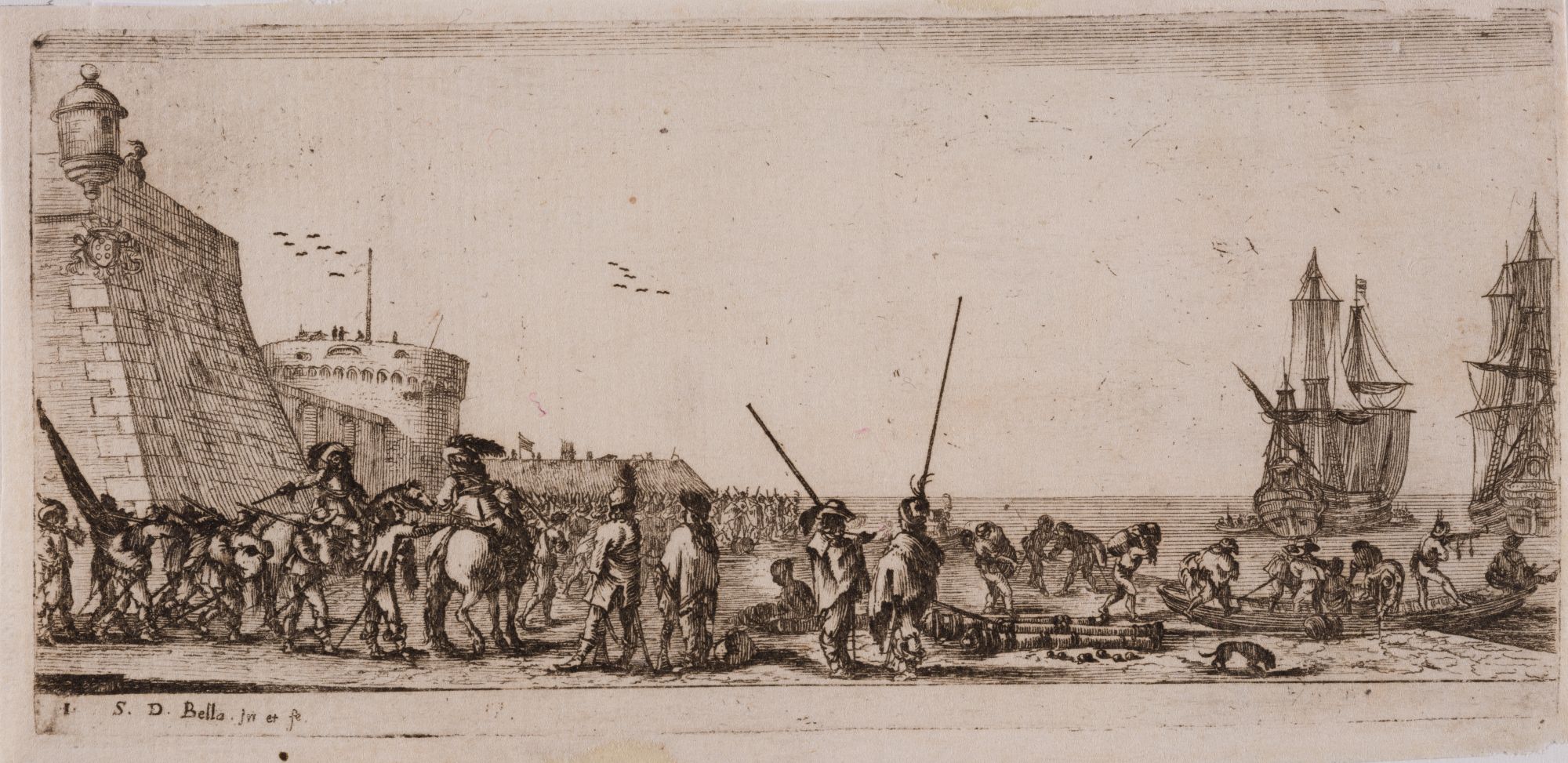
Soldiers Awaiting Embarkation (Soldiers Supervising Embarkation). From the "Various Embarkations" (Diversi imbarchi) Series
Stefano della Bella
Basic information
- ID
- Г-IV-904
- Author
- Stefano della Bella
- Name
- Soldiers Awaiting Embarkation (Soldiers Supervising Embarkation). From the "Various Embarkations" (Diversi imbarchi) Series
- Country
- France
- Technique
- etching
- Material
- paper
- Dimensions
- 7.6 x 16.2 cm (height x width)
Additionally
- Type
- graphic art
- Genre
- marine painting genre art architectural landscape
- Provenance
- Received from the Lviv Historical Museum, 1954
Information about author
Object description
The engraving presents a mirror image of most impressions held in museums worldwide, as well as the work under inventory number Г-IV-898 in the gallery collection.
This impression is from the first plate of the specified series. The print is dedicated to the daily maritime and port life of the seventeenth century in the port of Livorno. In the foreground, a large group of soldiers, mounted horsemen, and officers are gathered. They are awaiting embarkation or supervising the process of boarding the boats. Several soldiers hold long spears or pikes pointed sharply upwards.
On the left, fortification elements of the Old Fortress (Fortezza Vecchia) – an important defensive complex of Livorno – are represented. The foreground depicts a corner defensive structure with escarps, similar to the Canaviglia Bastion (Bastione della Canaviglia), which in the seventeenth century was topped by a barbet tower. This bastion directly protected the entrance to the old harbour. The middle ground is dominated by a circular tower, similar to the so-called Matilda Keep (Mastio di Matilde) – the oldest citadel, later integrated into the complex of fortress structures. However, the artist renders this element shorter than its real size and incorrectly positions it flush against the fortifications. Thus, while staying in Paris in the 1640s and capturing port scenes in his prints, the artist allowed certain deviations from reality when recalling his beloved Tuscan port. On the port waters to the right, large ships (galleons) with furled sails are shown riding at anchor, awaiting the arrival of people from the shore. Near the very edge of the water, workers are loading bales onto boats.
The work demonstrates an exquisite fineness of line, miniature detailing of the figures, a soft aerial perspective, and a virtuoso interplay of light and shade on the figures and architectural structures.
Inscriptions
Engraved at the bottom of the sheet on the left: "1 S.D. Bella jn. et. fe.". Beneath the sheet on the left on the mounting cardboard, the gallery collection number is written: "№ Г-IV-904/ ЛДКГ".
Legal regulation
Borys Voznytskyi Lviv National Art Gallery