Wedding Procession
Vasyl Poliovyi


Basic information
- ID
- Ж-6990
- Author
- Vasyl Poliovyi
- Name
- Wedding Procession
- Date of creation
- 1968
- Culture
- Ukrainian art of the Soviet period
- Technique
- original technique
- Material
- fibreboard
- Dimensions (height x width, cm)
- 120 x 100
Additionally
- Type
- painting
- Genre
- genre art symbolic art
- Plot
- Allegory
- Provenance
- Handed over to the museum from Vasyl Poliovyi
Information about author
Object description
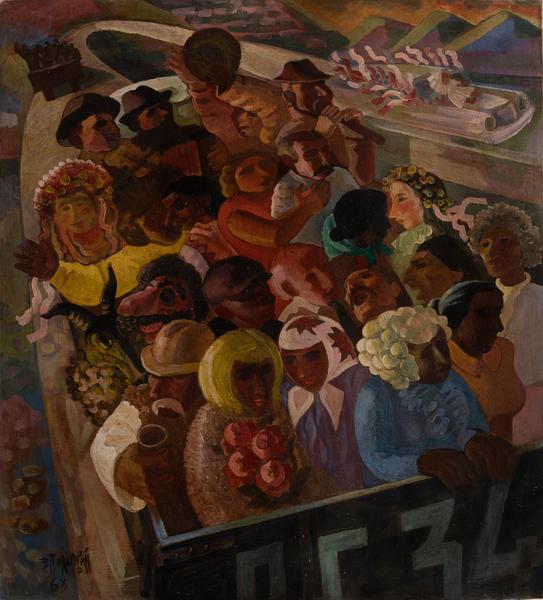
Wedding Procession is one of the most significant paintings of Vasyl Poliovyi, where one can discover the artist's exceptional individuality, ranging from the original features of his style to the technical aspects of execution. In the context of the narrative and stylistics, it is worth identifying elements of dialogue with the creative achievements of such authors as Oleksandr Volkov ("Wedding", 1927, and his other works), as well as contemporary artists from the collection of the Savitsky Art Museum (Nukus, Uzbekistan) from the 1930s. To a certain extent, there are allusions to the practices of the Boychukists. During his time in Moscow, Vasyl Poliovyi communicated with Oksana Pavlenko, an artist of Mykhailo Boychuk's circle. There is a preserved drawing of Pavlenko made by Poliovyi, where she wrote an inscription: "A good portrait and skilful drawing". After moving to Lviv, Vasyl Poliovyi maintained relationships with artists such as a Boychukist Okhrim Kravchenko. The composition's dynamics, harmony, and emotional and psychological perception were developed in an original and insightful way. Executing the idea took time since the visual inspection shows the adjustments to the finished work that the artist made in seeking the best solution for the image. The viewer can observe people moving in the wedding procession in several vehicles, including truck bodies (likely GAZ–63 regarding seating capacity, less likely Studebaker or ZIL–157 "Zakhar"). They follow a car decorated with wedding ribbons, probably a ZIM, with a doll in a white dress and veil on the car's hood. In the second truck, we can barely distinguish the silhouettes of eleven (or perhaps more) people. The main plot unfolds in the third truck, depicting the socio-cultural situation of the time and the essence of the 1960s society, where elements of tradition with a specific archaic nature remained. However, the dominant processes were urbanisation, gradually leading to alienation within micro-communities, particularly in families. Some of the women in the foreground are dressed according to the fashion trends of the time, some with curled or bleached hair. Next to them, practically in the front row, an elderly man is facing the viewer, holding a glass in his hands. He is dressed in a sleeveless fur vest (keptar) and a brimmed hat. Beside him are two characters from folk festivities – a goat and a mask of a moustached man with a large nose. A group of four men singing is next to them in the second row. Behind them are two women, one in a simple wreath with pink ribbons. Then there is a middle-aged couple, probably from the city, based on their clothes. Next to them are two men, one of them wearing a distinctive embroidered keptar. Beside them is a girl facing the viewer wearing a richly decorated wreath with many flowers, sparkles and colourful ribbons. In the last row are four musicians, each with their instrument: a violin, a bayan, a tambourine and a pipe. The scene occurs before a turn on a mountainous serpentine road. The artist reveals a comprehensive history that led them to this point through each character, unravelling their biographies. The vibrant diversity of colours, the dynamism, and the simultaneous distinction of the characters, along with the vector of the wedding procession movement, also serve as an allegory or a hint of what is to come beyond the artwork.
Inscriptions
In the bottom left corner there is an inscription: В Польовий 68
Legal regulation
Borys Voznytskyi Lviv National Art Gallery