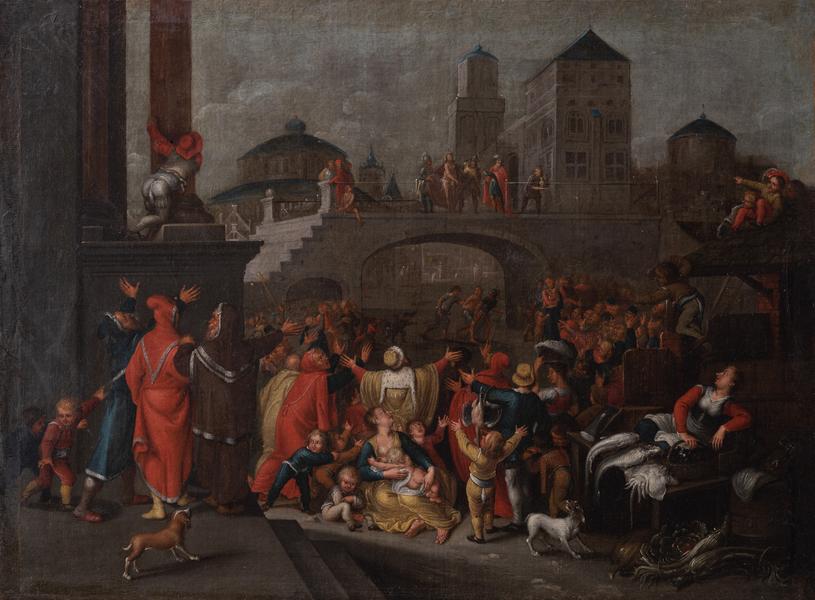
Pilate Presents Christ (Ecce Homo)
unknown (German School)



Basic information
- ID
- Ж-135
- Author
- unknown (German School)
- Name
- Pilate Presents Christ (Ecce Homo)
- Date of creation
- 17th c.
- Country
- Germany
- Technique
- oil painting
- Material
- canvas oil
- Dimensions (height x width, cm)
- 62.5 x 80.5
Additionally
- Type
- painting
- Genre
- religious
- Plot
- Ecce homo
- Provenance
- the Lubomirski collection
- Exposition
- Potocki Palace
Information about author
Object description
German School of Painting, 17th century, Baroque period. This period reflects the power of optimism and enthusiasm. The art of this era aimed to reach prosperity, beauty, splendour, and mastery in embodying celestial ideals. Art emphasized detail but embraced new ideas and deep exploration of portraying emotions. In Germany, as in many countries, religious themes remained popular. The artist depicts a group of people in an architectural landscape. Jesus Christ is standing on a hill in the centre. Pilate is to the left, pointing at Jesus. Below, a crowd of people is watching them. According to the Gospel of John, the procurator of Judaea, Pontius Pilate, hoping to evoke sympathy, presented Jesus Christ to the Jerusalem crowd after he had been scourged. Jesus was dressed in a purple robe and had a crown of thorns on his head. "Pilate therefore went forth again, and saith unto them, Behold, I bring him forth to you, that ye may know that I find no fault in him. Then came Jesus forth, wearing the crown of thorns, and the purple robe. And Pilate saith unto them, Behold the man! When the chief priests and officers saw him, they cried out, saying, Crucify him, crucify him. Pilate saith unto them, Take ye him, and crucify him: for I find no fault in him!" (John 19:4–6) The Gospel of John tells us that Pilate judged Jesus in a place called Lithostrōtos (λιθόστρωτος), or Gabbatha (גבתא) in Hebrew. "When Pilate therefore heard that saying, he brought Jesus forth, and sat down in the judgment seat in a place that is called the Pavement, but in the Hebrew, Gabbatha" (John 19:13). In Greek, "lithos" (λιθόσ) means "stone", and "trotos" (τρωτος) means "platform". The Aramaic word "havata" is related to the word "elevation". Pontius Pilate, the Roman prefect of Judaea from 26 to 36 AD, likely established his place for judgement in the courtyard of the Antonia Fortress in Jerusalem.
Legal regulation
Borys Voznytskyi Lviv National Art Gallery