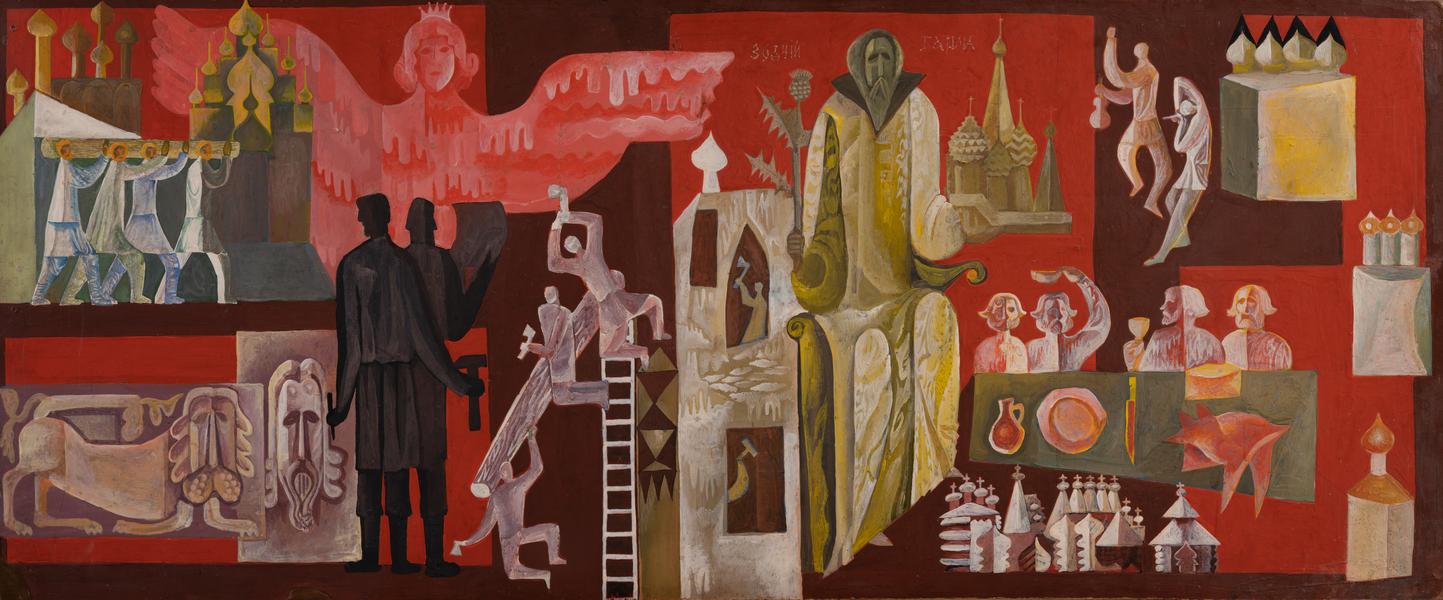
Sketch for the "Ruthenian Architects" Mural for the Main Foyer at Central Architectural and Planning Department in Moscow
Vasyl Poliovyi, Yuliia Podohova


Basic information
- ID
- Ж-8206
- Author
- Vasyl Poliovyi Yuliia Podohova
- Name
- Sketch for the "Ruthenian Architects" Mural for the Main Foyer at Central Architectural and Planning Department in Moscow
- Date of creation
- 1972–1973 (?)
- Culture
- Ukrainian art of the Soviet period
- Technique
- original technique
- Material
- fibreboard mixed media
- Dimensions (height x width, cm)
- 55 x 122
Additionally
- Type
- painting
- Genre
- symbolic art
- Plot
- Allegory
- Provenance
- Handed over to the museum from Vasyl Poliovyi
Information about author
Information about author
Object description
As with the other sketches in this series, a multi-exposure is used here, revealing the core idea of this monumental work: time is a combination of past and present, which is best reflected in the heredity of traditions. The artist depicts the period from Kyivan Rus to the 17th century when artistic imagery was developed based on the synthesis of Byzantine and Oriental cultures. From the thoughtful, focused, but completely anthropomorphic lions on the facades of the Northern Rus' cathedrals to the scenes of a short break from work, the world to some extent echoes the visual imagery of Andrii Tarkovskyi's film "Andrii Rublev" (1966). This approach helps overcome the psychological temporal distance between the past and the present since, in most aspects, human nature remains unchanged. Attention to historical details in the characters' costumes and everyday moments is combined with the creation of a space where real characters find themselves amidst legendary and symbolic images. In the left part of the artwork, one of the dominant motifs is the mythical bird Alkonost (indicated by the presence of a crown and the absence of a halo), whose wings seem to embrace the space where the composition unfolds. It is no less real than the images of the architects at work or rest. The composition is exceptionally dynamic yet harmonious, just like its colour and tonal resolution.
Legal regulation
Borys Voznytskyi Lviv National Art Gallery