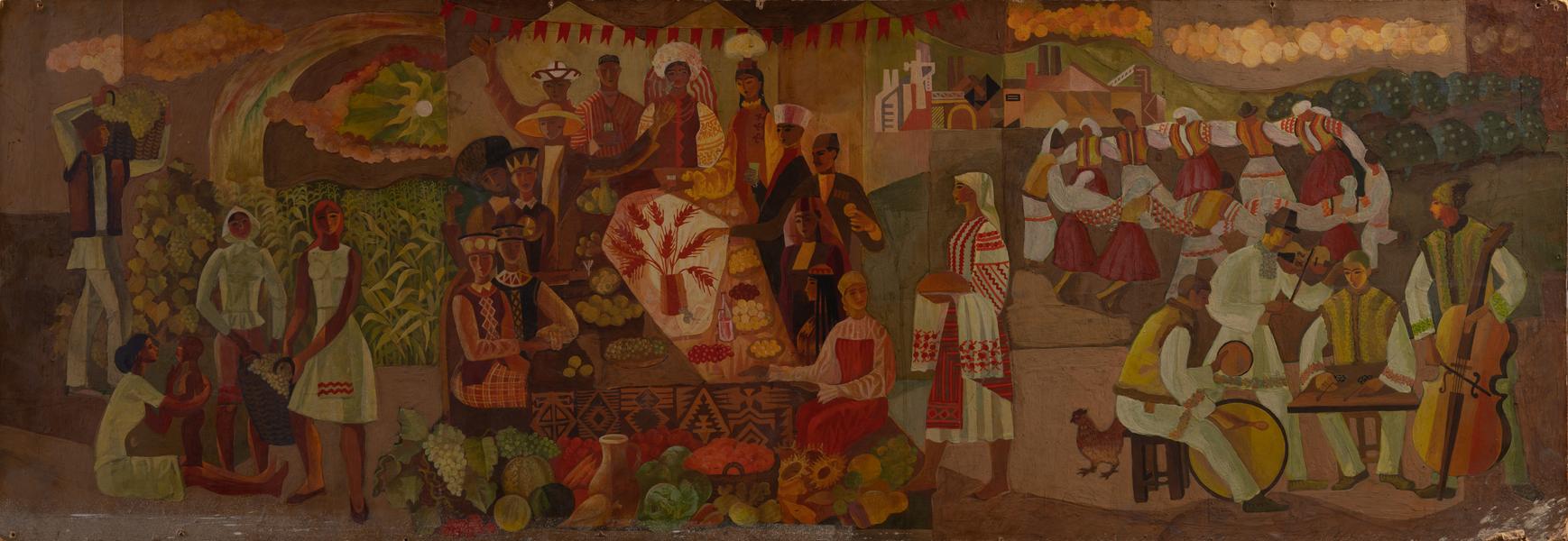
Mural "Friendship Of Peoples" in the Palace of Culture, Rybnitsa, Moldavian SSR
Vasyl Poliovyi, Volodymyr Kokoiachuk, Yuliia Podohova


Basic information
- ID
- Г-I-1484
- Author
- Vasyl Poliovyi Volodymyr Kokoiachuk Yuliia Podohova
- Name
- Mural "Friendship Of Peoples" in the Palace of Culture, Rybnitsa, Moldavian SSR
- Date of creation
- 1972–1973
- Culture
- Ukrainian art of the Soviet period
- Technique
- original technique
- Material
- fibreboard mixed media
- Dimensions (height x width, cm)
- 56 x 160
Additionally
- Type
- painting
- Genre
- symbolic art
- Plot
- Allegory
- Provenance
- Handed over to the museum from Vasyl Poliovyi
Information about author
Information about author
Information about author
Object description
The sketch for the monumental work, executed in 1978, was created with Vasyl Poliovyi, Yuliia Podohova and Volodymyr Kokoiachuk. The specific manner of execution is dominated by the stylisation and colouring characteristic of Vasyl Poliovyi (for example, it can be compared to two "Battle of Poltava" sketches from 1965). A review of both preserved and unpreserved works of Volodymyr Kokoiachuk confirms this, as his work is characterised by a realistic approach close to the Soviet propaganda art of the postwar period. The authors visualised unity among nations in a positive tone using a wedding scene enhanced by a vibrant colour scheme. On an ideological level, the work also depicts a labour scene (on the left side of the central part) and a Moldovan folk dance, "hora", accompanied by a taraf-like instrumental ensemble. The fruits in the composition's foreground (including bunches of grapes, watermelons, melons, pumpkins, sugar beets, cabbage, turnips, carrots, tomatoes, sunflowers, and aubergines) also symbolise the idea of celebrating the harvest. Representatives from different USSR republics are depicted in the central part of the composition during a feast celebrating an international wedding (based on the specifics of national costumes, particularly the headdresses of a Ukrainian woman and an Uzbek man). All the characters are shown in typical national costumes. Given the mural's location, most of the characters in flanking groups from the central part of the artwork are Moldovans. The composition is generally rendered in a warm, balanced range of colours with a predominance of red and ochre. The format and execution style contribute to the narrative nature of the mural.
Legal regulation
Borys Voznytskyi Lviv National Art Gallery