Mourning
Vasyl Poliovyi


Basic information
- ID
- Ж-6991
- Author
- Vasyl Poliovyi
- Name
- Mourning
- Date of creation
- 1979
- Country
- the USSR
- Culture
- Ukrainian art of the Soviet period
- Technique
- original technique
- Material
- fibreboard mixed media
- Dimensions (height x width, cm)
- 80 x 100
Additionally
- Type
- painting
- Genre
- symbolic art
- Plot
- Allegory
- Provenance
- Handed over to the museum from Vasyl Poliovyi
Information about author
Object description
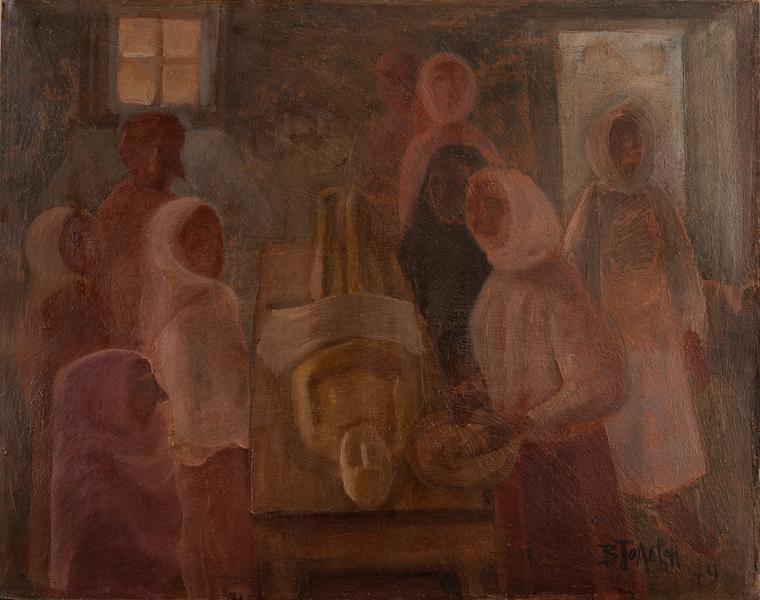
At first glance, the depiction of a rather ordinary and everyday scene is presented in a particular interpretation that takes it to a qualitatively different level of symbolic narrative. The author captures a scene of preparing the deceased man's body for the funeral rite, but the approach to the composition allows us to look at the table with the deceased and the room he is in from two points of view. The first perspective is ordinary, as one would expect from a viewer who enters that space. The second perspective is deliberately and drastically elevated, as if from the ceiling. This approach creates an impression of "otherworldliness" and immerses the viewer in the disposition of the deceased's soul. Similarly, the sunlight streaming through the window on the left side of the composition and the opened door on the right side, accompanied by diffused light from an unidentified source, contribute to the unique mystical atmosphere of the artwork. The colouring is complex, nuanced and developed in a warm range. In the centre of the composition is a tonal accent – the figure of an elderly woman in black (a relative of the deceased). The overall approach to stylistic composition aligns with the "severe style" principles. In terms of form and symbolism, there is a connection to the works of Viktor Popkov, namely "Widows. Memories" (1966), "The Northern Song'" (1968), and "Father's Overcoat" (1970–1972). In addition, this painting reveals the results of a creative dialogue with artists of the 1960s–1970s, such as Andrii Vasnietsov and Ihor Obrosov. That is why the author creates an impression of lightness in the mixed colour scheme and compositional structure without excessively mournful notes. Even the interpretation of the deceased's body suggests the image of a peaceful person at rest (an allusion to the Easter exapostilarion "In The Flesh You Fell Asleep"). Nine women, whose silhouettes are discernible, stand around the table with the deceased. Moreover, judging by the hints and outlines, more people may be in the room. The characters are dressed in simple attire, with virtually no specific regional details. Based on their outlines and the presence of headscarves, it is likely that they are over 30 years old. The interior is more in keeping with a rural home, which also contributes to an ascetic and balanced mood, consistent with the "severe style" ideas. However, it is worth emphasising that this is a rather complex and transitional scene, bordering between worlds rather than simply reflecting the artistic practices of that time.
Legal regulation
Borys Voznytskyi Lviv National Art Gallery